












![N-[2-(2-Pyridinyl)ethyl]-1-propanamine structure](https://static.chemtradehub.com/structs/554/55496-57-6-22b4.webp "N-[2-(2-Pyridinyl)ethyl]-1-propanamine structure")
A facile strategy to fabricate highly-stretchable self-healing poly(vinyl alcohol) hybrid hydrogels based on metal–ligand interactions and hydrogen bonding
Literature Information
Publication Date
2016-11-02
DOI
10.1039/C6PY01752E
Impact Factor
5.582
Authors
Yan Hui, Zhi-Bin Wen, Florence Pilate, Hui Xie, Cheng-Jie Fan, Lan Du, Dan Liu, Ke-Ke Yang, Yu-Zhong Wang
View Original
Abstract
Self-healing polymeric hydrogels have attracted tremendous attention owing to their great potential in a wide range of applications. However, it is still a big challenge to develop shape-memory hydrogels with both superior mechanical performance and excellent self-healing capacity. In this work, we report a facile strategy to fabricate highly-stretchable poly(vinyl alcohol) (PVA) hybrid hydrogels with excellent self-healing capacity, simply by introducing copper(II) ions (Cu(II)) and fibrous sepiolite (Sep) into PVA solution. The primary network of these hybrid hydrogels is constructed via the metal–ligand coordination between the hydroxyls of PVA and Cu(II), while the hydrogen bonding between the hydroxyls of PVA and the silanol groups (Si–OH) on the Sep surface further stabilizes the network. Moreover, the fibrous structure of Sep also observably improves the mechanical strength of the hydrogel. The dynamic nature of the metal–ligand coordination and hydrogen bonding endows the hydrogel with autonomous self-healing properties. To optimize the composition of the hydrogel, a series of PVA-Cu hydrogels and PVA-Cu-Sep hybrid hydrogels with different Cu(II) and Sep content were prepared. The influence of Cu(II) and Sep content on their equilibrium water content (EWC), mechanical strength, viscoelastic behavior and self-healing properties was investigated systematically. The sample PVA-Cu0.02-Sep8, with a Cu(II)/hydroxyl molar ratio of 0.02 and containing 8 wt% Sep, simultaneously exhibits desirable mechanical performance and excellent self-healing ability.
Related Literature
Surface-enhanced spatially-offset Raman spectroscopy (SESORS) for detection of neurochemicals through the skull at physiologically relevant concentrations
Amber S. Moody, Taylor D. Payne, Brian A. Barth, Bhavya Sharma
2020-01-16
Paper
DOI: 10.1039/C9AN01708A
Engineering DNAzyme cascade for signal transduction and amplification
Jing Li, Ke Quan, Yanjing Yang, Xiaohai Yang, Xiangxian Meng, Jin Huang, Kemin Wang
2020-01-10
Paper
DOI: 10.1039/C9AN02003A
SERS detection of polycyclic aromatic hydrocarbons using a bare gold nanoparticles coupled film system
Kai Hu, Da-Wei Li, Yi-Tao Long
2016-04-26
Paper
DOI: 10.1039/C6AN00319B
Ion hydration and association in aqueous potassium tetrahydroxyborate solutions
Toshio Yamaguchi, Koji Yoshida
2020-01-29
Paper
DOI: 10.1039/C9AN01662G
Graphene oxide-based electrochemical label-free detection of glycoproteins down to aM level using a lectin biosensor
L. Klukova, J. Filip, S. Belicky, A. Vikartovska, J. Tkac
2016-05-31
Communication
DOI: 10.1039/C6AN00793G
Signal-off electrochemiluminescence immunosensors based on the quenching effect between curcumin-conjugated Au nanoparticles encapsulated in ZIF-8 and CdS-decorated TiO2 nanobelts for insulin detection
Yu Du, Xiaojian Li, Xiang Ren, Huan Wang, Dan Wu, Hongmin Ma, Dawei Fan, Qin Wei
2020-01-20
Paper
DOI: 10.1039/C9AN02288K
Acetylcholinesterase-catalyzed silver deposition for ultrasensitive electrochemical biosensing of organophosphorus pesticides
Zhenhui Liu, Xin Xia, Guoxing Zhou, Lei Ge, Feng Li
2020-01-15
Paper
DOI: 10.1039/C9AN02546D
A paper-based colorimetric assay system for sensitive cysteine detection using a fluorescent probe
Xiaoya Ma
2020-01-15
Paper
DOI: 10.1039/C9AN02271F
The presence of a 5′-abasic lesion enhances discrimination of single nucleotide polymorphisms while inducing an isothermal ligase chain reaction
Abu Kausar, Eiman A. Osman, Tendai Gadzikwa, Julianne M. Gibbs-Davis
2016-05-27
Communication
DOI: 10.1039/C6AN00614K
An efficient core–shell fluorescent silica nanoprobe for ratiometric fluorescence detection of pH in living cells
Jingni Fu, Changqin Ding, Anwei Zhu
2016-05-31
Paper
DOI: 10.1039/C6AN00981F
You might also like
Compound Q&A
What precautions should be taken when handling lithium chloride hydrate (1:1:1) (CAS: 16712-20-2)?
When handling lithium chloride hydrate (1:1:1) (CAS: 16712-20-2), it is importan...
16712-20-2Lithium chloride hyd...
Compound Q&A
Is 4-(4H-1,2,4-Triazol-4-yl)piperidine (CAS: 690261-92-8) safe?
4-(4H-1,2,4-Triazol-4-yl)piperidine is generally considered safe for use in phar...
690261-92-84-(4H-1,2,4-Triazol-...
Compound Q&A
How should waste containing 1,3-Thiazole-2-carboxamide (CAS: 16733-85-0) be handled?
Waste containing 1,3-Thiazole-2-carboxamide (CAS: 16733-85-0) should be collecte...
16733-85-01,3-Thiazole-2-carbo...
Compound Q&A
What regulatory guidelines apply to 5-(Difluoromethyl)-2-fluorobenzonitrile (CAS: 934175-58-3)?
5-(Difluoromethyl)-2-fluorobenzonitrile (CAS: 934175-58-3) is subject to regulat...
934175-58-35-(Difluoromethyl)-2...
Compound Q&A
How is Methyl 3-acetamido-2-thiophenecarboxylate (CAS: 22288-79-5) typically synthesized?
Methyl 3-acetamido-2-thiophenecarboxylate can be synthesized by the reaction of ...
22288-79-5Methyl 3-acetamido-2...
Compound Q&A
What is 4-Isoquinolinecarbonitrile (CAS: 34846-65-6)?
4-Isoquinolinecarbonitrile is a chemical compound with the CAS number 34846-65-6...
34846-65-64-Isoquinolinecarbon...
Compound Q&A
How should Methyl 1H-1,2,3-triazole-4-carboxylate (CAS: 877309-59-6) be stored?
Store Methyl 1H-1,2,3-triazole-4-carboxylate (CAS: 877309-59-6) in a cool, dry p...
877309-59-6Methyl 1H-1,2,3-tria...
Compound Q&A
What regulatory guidelines apply to 6-Bromo[1,3]thiazolo[5,4-b]pyridin-2-amine (CAS: 1160791-13-8)?
6-Bromo[1,3]thiazolo[5,4-b]pyridin-2-amine (CAS: 1160791-13-8) is subject to the...
1160791-13-86-Bromo[1,3]thiazolo...
Compound Q&A
Is (2S,3S)-2-Ammonio-3-(3,4-dihydroxyphenyl)-3-hydroxypropanoate (CAS: 23651-95-8) safe?
(2S,3S)-2-Ammonio-3-(3,4-dihydroxyphenyl)-3-hydroxypropanoate (CAS: 23651-95-8) ...
23651-95-8(2S,3S)-2-Ammonio-3-...
Compound Q&A
What are the physical and chemical properties of 7-bromo-3-methyl-3,4-dihydroquinazolin-4-one (CAS: 1293987-84-4)?
7-Bromo-3-methyl-3,4-dihydroquinazolin-4-one is a solid with a crystalline form....
1293987-84-47-bromo-3-methyl-3,4...
Source Journal
Polymer Chemistry

CiteScore:
8.6
Self-citation Rate:
7.3%
Articles per Year:
457
Polymer Chemistry welcomes submissions in all areas of polymer science that have a strong focus on macromolecular chemistry. Manuscripts may cover a broad range of fields, yet no direct application focus is required.
Recommended Compounds
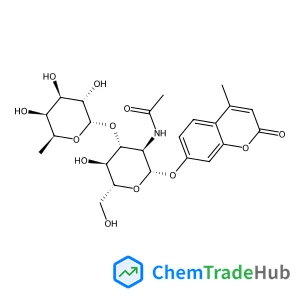
4-Methyl-2-oxo-2H-chromen-7-yl 2-acetamido-2-deoxy-3-O-(6-deoxy-alpha-L-galactopyranosyl)-beta-D-glucopyranoside
CAS Number:
383160-12-1
Molecular Formula:
C24H31NO12
![(R)-N-[(S)-1-[2-(Diphenylphosphino)phenyl]ethyl]-2-methylpropane-2-sulfinamide structure](https://static.chemtradehub.com/structs/159/1595319-98-4-33e7.webp "(R)-N-[(S)-1-[2-(Diphenylphosphino)phenyl]ethyl]-2-methylpropane-2-sulfinamide structure")
(R)-N-[(S)-1-[2-(Diphenylphosphino)phenyl]ethyl]-2-methylpropane-2-sulfinamide
CAS Number:
1595319-98-4
Molecular Formula:
C24H28NOPS
![6-(Benzyloxy)-8-(2-bromoacetyl)-2H-benzo[b][1,4]oxazin-3(4H)-one structure](https://static.chemtradehub.com/structs/926/926319-53-1-2287.webp "6-(Benzyloxy)-8-(2-bromoacetyl)-2H-benzo[b][1,4]oxazin-3(4H)-one structure")
6-(Benzyloxy)-8-(2-bromoacetyl)-2H-benzo[b][1,4]oxazin-3(4H)-one
CAS Number:
926319-53-1
Molecular Formula:
C17H14BrNO4
Recommended Suppliers






Disclaimer
This page provides academic journal information for reference and research purposes only. We are not affiliated with any journal publishers and do not handle publication submissions. For publication-related inquiries, please contact the respective journal publishers directly.
If you notice any inaccuracies in the information displayed, please contact us at support@chemtradehub.com. We will promptly review and address your concerns.