












Shape-memory and self-healing polyurethanes based on cyclic poly(ε-caprolactone)
Literature Information
Publication Date
2016-10-12
DOI
10.1039/C6PY01638C
Impact Factor
5.582
Authors
Wei Chen, Yanyan Zhou, Ying Li, Jun Sun, Xiangqiang Pan, Qian Yu, Nianchen Zhou, Zhengbiao Zhang, Xiulin Zhu
View Original
Abstract
The structure–property relationship is a primary and eternal topic in polymer science. Cyclic topology, due to no chain ends, has been confirmed to have significant effects on polymer properties and performance. In this work, cyclic poly(ε-caprolactone) (PCL) with two definite hydroxyl groups on each polymer chain was prepared via successive ring-opening polymerization, chain end modification and bimolecular ring closure reaction, and was fully characterized using size exclusion chromatography, NMR, FTIR and matrix assisted laser desorption/ionization time of flight. Higher crystallinity of the cyclic PCL was found in comparison with its linear counterpart. Cross linked polyurethanes (PUs) were then prepared based on cyclic PCL, hexamethylene diisocyanate and tetrahydroxy functionalized crosslinkers incorporated with dynamic covalent bonds between furan and maleimide. The PUs made using cyclic PCL resulted in more compact networks than those made from linear polymers due to topology effects, which significantly lowered the crystallinity of the cyclic polymers in the PUs. It was found that the shape memory of the cross linked PUs was not dominated by the crystallinity but by the degree of cross linking. The PUs made from cyclic PCL gave a higher shape fixity ratio (∼95%) than those from linear PCL (∼80%), however, the recovery ratio of the cyclic PCL made PUs was slightly lower. The discrepancy in the shape memory performance was attributed to the different cross linked networks arising from topology effects. Self-healing tests showed that the cyclic PCL and linear PCL derived PUs showed good and approximate self-healing abilities. This work provides an unprecedented example for the exploration of the cyclic topology effects on the shape memory performance of bulk PU materials, providing a novel angle to elucidate the structure–property relationship of polymeric materials.
Recommended Journals
Related Literature
Solute–solvent interactions in imidazolium camphorsulfonate ionic liquids
Kaoru Nobuoka, Satoshi Kitaoka, Masashi Iio, Thomas Harran, Yuichi Ishikawa
2007-08-28
Paper
DOI: 10.1039/B709407H
Intersystem crossing driven by vibronic spin–orbit coupling: a case study on psoralen
Jörg Tatchen, Natalie Gilka, Christel M. Marian
2007-09-03
Paper
DOI: 10.1039/B706410A
Binding free energy prediction in strongly hydrophobic biomolecular systems
Landry Charlier, Claude Nespoulous, Sébastien Fiorucci, Serge Antonczak, Jérome Golebiowski
2007-09-17
Paper
DOI: 10.1039/B710186D
Multiphoton dissociation dynamics of BrCl and the BrCl+cation
Olivier P. J. Vieuxmaire, N. Hendrik Nahler, Richard N. Dixon, Michael N. R. Ashfold
2007-08-30
Paper
DOI: 10.1039/B709222A
Dependence of the nascent vibrational distribution of NO(v) on the photolysis wavelength of NO2 in the range λ = 266–327 nm measured by time-resolved Fourier transform infrared emission
C. Brooks, G. Hancock, M. Saunders
2007-08-03
Paper
DOI: 10.1039/B710594K
Adsorption of sulfur dioxide on hematite and goethite particle surfaces
Jonas Baltrusaitis, Vicki H. Grassian
2007-08-30
Paper
DOI: 10.1039/B709167B
You might also like
Compound Q&A
What is 1-(2,4,6-Trifluorophenyl)ethanol (CAS: 1250113-83-7)?
1-(2,4,6-Trifluorophenyl)ethanol is an organic compound with the CAS number 1250...
1250113-83-71-(2,4,6-Trifluoroph...
Compound Q&A
Is 1-(2,4-Dimethoxybenzyl)-4-(hydroxymethyl)-2-pyrrolidinone (CAS: 919111-34-5) safe?
1-(2,4-Dimethoxybenzyl)-4-(hydroxymethyl)-2-pyrrolidinone (CAS: 919111-34-5) is ...
919111-34-51-(2,4-Dimethoxybenz...
Compound Q&A
What are the physical and chemical properties of (7S,15R)-6β,15-Diacetoxy-7α,20-epoxy-7-hydroxykaura-2,16-dien-1-one (CAS: 51419-51-3)?
(7S,15R)-6β,15-Diacetoxy-7α,20-epoxy-7-hydroxykaura-2,16-dien-1-one is a crystal...
51419-51-3(7S,15R)-6β,15-Diace...
Compound Q&A
What regulatory guidelines apply to rac-ethyl (1r,4r)-4-hydroxycyclohexane-1-carboxylate, trans (CAS: 3618-04-0)?
The compound rac-ethyl (1r,4r)-4-hydroxycyclohexane-1-carboxylate, trans (CAS: 3...
3618-04-0rac-ethyl (1r,4r)-4-...
Compound Q&A
What is the market or research trend for 2-(2,4-Difluorophenoxy)-3-nitropyridine (CAS: 175135-62-3)?
The market for 2-(2,4-Difluorophenoxy)-3-nitropyridine (CAS: 175135-62-3) is cur...
175135-62-32-(2,4-Difluoropheno...
Compound Q&A
What are the main uses of 6-Diazo-5-oxo-L-norleucine (CAS: 157-03-9)?
The main uses of 6-Diazo-5-oxo-L-norleucine (CAS: 157-03-9) include research in ...
157-03-96-Diazo-5-oxo-L-norl...
Compound Q&A
What precautions should be taken when handling 2-Aminoethyl-mono-amide-DOTA-tris(tBu ester) (CAS: 173308-19-5)?
When handling 2-Aminoethyl-mono-amide-DOTA-tris(tBu ester) (CAS: 173308-19-5), i...
173308-19-52-Aminoethyl-mono-am...
Compound Q&A
How is 5-Methylimidazo[1,2-a]pyridine-3-carbaldehyde (CAS: 178488-37-4) typically synthesized?
5-Methylimidazo[1,2-a]pyridine-3-carbaldehyde (CAS: 178488-37-4) can be synthesi...
178488-37-45-Methylimidazo[1,2-...
Compound Q&A
Are there alternatives to 2,4,6-Trihydroxyisophthalaldehyde (CAS: 4396-13-8) in synthesis?
There are alternative reagents that can be used in the synthesis of 2,4,6-Trihyd...
4396-13-82,4,6-Trihydroxyisop...
Compound Q&A
What is (2Z)-3-(5-Fluoro-1H-indol-3-yl)-2-sulfanylacrylic acid (CAS: 179461-52-0)?
(2Z)-3-(5-Fluoro-1H-indol-3-yl)-2-sulfanylacrylic acid is a chemical compound wi...
179461-52-0(2Z)-3-(5-Fluoro-1H-...
Source Journal
Polymer Chemistry

CiteScore:
8.6
Self-citation Rate:
7.3%
Articles per Year:
457
Polymer Chemistry welcomes submissions in all areas of polymer science that have a strong focus on macromolecular chemistry. Manuscripts may cover a broad range of fields, yet no direct application focus is required.
Recommended Compounds
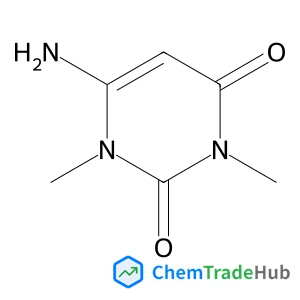
6-amino-1,3-dimethyl-1,2,3,4-tetrahydropyrimidine-2,4-dione
CAS Number:
6642-31-5
Molecular Formula:
C6H9N3O2
Recommended Suppliers






Disclaimer
This page provides academic journal information for reference and research purposes only. We are not affiliated with any journal publishers and do not handle publication submissions. For publication-related inquiries, please contact the respective journal publishers directly.
If you notice any inaccuracies in the information displayed, please contact us at support@chemtradehub.com. We will promptly review and address your concerns.