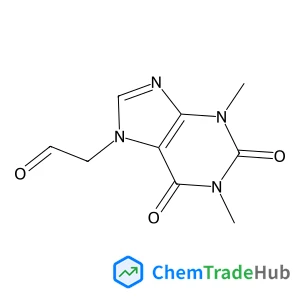
(1,3-Dimethyl-2,6-dioxo-1,2,3,6-tetrahydro-7H-purin-7-yl)acetaldehyde
CAS Number:
5614-53-9
Molecular Formula:
C9H10N4O3
A. Mero, A. Grigoletto, K. Maso, H. Yoshioka, A. Rosato
Microbial transglutaminase (mTGase) is an enzyme that catalyzes site-specific protein derivatization at specific glutamines. mTGase-mediated conjugation with PEG-NH2 to granulocyte colony stimulating factor (G-CSF) yields a site selective mono-derivative conjugate involving Gln135. The same enzymatic reaction of mTGase, i.e. the transfer of the Gln acyl group to an amino donor, was investigated by reversing the substrates. A specific acyl donor PEG derivative was synthesized by coupling the Z-QG mTGase substrate to PEG. The mTGase-mediated conjugation of this PEG-ZQG in the presence of G-CSF generated a high-yield PEG-G-CSF conjugate in which the polymer was selectively coupled to Lys41 of the protein. The PEG-K41-G-CSF conjugate was compared with the PEG-Q135-G-CSF one obtained through mTGase conjugation of PEG-NH2 to Gln135. Biophysical characterization showed that the two positional isomers have similar behaviors, and pharmacokinetic studies in rats demonstrated that they have comparable half-life extensions. Overall, the study demonstrates that mTGase protein derivatization is linked to inherent advantages because it carries with it the possibility of targeting lysines or glutamines, in both cases with a high site-selective specificity.
M. Gnanaprakasam, G. Saranya, S. Bandaru, N. J. English, K. Senthilkumar
DOI: 10.1039/C9CP04271G
Zhengxi Yin, Yafu Guan, Bina Fu, Dong H. Zhang
DOI: 10.1039/C9CP03592C
Helder M. Marques, Preston J. MacDougall
DOI: 10.1039/C9CP03783G
Jean Demaison, Rizalina Tama Saragi, Marcos Juanes, Heinz Dieter Rudolph, Alberto Lesarri
DOI: 10.1039/C9CP02508A
Artur Nowak, Paweł Tecmer, Katharina Boguslawski
DOI: 10.1039/C9CP03678D
Yunlong Ma, Sen Zhang, Yunfei Xu, Xiaoyi Liu
DOI: 10.1039/C9CP06830A
Jiao Yu, Shaochun Li, Dongshuai Hou, Zuquan Jin, Qing-feng Liu
DOI: 10.1039/C9CP90225B
Ting Jia, Zhi Zeng, Xiaoli Zhang, Paul Ohodnicki, Benjamin Chorpening, Gregory Hackett, Jonathan Lekse, Yuhua Duan
DOI: 10.1039/C9CP03883C
When handling 2-Methyl-2-propanyl 5-amino-2-thiophenecarboxylate (CAS: 1498311-5...
5-Bromo-1,2-dichloro-3-fluorobenzene (CAS: 1000572-93-9) is a crystalline solid ...
(2R)-2-Amino-2-(4-bromophenyl)ethanol (CAS: 354153-64-3) should be stored in a c...
Methyl 4-(aminomethyl)tetrahydro-2H-pyran-4-carboxylate hydrochloride (CAS: 3627...
1,4-Dimethyl-1H-pyrazole-5-sulfonyl chloride is primarily used as an intermediat...
Dinaphtho[1,2-b:2',1'-d]furan is generally safe when handled with appropriate pe...
The market for 7-Methyl-7,9-dihydro-1H-purine-2,6,8(3H)-trione (CAS: 612-37-3) i...
2-(4-Chlorophenyl)malonaldehyde (CAS: 205676-17-1) is a colorless or light yello...
2-Methylchrysene (CAS: 3351-32-4) is typically synthesized via the reaction of c...
N-(6-aminopyrimidin-4-yl)acetamide (CAS: 89533-23-3) is generally considered saf...

Polymer Chemistry welcomes submissions in all areas of polymer science that have a strong focus on macromolecular chemistry. Manuscripts may cover a broad range of fields, yet no direct application focus is required.
![2-Bromo-7-chloro-4H-pyrrolo[2,3-b]pyrazine structure](https://static.chemtradehub.com/structs/115/1150617-58-5-0b0a.webp "2-Bromo-7-chloro-4H-pyrrolo[2,3-b]pyrazine structure")