












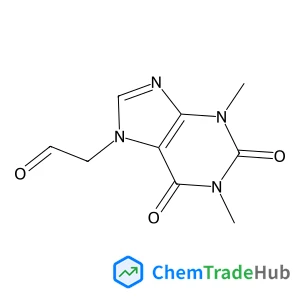
(1,3-Dimethyl-2,6-dioxo-1,2,3,6-tetrahydro-7H-purin-7-yl)acetaldehyde
CAS Number:
5614-53-9
Molecular Formula:
C9H10N4O3
Jiaqi Liu, Saide Cui, Zhenjiang Li, Songquan Xu, Jiaxi Xu, Xianfu Pan, Yaya Liu, He Dong, Herui Sun, Kai Guo
The homopolymerization of trimethylene carbonates (TMC) and their diblock copolymerization to PTMC-b-PVL and PTMC-b-PCL were carried out using benzyl alcohol (BnOH) as the initiator and 1,1′-binaphthyl-2,2′-diyl hydrogen phosphate (BNPH) as the catalyst in toluene at room temperature. The measured 1H NMR molecular weight (PTMC, Mn, NMR = 5300 g mol−1) and the theoretical one (PTMC, Mn, theo = 5100 g mol−1) calculated from the initial ratio of [TMC]0/[BnOH]0 and the monomer conversion matched ideally. The 1H NMR, SEC and MALDI-ToF MS measurements clarified that the obtained polymers were exactly as expected. Kinetics and chain extension experiments demonstrated the controlled/living nature for the ROP of TMC using BNPH. NMR titration experiments confirmed that the polymerization proceeded via a bifunctional activation mechanism. Extension of the initiators by using multifunctional 1,3-propanediol, pentaerythritol, propargyl alcohol, 5-hexen-1-ol, and N-(2-hydroxyethyl)maleimide installed α,ω-dihydroxy telechelic, star-shaped, and clickable end-functionalized polycarbonates. Block copolymers poly(trimethylene carbonate)-block-poly(δ-valerolactone), poly(trimethylene carbonate)-block-poly(ε-caprolactone), and poly(trimethylene carbonate)-block-poly(L-lactide) had been successfully obtained, which suggests that the BNPH catalysis is broadly applicable.
DOI: 10.1039/C9CP05795A
Yuji Otsuki, Kazuya Watanabe, Yoshiyasu Matsumoto
DOI: 10.1039/C8CP07269H
Helmar Görls
DOI: 10.1039/D0CP00232A
Gregor Klinser, Roman Zettl, Heinz Krenn, Roland Würschum
DOI: 10.1039/C9CP04045E
Andrés F. Marmolejo-Valencia, Zaahel Mata-Pinzón, Laura Dominguez, Carlos Amador-Bedolla
DOI: 10.1039/C9CP04041B
Lam K. Huynh
DOI: 10.1039/C9CP02187F
Yongnan Xiong, Xiaofan Li, Shifang Xiao, Huiqiu Deng, Bowen Huang, Wenjun Zhu, Wangyu Hu
DOI: 10.1039/C9CP02920F
Hiroshi Nonaka, Shinsuke Sando
DOI: 10.1039/C9CP00977A
Ruth Prieto-Montero, Rebeca Sola-Llano, Raul Montero, Asier Longarte, Teresa Arbeloa, Iñigo López-Arbeloa, Virginia Martínez-Martínez, Sylvie Lacombe
DOI: 10.1039/C9CP03454D
M. Gnanaprakasam, G. Saranya, S. Bandaru, N. J. English, K. Senthilkumar
DOI: 10.1039/C9CP04271G
When handling 2-Methyl-2-propanyl 5-amino-2-thiophenecarboxylate (CAS: 1498311-5...
5-Bromo-1,2-dichloro-3-fluorobenzene (CAS: 1000572-93-9) is a crystalline solid ...
(2R)-2-Amino-2-(4-bromophenyl)ethanol (CAS: 354153-64-3) should be stored in a c...
Methyl 4-(aminomethyl)tetrahydro-2H-pyran-4-carboxylate hydrochloride (CAS: 3627...
1,4-Dimethyl-1H-pyrazole-5-sulfonyl chloride is primarily used as an intermediat...
Dinaphtho[1,2-b:2',1'-d]furan is generally safe when handled with appropriate pe...
The market for 7-Methyl-7,9-dihydro-1H-purine-2,6,8(3H)-trione (CAS: 612-37-3) i...
2-(4-Chlorophenyl)malonaldehyde (CAS: 205676-17-1) is a colorless or light yello...
2-Methylchrysene (CAS: 3351-32-4) is typically synthesized via the reaction of c...
N-(6-aminopyrimidin-4-yl)acetamide (CAS: 89533-23-3) is generally considered saf...

Polymer Chemistry welcomes submissions in all areas of polymer science that have a strong focus on macromolecular chemistry. Manuscripts may cover a broad range of fields, yet no direct application focus is required.
![1-{[5-(4,4,5,5-Tetramethyl-1,3,2-dioxaborolan-2-yl)-2-thienyl]methyl}piperidine structure](https://static.chemtradehub.com/structs/121/1218790-44-3-baef.webp "1-{[5-(4,4,5,5-Tetramethyl-1,3,2-dioxaborolan-2-yl)-2-thienyl]methyl}piperidine structure")
![2-[2-(2-Methoxyethoxy)ethoxy]-2-methylpropane structure](https://static.chemtradehub.com/structs/527/52788-79-1-71c1.webp "2-[2-(2-Methoxyethoxy)ethoxy]-2-methylpropane structure")



