












100% hyperbranched polymers via the acid-catalyzed Friedel–Crafts aromatic substitution reaction
Literature Information
Publication Date
2016-07-29
DOI
10.1039/C6PY01168C
Impact Factor
5.582
Authors
Dong Yang, Jie Kong
View Original
Abstract
A highly efficient and benign strategy to synthesize hyperbranched polymers with a degree of branching of 100% was presented via a Friedel–Crafts aromatic substitution reaction of an AB2 monomer, 5-(4-phenoxyphenoxy)isobenzofuran-1,3-dione, in the presence of trifluoromethanesulfonic acid. The molecular weight (Mw: 66.1–294.8 kDa) and the polydispersity (close to 2.0) can be tuned by controlling polymerization conditions. It makes it convenient to tailor hyperbranched polymers for potential application in functional materials.
Recommended Journals
Related Literature
A novel approach to carbon hollow spheres and vessels from CCl4 at low temperatures
Zhengquan Li, Changzheng Wu, Rong Zhang
2003-03-10
Communication
DOI: 10.1039/B211996J
Cyclopentanes from N-amino-glyconolactams. A synthesis of mannostatin A
Guixian Hu, Martin Zimmermann, Chepuri Venkata Ramana, Andrea Vasella
2003-03-18
Communication
DOI: 10.1039/B301213A
Synthesis and catalytic activity of a chiral periodic mesoporous organosilica (ChiMO)
Bárbara Gigante, Debasish Das, Mercedes Alvaro, Hermenegildo Garcia, Avelino Corma
2003-06-18
Communication
DOI: 10.1039/B304814D
Stereoselective formation of dinuclear complexes with anomalous CD spectra
Shane G. Telfer, Tomohiro Sato
2003-03-27
Communication
DOI: 10.1039/B301267K
Identification of distinct Brønsted acidic sites in zeolite mordenite by proton localization and [27Al]-1H REAPDOR NMR
Subramanian Ganapathy, Rajiv Kumar, Laurent Delevoye, Jean-Paul Amoureux
2003-07-10
Communication
DOI: 10.1039/B304548J
Synthesis of protein–nucleic acid conjugates by expressed protein ligation
Marina Lovrinovic, Ralf Seidel, Hendrik Schroeder, Oliver Seitz, Martin Engelhard, Roger S. Goody, Christof M. Niemeyer
2003-03-10
Communication
DOI: 10.1039/B212294D
Water solubilization, determination of the number of different types of single-wall carbon nanotubes and their partial separation with respect to diameters by complexation with η-cyclodextrin
Helena Dodziuk, Andrzej Ejchart, Waldemar Anczewski, Haruhisa Ueda, Grygoriy Dolgonos, Wlodzimierz Kutner
2003-03-18
Communication
DOI: 10.1039/B211365A
The structure of a self-assembled calixarene aqua-channel system
Anthony W. Coleman, Eric Da Silva, Farid Nouar, Martine Nierlich, Alda Navaza
2003-03-03
Communication
DOI: 10.1039/B301460F
In situFTIR studies on the electrochemical reduction of halogenated phenols
2003-03-26
Communication
DOI: 10.1039/B212647H
Low-temperature synthesis of titanium disulfidenanotubes
Jun Chen, Suo-Long Li, Zhan-Liang Tao, Feng Gao
2003-03-18
Communication
DOI: 10.1039/B300054K
You might also like
Compound Q&A
What precautions should be taken when handling 2-Methyl-2-propanyl 5-amino-2-thiophenecarboxylate (CAS: 1498311-57-1)?
When handling 2-Methyl-2-propanyl 5-amino-2-thiophenecarboxylate (CAS: 1498311-5...
1498311-57-12-Methyl-2-propanyl ...
Compound Q&A
What are the physical and chemical properties of 5-Bromo-1,2-dichloro-3-fluorobenzene (CAS: 1000572-93-9)?
5-Bromo-1,2-dichloro-3-fluorobenzene (CAS: 1000572-93-9) is a crystalline solid ...
1000572-93-95-Bromo-1,2-dichloro...
Compound Q&A
How should (2R)-2-Amino-2-(4-bromophenyl)ethanol (CAS: 354153-64-3) be stored?
(2R)-2-Amino-2-(4-bromophenyl)ethanol (CAS: 354153-64-3) should be stored in a c...
354153-64-3(2R)-2-Amino-2-(4-br...
Compound Q&A
What regulatory guidelines apply to Methyl 4-(aminomethyl)tetrahydro-2H-pyran-4-carboxylate hydrochloride (CAS: 362707-24-2)?
Methyl 4-(aminomethyl)tetrahydro-2H-pyran-4-carboxylate hydrochloride (CAS: 3627...
362707-24-2Methyl 4-(aminomethy...
Compound Q&A
What are the main uses of 1,4-dimethyl-1H-pyrazole-5-sulfonyl chloride (CAS: 1174834-52-6)?
1,4-Dimethyl-1H-pyrazole-5-sulfonyl chloride is primarily used as an intermediat...
1174834-52-61,4-dimethyl-1H-pyra...
Compound Q&A
Is Dinaphtho[1,2-b:2',1'-d]furan (CAS: 239-69-0) safe?
Dinaphtho[1,2-b:2',1'-d]furan is generally safe when handled with appropriate pe...
239-69-0Dinaphtho[1,2-b:2',1...
Compound Q&A
What is the market or research trend for 7-Methyl-7,9-dihydro-1H-purine-2,6,8(3H)-trione (CAS: 612-37-3)?
The market for 7-Methyl-7,9-dihydro-1H-purine-2,6,8(3H)-trione (CAS: 612-37-3) i...
612-37-37-Methyl-7,9-dihydro...
Compound Q&A
What are the physical and chemical properties of 2-(4-Chlorophenyl)malonaldehyde (CAS: 205676-17-1)?
2-(4-Chlorophenyl)malonaldehyde (CAS: 205676-17-1) is a colorless or light yello...
205676-17-12-(4-Chlorophenyl)ma...
Compound Q&A
How is 2-Methylchrysene (CAS: 3351-32-4) typically synthesized?
2-Methylchrysene (CAS: 3351-32-4) is typically synthesized via the reaction of c...
3351-32-42-Methylchrysene
Compound Q&A
Is N-(6-aminopyrimidin-4-yl)acetamide (CAS: 89533-23-3) safe?
N-(6-aminopyrimidin-4-yl)acetamide (CAS: 89533-23-3) is generally considered saf...
89533-23-3N-(6-aminopyrimidin-...
Source Journal
Polymer Chemistry

CiteScore:
8.6
Self-citation Rate:
7.3%
Articles per Year:
457
Polymer Chemistry welcomes submissions in all areas of polymer science that have a strong focus on macromolecular chemistry. Manuscripts may cover a broad range of fields, yet no direct application focus is required.
Recommended Compounds
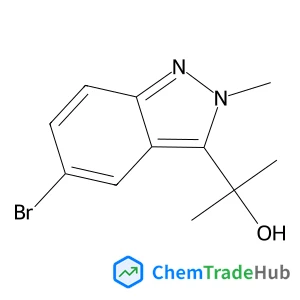
2-(5-Bromo-2-methyl-2H-indazol-3-yl)-2-propanol
CAS Number:
1823787-20-7
Molecular Formula:
C11H13BrN2O
Recommended Suppliers






Disclaimer
This page provides academic journal information for reference and research purposes only. We are not affiliated with any journal publishers and do not handle publication submissions. For publication-related inquiries, please contact the respective journal publishers directly.
If you notice any inaccuracies in the information displayed, please contact us at support@chemtradehub.com. We will promptly review and address your concerns.