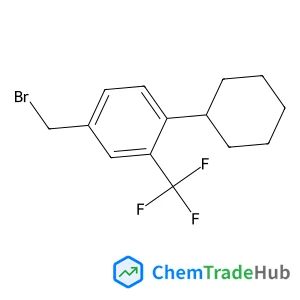
4-(Bromomethyl)-1-cyclohexyl-2-(trifluoromethyl)benzene
CAS Number:
800381-60-6
Molecular Formula:
C14H16BrF3
Cai Wang, Yudong Zheng, Yi Sun, Jinsheng Fan, Qiujing Qin, Zhenjiang Zhao
A novel block polyurethane was designed and synthesized based on poly(3-hydroxybutyrate-co-3-hydroxyvalerate) (PHBV), 4,4′-diphenylmethanediisocyanate (MDI) and poly(ethylene glycol) (PEG). The obtained polyurethanes were characterized by proton nuclear magnetic resonance (1H NMR), Fourier transform infrared spectroscopy (FTIR), atomic force microscopy (AFM), differential scanning calorimetry (DSC) and wide angle X-ray diffraction (WAXD). Furthermore, the biodegradability of the synthesized polyurethanes was evaluated at 37 °C in phosphate buffer solution (PBS) at pH 7.4. The results showed that these PHBV-based polyurethanes were degradable in PBS, as indicated by weight loss measurements, scanning electron microscopy (SEM) and FTIR. The cytotoxicity of the novel polyurethane was evaluated using the cell counting kit-8 (CCK8) assay in vitro. Preliminary evaluation of hemocompatibility was carried out via the hemolysis test, dynamic blood coagulation time and platelet adhesion. The current work provides a promising approach to prepare nontoxic and biodegradable polyurethanes with excellent mechanical properties and good hemocompatibility. This new material may find potential application in blood vessel tissue engineering.
Jun Guo, Xiaomin Xue, Fangfang Li, Meiting Zhao, Youcong Xing, Yanmin Song, Chang Long, Tingting Zhao, Zhiyong Tang
DOI: 10.1039/D3NH00419H
Santhoshkumar Sundaramoorthy, Amitava Choudhury, Naresh C. Osti, Alexander I. Kolesnikov, Matthew B. Stone, Yongqiang Cheng
DOI: 10.1039/D3TA04479C
Jun Wang, Xiuyang Zou, Lina Song, Jianguo Lu, Xiang Gao, Qinggang He
DOI: 10.1039/D3TA04886A
Xiaofeng Cui, Na Zhang, Ming Huang, Guoli Gao, Shihai Liu, Chuntai Liu
DOI: 10.1039/D3TA05595G
Yuheng Huang, Kuibo Yin, Binghui Li, Anqi Zheng, Bozhi Wu, Litao Sun, Meng Nie
DOI: 10.1039/D3NH00407D
Javier M. Rodríguez
DOI: 10.1039/D3NH00195D
Haijia Li, Jian Cai, Jianping Liao, Yiting Li, Xueyi Zeng, Xin He, Chaojun Fan, Zhen Ma, Junmin Nan
DOI: 10.1039/D3TA04535H
Moon Sung Kang, Hee Jeong Jang, Hyo Jung Jo, Iruthayapandi Selestin Raja
DOI: 10.1039/D3NH00428G
Shuonan Wang, Kai Zhang, Hao Liu, Libing Liao
DOI: 10.1039/D3TA05355E
When handling lithium chloride hydrate (1:1:1) (CAS: 16712-20-2), it is importan...
4-(4H-1,2,4-Triazol-4-yl)piperidine is generally considered safe for use in phar...
Waste containing 1,3-Thiazole-2-carboxamide (CAS: 16733-85-0) should be collecte...
5-(Difluoromethyl)-2-fluorobenzonitrile (CAS: 934175-58-3) is subject to regulat...
Methyl 3-acetamido-2-thiophenecarboxylate can be synthesized by the reaction of ...
4-Isoquinolinecarbonitrile is a chemical compound with the CAS number 34846-65-6...
Store Methyl 1H-1,2,3-triazole-4-carboxylate (CAS: 877309-59-6) in a cool, dry p...
6-Bromo[1,3]thiazolo[5,4-b]pyridin-2-amine (CAS: 1160791-13-8) is subject to the...
(2S,3S)-2-Ammonio-3-(3,4-dihydroxyphenyl)-3-hydroxypropanoate (CAS: 23651-95-8) ...
7-Bromo-3-methyl-3,4-dihydroquinazolin-4-one is a solid with a crystalline form....

Polymer Chemistry welcomes submissions in all areas of polymer science that have a strong focus on macromolecular chemistry. Manuscripts may cover a broad range of fields, yet no direct application focus is required.