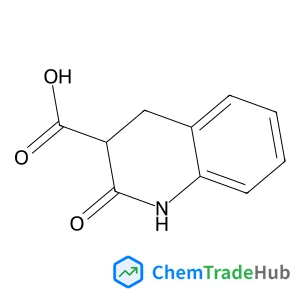
2-Oxo-1,2,3,4-tetrahydro-3-quinolinecarboxylic acid
CAS Number:
246867-17-4
Molecular Formula:
C10H9NO3
Diana Kalden, Matthias Westerhausen
A series of amphiphilic heterografted comb polymers comprising various ratios of oligomeric polylactide (PLA) and poly(2-ethyl-2-oxazoline) (PEtOx) side chains was synthesized via the grafting-through method employing the reversible addition–fragmentation chain transfer copolymerization. Two well-defined PLA macromonomers were prepared via ring opening polymerization (ROP) of L-lactide using a calcium-based pre-catalyst, pyrenebutanol as an initiator and methacryloyl chloride as an end-capping agent. The PEtOx macromonomer was obtained from the cationic ROP of EtOx and end-capping with methacrylic acid. The amphiphilic comb polymers self-assembled in aqueous solution to form spherical and worm-like micelles, vesicles and more complex morphologies as a function of the composition, as is evident from dynamic light scattering and cryo-transmission electron microscopy studies. All polymers were found to be non-toxic to L929 cells up to a concentration of 200 μg mL−1. Cellular uptake studies with HEK-293 cells by live cell confocal fluorescence microscopy revealed localization in the cytosol after 4 h and suggest an energy-driven cellular uptake mechanism.
Ziwei Xiao, Brian O. Patrick, David Dolphin
DOI: 10.1039/B211990K
Vladimir Lokshin, Magali Valès, André Samat, Gérard Pèpe, Anatoly Metelitsa, Vladimir Khodorkovsky
DOI: 10.1039/B304861F
Helena Dodziuk, Andrzej Ejchart, Waldemar Anczewski, Haruhisa Ueda, Grygoriy Dolgonos, Wlodzimierz Kutner
DOI: 10.1039/B211365A
Ying-Chun Zhu, Yoshio Bando, Yoichiro Uemura
DOI: 10.1039/B300249G
Shigeru Yamada, Danhong Wang, Songri Li, Megumi Nishikawa, Eika Weihua Qian, Atsushi Ishihara, Toshiaki Kabe
DOI: 10.1039/B212438F
Yannick Ortin, Alix Sournia-Saquet, Noël Lugan, René Mathieu
DOI: 10.1039/B300623A
Constantinos J. Milios, Elena Kefalloniti, Catherine P. Raptopoulou, Aris Terzis, Ramon Vicente, Nikolia Lalioti, Albert Escuer, Spyros P. Perlepes
DOI: 10.1039/B300986F
Tomikazu Sasaki
DOI: 10.1039/B212364A
Subramanian Ganapathy, Rajiv Kumar, Laurent Delevoye, Jean-Paul Amoureux
DOI: 10.1039/B304548J
Takako Nakamura, Masatou Ishihara, Tsuguyori Ohana, Yoshinori Koga
DOI: 10.1039/B211807F
When handling 2-Methyl-2-propanyl 5-amino-2-thiophenecarboxylate (CAS: 1498311-5...
5-Bromo-1,2-dichloro-3-fluorobenzene (CAS: 1000572-93-9) is a crystalline solid ...
(2R)-2-Amino-2-(4-bromophenyl)ethanol (CAS: 354153-64-3) should be stored in a c...
Methyl 4-(aminomethyl)tetrahydro-2H-pyran-4-carboxylate hydrochloride (CAS: 3627...
1,4-Dimethyl-1H-pyrazole-5-sulfonyl chloride is primarily used as an intermediat...
Dinaphtho[1,2-b:2',1'-d]furan is generally safe when handled with appropriate pe...
The market for 7-Methyl-7,9-dihydro-1H-purine-2,6,8(3H)-trione (CAS: 612-37-3) i...
2-(4-Chlorophenyl)malonaldehyde (CAS: 205676-17-1) is a colorless or light yello...
2-Methylchrysene (CAS: 3351-32-4) is typically synthesized via the reaction of c...
N-(6-aminopyrimidin-4-yl)acetamide (CAS: 89533-23-3) is generally considered saf...

Polymer Chemistry welcomes submissions in all areas of polymer science that have a strong focus on macromolecular chemistry. Manuscripts may cover a broad range of fields, yet no direct application focus is required.
![3-(benzotriazol-1-yl)-N-[[2-[(3-bromophenyl)methoxy]phenyl]methylideneamino]propanamide structure](https://static.chemtradehub.com/structs/559/5595-78-8-0a32.webp "3-(benzotriazol-1-yl)-N-[[2-[(3-bromophenyl)methoxy]phenyl]methylideneamino]propanamide structure")
![N-[(1-Ethyl-2-pyrrolidinyl)methyl]-2-hydroxy-5-sulfamoylbenzamide structure](https://static.chemtradehub.com/structs/673/67381-52-6-877f.webp "N-[(1-Ethyl-2-pyrrolidinyl)methyl]-2-hydroxy-5-sulfamoylbenzamide structure")