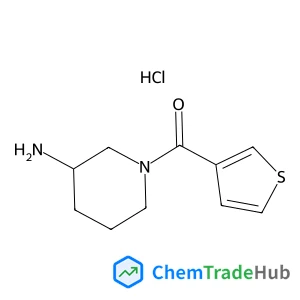
(3-Amino-piperidin-1-yl)-thiophen-3-yl-methanone hydrochloride
CAS Number:
1185316-70-4
Molecular Formula:
C10H15ClN2OS
Vladimir Lokshin, Magali Valès, André Samat, Gérard Pèpe, Anatoly Metelitsa, Vladimir Khodorkovsky
A novel photoreversible photochromic system, 3-(2-benzylbenzoyl)-1,2-R,R1-4(1H)-quinolinones/12-hydroxy-5-R-5a-R1-6-phenyl-5a,6-dihydrobenzo[b]acridin-11(5H)-ones, is described.
Clarke Palmer, Maryam Tarazkar, Michael J. Gordon, Horia Metiu, Eric W. McFarland
DOI: 10.1039/D1SE01408K
Hwapyung Jung, Arindam Adhikari, Rajkumar Patel
DOI: 10.1039/D1SE01716K
P. Arévalo-Cid, P. Dias, A. Mendes, J. Azevedo
DOI: 10.1039/D1SE00839K
Nilanka M. Keppetipola, Céline Olivier, Thierry Toupance, Ludmila Cojocaru
DOI: 10.1039/D1SE00954K
Troy R. Hawkins
DOI: 10.1039/D1SE01742J
Lin Lei, Weijia Wang, Zhengfeng Xie, Xiaobo Wu, Arun Kumar Yadav, Huiqing Fan
DOI: 10.1039/D1SE01244D
Chelsea L. Tucker, Ankur Bordoloi, Eric van Steen
DOI: 10.1039/D1SE01299A
Lizhi Qian, Zhiqiang Wei, Tingli Yu, Bingdong Chang, Hongyu Sun, Wei Huang
DOI: 10.1039/D1SE00829C
Yutaka Ikeda, Yuki Cho
DOI: 10.1039/D1SE01264A
Alfonsina Abat Amelenan Torimtubun, Maria Méndez, José G. Sánchez, Josep Pallarès, Lluis F. Marsal
DOI: 10.1039/D1SE01107C
When handling 2-Methyl-2-propanyl 5-amino-2-thiophenecarboxylate (CAS: 1498311-5...
5-Bromo-1,2-dichloro-3-fluorobenzene (CAS: 1000572-93-9) is a crystalline solid ...
(2R)-2-Amino-2-(4-bromophenyl)ethanol (CAS: 354153-64-3) should be stored in a c...
Methyl 4-(aminomethyl)tetrahydro-2H-pyran-4-carboxylate hydrochloride (CAS: 3627...
1,4-Dimethyl-1H-pyrazole-5-sulfonyl chloride is primarily used as an intermediat...
Dinaphtho[1,2-b:2',1'-d]furan is generally safe when handled with appropriate pe...
The market for 7-Methyl-7,9-dihydro-1H-purine-2,6,8(3H)-trione (CAS: 612-37-3) i...
2-(4-Chlorophenyl)malonaldehyde (CAS: 205676-17-1) is a colorless or light yello...
2-Methylchrysene (CAS: 3351-32-4) is typically synthesized via the reaction of c...
N-(6-aminopyrimidin-4-yl)acetamide (CAS: 89533-23-3) is generally considered saf...

ChemComm publishes urgent research which is of outstanding significance and interest to experts in the field, while also appealing to the journal’s broad chemistry readership. Our communication format is ideally suited to short, urgent studies that are of such importance that they require accelerated publication. Our scope covers all topics in chemistry, and research at the interface of chemistry and other disciplines (such as materials science, nanoscience, physics, engineering and biology) where there is a significant novelty in the chemistry aspects. Major topic areas covered include: Analytical Chemistry Catalysis Chemical Biology and medicinal chemistry Computational Chemistry and Machine Learning Energy and sustainable chemistry Environmental Chemistry Green Chemistry Inorganic Chemistry Materials Chemistry Nanoscience Organic Chemistry Physical Chemistry Polymer Chemistry Supramolecular Chemistry