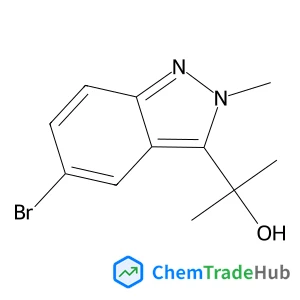
2-(5-Bromo-2-methyl-2H-indazol-3-yl)-2-propanol
CAS Number:
1823787-20-7
Molecular Formula:
C11H13BrN2O
Ying-Chun Zhu, Yoshio Bando, Yoichiro Uemura
ZnS–Zn nanocables and ZnS nanotubes have been synthesized by a thermochemical process in a simple and safe way. The as-prepared nanocables consist of a single crystal Zn core with a diameter of 20 nm and a polycrystalline ZnS sheath with a thickness of 8 nm. The evaporation of the Zn core leads to the formation of ZnS nanotubes.
Hiroto Mogi, Shunta Nishioka, Kazuhiko Maeda
DOI: 10.1039/D1SE01075A
Lin Lei, Weijia Wang, Zhengfeng Xie, Xiaobo Wu, Arun Kumar Yadav, Huiqing Fan
DOI: 10.1039/D1SE01244D
Peisen Wu, Yongbo Wu, Kaiyin Zhu, Guozheng Ma, Xiaoming Lin, Akif Zeb, Xinli Chen, Kang Li
DOI: 10.1039/D1SE01368H
Xiucui Hu, Yadi Liu, Liguang Dou, Yuan Gao, Xin Tu
DOI: 10.1039/D1SE01441B
Saeed M. Alhassan
DOI: 10.1039/D1SE01134K
Clarke Palmer, Maryam Tarazkar, Michael J. Gordon, Horia Metiu, Eric W. McFarland
DOI: 10.1039/D1SE01408K
Annika Reichert, Michael Pohorely, Erik Meers, Newton Libanio Ferreira, Michal Jeremias
DOI: 10.1039/D1SE00998B
When handling 2-Methyl-2-propanyl 5-amino-2-thiophenecarboxylate (CAS: 1498311-5...
5-Bromo-1,2-dichloro-3-fluorobenzene (CAS: 1000572-93-9) is a crystalline solid ...
(2R)-2-Amino-2-(4-bromophenyl)ethanol (CAS: 354153-64-3) should be stored in a c...
Methyl 4-(aminomethyl)tetrahydro-2H-pyran-4-carboxylate hydrochloride (CAS: 3627...
1,4-Dimethyl-1H-pyrazole-5-sulfonyl chloride is primarily used as an intermediat...
Dinaphtho[1,2-b:2',1'-d]furan is generally safe when handled with appropriate pe...
The market for 7-Methyl-7,9-dihydro-1H-purine-2,6,8(3H)-trione (CAS: 612-37-3) i...
2-(4-Chlorophenyl)malonaldehyde (CAS: 205676-17-1) is a colorless or light yello...
2-Methylchrysene (CAS: 3351-32-4) is typically synthesized via the reaction of c...
N-(6-aminopyrimidin-4-yl)acetamide (CAS: 89533-23-3) is generally considered saf...

ChemComm publishes urgent research which is of outstanding significance and interest to experts in the field, while also appealing to the journal’s broad chemistry readership. Our communication format is ideally suited to short, urgent studies that are of such importance that they require accelerated publication. Our scope covers all topics in chemistry, and research at the interface of chemistry and other disciplines (such as materials science, nanoscience, physics, engineering and biology) where there is a significant novelty in the chemistry aspects. Major topic areas covered include: Analytical Chemistry Catalysis Chemical Biology and medicinal chemistry Computational Chemistry and Machine Learning Energy and sustainable chemistry Environmental Chemistry Green Chemistry Inorganic Chemistry Materials Chemistry Nanoscience Organic Chemistry Physical Chemistry Polymer Chemistry Supramolecular Chemistry
![1-{[5-(4,4,5,5-Tetramethyl-1,3,2-dioxaborolan-2-yl)-2-thienyl]methyl}piperidine structure](https://static.chemtradehub.com/structs/121/1218790-44-3-baef.webp "1-{[5-(4,4,5,5-Tetramethyl-1,3,2-dioxaborolan-2-yl)-2-thienyl]methyl}piperidine structure")