












![2-Bromo-7-chloro-4H-pyrrolo[2,3-b]pyrazine structure](https://static.chemtradehub.com/structs/115/1150617-58-5-0b0a.webp "2-Bromo-7-chloro-4H-pyrrolo[2,3-b]pyrazine structure")
Dendrons as active clicking tool for generating non-leaching antibacterial materials
Literature Information
Publication Date
2016-07-20
DOI
10.1039/C6PY01105E
Impact Factor
5.582
Authors
Hadi Bakhshi, Seema Agarwal
View Original
Abstract
We show a novel concept of using dendrons as a tool for making non-active materials antibacterial in a simple way. A dendron is a part of a dendrimer with the advantage of having many peripheral functional groups and a focal point. We used this structural advantage in making an antibacterial polymeric tool for clicking to other non-active polymers and surfaces. We show the success of the concept by making new antibacterial poly(urethane-biuret) dendrons containing quaternary ammonium salts (QASs) on the periphery and a primary hydroxyl group as the focal point in one pot. The chemical structure and thermal properties of the dendrons were fully studied. All quaternized dendrons were stable until above 200 °C. The newly synthesized dendrons show high activity against Escherichia coli (E. coli) and Bacillus subtilis (B. subtilis) as tested by the determination of MIC, MBC values and the Kirby–Bauer assay. The hydroxyl group enabled the attachment of the dendrons to a cotton mat and PU foam, as a reactive additive, bringing them non-leaching fast bactericidal activity. The interaction of urethane and biuret bonds in the dendrons’ backbone led to a transparent non-leaching bactericidal coating on the treated glass slides.
Related Literature
Solvent-dependent 44 square grid and 64.82 NbO frameworks formed by Cu(Pyac)2 (bis[3-(4-pyridyl)pentane-2,4-dionato]copper(ii))
Banglin Chen, Frank R. Fronczek, Andrew W. Maverick
2003-07-28
Communication
DOI: 10.1039/B305457H
Swift oxo transfer reactions of perchlorate and other substrates catalyzed by rhenium oxazoline and thiazoline complexes
2003-06-24
Feature Article
DOI: 10.1039/B300189J
Palladacyclic catalysts in C–C and C–heteroatom bond-forming reactions
2003-06-09
Feature Article
DOI: 10.1039/B211298C
A facile tetrahydrothiophene-catalyzed ylide route to vinyloxiranes
Kai Li, Xian-Ming Deng, Yong Tang
2003-07-10
Communication
DOI: 10.1039/B304443B
A novel peptide synthesis using fluorous chemistry
Mamoru Mizuno, Kohtaro Goto, Tsuyoshi Miura, Daisuke Hosaka, Toshiyuki Inazu
2003-03-18
Communication
DOI: 10.1039/B300682D
Synthesis of the aminocyclopentitol moieties of the hopanoids of Zymomonas mobilis and ‘Anacystis montana’
Jose Luis Chiara, Isabel Storch de Gracia, Ágatha Bastida
2003-06-20
Communication
DOI: 10.1039/B304576E
C–C bond formation through oxidatively induced elimination of platinum complexes—A novel approach towards conjugated macrocycles
Gerda Fuhrmann, Tony Debaerdemaeker, Peter Bäuerle
2003-03-14
Communication
DOI: 10.1039/B300542A
Unexpected coupling between an η5-indenyl ligand and alkenyl-vinylidene fragments: synthesis of unprecedented (η6-indene)ruthenium(ii) metallacycles
Victorio Cadierno, Salvador Conejero, Josefina Díez, M. Pilar Gamasa, José Gimeno, Santiago García-Granda
2003-02-28
Communication
DOI: 10.1039/B212406H
Nonenzymatic peptide-based catalytic asymmetric phosphorylation of inositol derivatives
Bianca R. Sculimbrene, Adam J. Morgan, Scott J. Miller
2003-06-24
Focus
DOI: 10.1039/B304015C
Diastereoselective formation of a dipalladium(i) complex supported by a bridging tetradentate ligand, and oxidative addition of RS–H across a phosphine-bridged PdI–PdI bond
S. Jo Ling Foo, Nathan D. Jones, Brian O. Patrick, Brian R. James
2003-03-20
Communication
DOI: 10.1039/B300177F
You might also like
Compound Q&A
What precautions should be taken when handling 2-Methyl-2-propanyl 5-amino-2-thiophenecarboxylate (CAS: 1498311-57-1)?
When handling 2-Methyl-2-propanyl 5-amino-2-thiophenecarboxylate (CAS: 1498311-5...
1498311-57-12-Methyl-2-propanyl ...
Compound Q&A
What are the physical and chemical properties of 5-Bromo-1,2-dichloro-3-fluorobenzene (CAS: 1000572-93-9)?
5-Bromo-1,2-dichloro-3-fluorobenzene (CAS: 1000572-93-9) is a crystalline solid ...
1000572-93-95-Bromo-1,2-dichloro...
Compound Q&A
How should (2R)-2-Amino-2-(4-bromophenyl)ethanol (CAS: 354153-64-3) be stored?
(2R)-2-Amino-2-(4-bromophenyl)ethanol (CAS: 354153-64-3) should be stored in a c...
354153-64-3(2R)-2-Amino-2-(4-br...
Compound Q&A
What regulatory guidelines apply to Methyl 4-(aminomethyl)tetrahydro-2H-pyran-4-carboxylate hydrochloride (CAS: 362707-24-2)?
Methyl 4-(aminomethyl)tetrahydro-2H-pyran-4-carboxylate hydrochloride (CAS: 3627...
362707-24-2Methyl 4-(aminomethy...
Compound Q&A
What are the main uses of 1,4-dimethyl-1H-pyrazole-5-sulfonyl chloride (CAS: 1174834-52-6)?
1,4-Dimethyl-1H-pyrazole-5-sulfonyl chloride is primarily used as an intermediat...
1174834-52-61,4-dimethyl-1H-pyra...
Compound Q&A
Is Dinaphtho[1,2-b:2',1'-d]furan (CAS: 239-69-0) safe?
Dinaphtho[1,2-b:2',1'-d]furan is generally safe when handled with appropriate pe...
239-69-0Dinaphtho[1,2-b:2',1...
Compound Q&A
What is the market or research trend for 7-Methyl-7,9-dihydro-1H-purine-2,6,8(3H)-trione (CAS: 612-37-3)?
The market for 7-Methyl-7,9-dihydro-1H-purine-2,6,8(3H)-trione (CAS: 612-37-3) i...
612-37-37-Methyl-7,9-dihydro...
Compound Q&A
What are the physical and chemical properties of 2-(4-Chlorophenyl)malonaldehyde (CAS: 205676-17-1)?
2-(4-Chlorophenyl)malonaldehyde (CAS: 205676-17-1) is a colorless or light yello...
205676-17-12-(4-Chlorophenyl)ma...
Compound Q&A
How is 2-Methylchrysene (CAS: 3351-32-4) typically synthesized?
2-Methylchrysene (CAS: 3351-32-4) is typically synthesized via the reaction of c...
3351-32-42-Methylchrysene
Compound Q&A
Is N-(6-aminopyrimidin-4-yl)acetamide (CAS: 89533-23-3) safe?
N-(6-aminopyrimidin-4-yl)acetamide (CAS: 89533-23-3) is generally considered saf...
89533-23-3N-(6-aminopyrimidin-...
Source Journal
Polymer Chemistry

CiteScore:
8.6
Self-citation Rate:
7.3%
Articles per Year:
457
Polymer Chemistry welcomes submissions in all areas of polymer science that have a strong focus on macromolecular chemistry. Manuscripts may cover a broad range of fields, yet no direct application focus is required.
Recommended Compounds
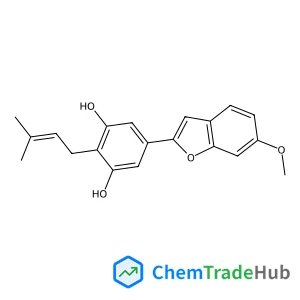
5-(6-Methoxy-1-benzofuran-2-yl)-2-(3-methyl-2-buten-1-yl)-1,3-benzenediol
CAS Number:
1017277-40-5
Molecular Formula:
C20H20O4
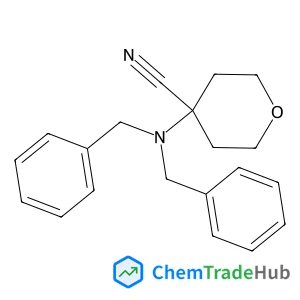
4-(Dibenzylamino)tetrahydro-2H-pyran-4-carbonitrile
CAS Number:
1630906-81-8
Molecular Formula:
C20H22N2O
![1-{[5-(4,4,5,5-Tetramethyl-1,3,2-dioxaborolan-2-yl)-2-thienyl]methyl}piperidine structure](https://static.chemtradehub.com/structs/121/1218790-44-3-baef.webp "1-{[5-(4,4,5,5-Tetramethyl-1,3,2-dioxaborolan-2-yl)-2-thienyl]methyl}piperidine structure")
1-{[5-(4,4,5,5-Tetramethyl-1,3,2-dioxaborolan-2-yl)-2-thienyl]methyl}piperidine
CAS Number:
1218790-44-3
Molecular Formula:
C16H26BNO2S
![N-[(1-Ethyl-2-pyrrolidinyl)methyl]-2-hydroxy-5-sulfamoylbenzamide structure](https://static.chemtradehub.com/structs/673/67381-52-6-877f.webp "N-[(1-Ethyl-2-pyrrolidinyl)methyl]-2-hydroxy-5-sulfamoylbenzamide structure")
N-[(1-Ethyl-2-pyrrolidinyl)methyl]-2-hydroxy-5-sulfamoylbenzamide
CAS Number:
67381-52-6
Molecular Formula:
C14H21N3O4S
Recommended Suppliers




Disclaimer
This page provides academic journal information for reference and research purposes only. We are not affiliated with any journal publishers and do not handle publication submissions. For publication-related inquiries, please contact the respective journal publishers directly.
If you notice any inaccuracies in the information displayed, please contact us at support@chemtradehub.com. We will promptly review and address your concerns.