



A composition-controlled cross-linking resin network through rapid visible-light photo-copolymerization
Literature Information
Publication Date
2016-07-18
DOI
10.1039/C6PY00606J
Impact Factor
5.582
Authors
Yin Yang, Aaron Urbas, Andres Gonzalez-Bonet, Richard J. Sheridan, Jonathan E. Seppala, Kathryn L. Beers, Jirun Sun
View Original
Abstract
An assembly that delivers well-defined functional materials, clinically practical procedures to make these materials in situ, and appropriate analytical tools for chemical structure and kinetic studies is desirable, though currently unavailable. Herein, we introduce a system that addresses this need through the development and characterization of a cross-linking resin network, which is achieved through rapid, visible-light induced polymerization in a solvent-free environment. This resin network is the result of co-polymerization of a distyrenyl-monomer with a dimethacryl-monomer. Ninety percent of vinyl conversion is achieved in seconds. In addition, an azeotropic composition is identified and confirmed through static end-point evaluation, sol–gel experiment, kinetic study, and mathematical modeling of data acquired via FTIR, real-time Raman and 1H NMR spectroscopies. These results yield opportunities for the design and development of new functional materials to be used in various applications.
Recommended Journals

Atomization and Sprays

Bioorganic & Medicinal Chemistry

Journal of Chemical Sciences

Herald of the Russian Academy of Sciences

Topics in Catalysis

Bioorganic & Medicinal Chemistry Letters

Medicinal Chemistry Research

Journal of the Indian Institute of Science

Acta Metallurgica Sinica-English Letters

Biocatalysis and Biotransformation
Related Literature
Observation of high enantioselectivity for the gas phase hydrogenation of methyl pyruvate using supported Pt catalysts pre-modified with cinchonidine
Nicholas Dummer, David J. Willock, Stuart H. Taylor, Richard P. K. Wells, Peter B. Wells, Graham J. Hutchings
2003-06-27
Communication
DOI: 10.1039/B304976K
A rapid and effective synthesis of propylene carbonate using a supercritical CO2–ionic liquid system
Akiyoshi Sasaki, Keitaro Matsui
2003-03-07
Communication
DOI: 10.1039/B212823C
Chemical modification of diamond powder using photolysis of perfluoroazooctane
Takako Nakamura, Masatou Ishihara, Tsuguyori Ohana, Yoshinori Koga
2003-03-10
Communication
DOI: 10.1039/B211807F
Water solubilization, determination of the number of different types of single-wall carbon nanotubes and their partial separation with respect to diameters by complexation with η-cyclodextrin
Helena Dodziuk, Andrzej Ejchart, Waldemar Anczewski, Haruhisa Ueda, Grygoriy Dolgonos, Wlodzimierz Kutner
2003-03-18
Communication
DOI: 10.1039/B211365A
Thermolysis of fluorinated cycloalkylidene fulgides yields a new class of photochromic compounds
Mason A. Wolak, Nathan B. Gillespie, Robert R. Birge, Watson J. Lees
2003-03-27
Communication
DOI: 10.1039/B300010A
Versatile synthesis of nanometer sized hollow silica spheres
Jeroen J. L. M. Cornelissen, Eric. F. Connor, Ho-Cheol Kim, Victor Y. Lee, Teddie Magibitang, Philip M. Rice, Willi Volksen, Linda K. Sundberg, Robert D. Miller
2003-03-21
Communication
DOI: 10.1039/B212811J
In situUV-visible assessment of extent of reduction during oxidation reactions on oxidecatalysts
Morris D. Argyle, Alexis T. Bell, Enrique Iglesia
2003-07-15
Communication
DOI: 10.1039/B305264H
Enantio-differentiating catalytic oxidation by a biomimetic trinuclear copper complex containing l-histidine residues
Laura Santagostini, Michele Gullotti, Roberto Pagliarin, Enrico Monzani, Luigi Casella
2003-07-28
Communication
DOI: 10.1039/B307349A
A mono-TTF-annulated porphyrin as a fluorescence switch
Hongchao Li, Jan O. Jeppesen, Eric Levillain, Jan Becher
2003-02-27
Communication
DOI: 10.1039/B212456D
Low-temperature synthesis of titanium disulfidenanotubes
Jun Chen, Suo-Long Li, Zhan-Liang Tao, Feng Gao
2003-03-18
Communication
DOI: 10.1039/B300054K
You might also like
Compound Q&A
What precautions should be taken when handling 2-Methyl-2-propanyl 5-amino-2-thiophenecarboxylate (CAS: 1498311-57-1)?
When handling 2-Methyl-2-propanyl 5-amino-2-thiophenecarboxylate (CAS: 1498311-5...
1498311-57-12-Methyl-2-propanyl ...
Compound Q&A
What are the physical and chemical properties of 5-Bromo-1,2-dichloro-3-fluorobenzene (CAS: 1000572-93-9)?
5-Bromo-1,2-dichloro-3-fluorobenzene (CAS: 1000572-93-9) is a crystalline solid ...
1000572-93-95-Bromo-1,2-dichloro...
Compound Q&A
How should (2R)-2-Amino-2-(4-bromophenyl)ethanol (CAS: 354153-64-3) be stored?
(2R)-2-Amino-2-(4-bromophenyl)ethanol (CAS: 354153-64-3) should be stored in a c...
354153-64-3(2R)-2-Amino-2-(4-br...
Compound Q&A
What regulatory guidelines apply to Methyl 4-(aminomethyl)tetrahydro-2H-pyran-4-carboxylate hydrochloride (CAS: 362707-24-2)?
Methyl 4-(aminomethyl)tetrahydro-2H-pyran-4-carboxylate hydrochloride (CAS: 3627...
362707-24-2Methyl 4-(aminomethy...
Compound Q&A
What are the main uses of 1,4-dimethyl-1H-pyrazole-5-sulfonyl chloride (CAS: 1174834-52-6)?
1,4-Dimethyl-1H-pyrazole-5-sulfonyl chloride is primarily used as an intermediat...
1174834-52-61,4-dimethyl-1H-pyra...
Compound Q&A
Is Dinaphtho[1,2-b:2',1'-d]furan (CAS: 239-69-0) safe?
Dinaphtho[1,2-b:2',1'-d]furan is generally safe when handled with appropriate pe...
239-69-0Dinaphtho[1,2-b:2',1...
Compound Q&A
What is the market or research trend for 7-Methyl-7,9-dihydro-1H-purine-2,6,8(3H)-trione (CAS: 612-37-3)?
The market for 7-Methyl-7,9-dihydro-1H-purine-2,6,8(3H)-trione (CAS: 612-37-3) i...
612-37-37-Methyl-7,9-dihydro...
Compound Q&A
What are the physical and chemical properties of 2-(4-Chlorophenyl)malonaldehyde (CAS: 205676-17-1)?
2-(4-Chlorophenyl)malonaldehyde (CAS: 205676-17-1) is a colorless or light yello...
205676-17-12-(4-Chlorophenyl)ma...
Compound Q&A
How is 2-Methylchrysene (CAS: 3351-32-4) typically synthesized?
2-Methylchrysene (CAS: 3351-32-4) is typically synthesized via the reaction of c...
3351-32-42-Methylchrysene
Compound Q&A
Is N-(6-aminopyrimidin-4-yl)acetamide (CAS: 89533-23-3) safe?
N-(6-aminopyrimidin-4-yl)acetamide (CAS: 89533-23-3) is generally considered saf...
89533-23-3N-(6-aminopyrimidin-...
Source Journal
Polymer Chemistry

CiteScore:
8.6
Self-citation Rate:
7.3%
Articles per Year:
457
Polymer Chemistry welcomes submissions in all areas of polymer science that have a strong focus on macromolecular chemistry. Manuscripts may cover a broad range of fields, yet no direct application focus is required.
Recommended Compounds
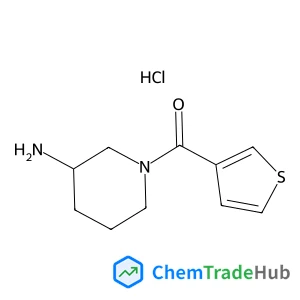
(3-Amino-piperidin-1-yl)-thiophen-3-yl-methanone hydrochloride
CAS Number:
1185316-70-4
Molecular Formula:
C10H15ClN2OS
Recommended Suppliers






Disclaimer
This page provides academic journal information for reference and research purposes only. We are not affiliated with any journal publishers and do not handle publication submissions. For publication-related inquiries, please contact the respective journal publishers directly.
If you notice any inaccuracies in the information displayed, please contact us at support@chemtradehub.com. We will promptly review and address your concerns.