












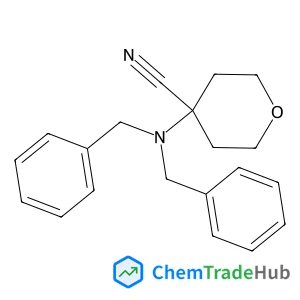
4-(Dibenzylamino)tetrahydro-2H-pyran-4-carbonitrile
CAS Number:
1630906-81-8
Molecular Formula:
C20H22N2O
Nicholas Dummer, David J. Willock, Stuart H. Taylor, Richard P. K. Wells, Peter B. Wells, Graham J. Hutchings
Pt supported on α-Al2O3, γ-Al2O3 and SiO2 pre-modified with cinchonidine gives over 50% ee in the hydrogenation of methyl pyruvate to methyl lactate using gas phase reactants at 40 °C giving the first clear observation of high enantioselection at the gas/solid interface.
Yayun Zhang, Yunfeng Zhao, Moriko Qian, Xiaona Lin, Hanwu Lei
DOI: 10.1039/D1SE01108A
Yutaka Ikeda, Yuki Cho
DOI: 10.1039/D1SE01264A
Adrian Loy Chun Minh, Shanthi Priya Samudrala, Sankar Bhattacharya
DOI: 10.1039/D1SE01333E
Daniel Rojas Sánchez, Kaveh Khalilpour, Andrew F. A. Hoadley
DOI: 10.1039/D1SE01462E
Saeed M. Alhassan
DOI: 10.1039/D1SE01134K
Rachael H. Dolan, James E. Anderson, Timothy J. Wallington
DOI: 10.1039/D1SE00979F
Caitlin D. Parke, Linnette Teo, Daniel T. Schwartz, Venkat R. Subramanian
DOI: 10.1039/D1SE01090E
Omprakash Sarkar, Ulrika Rova, Paul Christakopoulos, Leonidas Matsakas
DOI: 10.1039/D1SE01691A
When handling 2-Methyl-2-propanyl 5-amino-2-thiophenecarboxylate (CAS: 1498311-5...
5-Bromo-1,2-dichloro-3-fluorobenzene (CAS: 1000572-93-9) is a crystalline solid ...
(2R)-2-Amino-2-(4-bromophenyl)ethanol (CAS: 354153-64-3) should be stored in a c...
Methyl 4-(aminomethyl)tetrahydro-2H-pyran-4-carboxylate hydrochloride (CAS: 3627...
1,4-Dimethyl-1H-pyrazole-5-sulfonyl chloride is primarily used as an intermediat...
Dinaphtho[1,2-b:2',1'-d]furan is generally safe when handled with appropriate pe...
The market for 7-Methyl-7,9-dihydro-1H-purine-2,6,8(3H)-trione (CAS: 612-37-3) i...
2-(4-Chlorophenyl)malonaldehyde (CAS: 205676-17-1) is a colorless or light yello...
2-Methylchrysene (CAS: 3351-32-4) is typically synthesized via the reaction of c...
N-(6-aminopyrimidin-4-yl)acetamide (CAS: 89533-23-3) is generally considered saf...

ChemComm publishes urgent research which is of outstanding significance and interest to experts in the field, while also appealing to the journal’s broad chemistry readership. Our communication format is ideally suited to short, urgent studies that are of such importance that they require accelerated publication. Our scope covers all topics in chemistry, and research at the interface of chemistry and other disciplines (such as materials science, nanoscience, physics, engineering and biology) where there is a significant novelty in the chemistry aspects. Major topic areas covered include: Analytical Chemistry Catalysis Chemical Biology and medicinal chemistry Computational Chemistry and Machine Learning Energy and sustainable chemistry Environmental Chemistry Green Chemistry Inorganic Chemistry Materials Chemistry Nanoscience Organic Chemistry Physical Chemistry Polymer Chemistry Supramolecular Chemistry
![1-Oxa-8-azaspiro[4.5]decan-3-ol structure](https://static.chemtradehub.com/structs/757/757239-76-2-a0ec.webp "1-Oxa-8-azaspiro[4.5]decan-3-ol structure")




