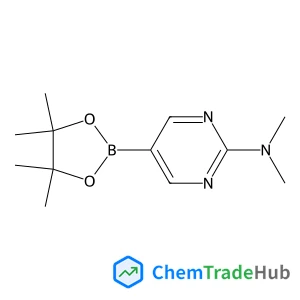
N,N-Dimethyl-5-(4,4,5,5-tetramethyl-1,3,2-dioxaborolan-2-yl)-2-pyrimidinamine
CAS Number:
1032759-30-0
Molecular Formula:
C12H20BN3O2
A. S. De León, S. Malhotra, M. Molina, A. Muñoz-Bonilla, J. Rodríguez-Hernández
Herein we report the preparation of honeycomb porous films for selective immobilization of biomolecules via the breath figure technique, a water-assisted micropatterning method. In particular, porous films are obtained from polymeric blends composed of high molecular weight polystyrene as the major component and an oligoglycerol based dendron covalently bonded to a hydrophobic polystyrene chain as the minor constituent. The multivalent dendritic architecture presents a well-defined molecular structure with controlled glycine arrays on their surfaces. Due to the mechanism of the breath figure formation, the resulting films exhibit an especial chemical distribution at the surfaces, in which the dendritic functional polymer is located preferentially in the interior of the pores while the rest of the polymer surface is mainly formed by the high molecular weight polystyrene. The high amount of amine functional groups inside the pores allowed the specific immobilization of biomolecules into the cavities by electrostatic interactions. In particular, the protein bovine serum albumin (BSA) and a DNA sequence were attached onto the films as a proof of concept. Besides, it was demonstrated that the density of biomolecules immobilized can be easily tuned by varying the content of the dendritic functional polymer in the film. These unique characteristics open new alternatives for the use of these platforms in biorelated applications including bio-recognition processes, or the understanding of cell–protein and even cell–DNA interactions on biofunctional microstructured polymeric supports.
Jhih-Siang Chen, Pin-Fan Chen, Hana Tzu-Han Lin
DOI: 10.1039/D0AN01201G
Naoya Jinno, Mari Murakami, Kiyoshi Mizohata, Masahiko Hashimoto, Kazuhiko Tsukagoshi
DOI: 10.1039/C0AN00820F
Xinwei Wei, Yuxiang Pan, Tao Liang, Ying Gan, Keqiang Gao, Yong Qiu
DOI: 10.1039/C9AY01592B
Masato Suzuki, Satoshi Arimoto, Tsuguhiro Korenaga, Tomoyuki Yasukawa
DOI: 10.1039/D0AN00100G
Duo Lin, Jiahui Zhou, Yun Yu, Weiwei Chen, Pei-Hsuan Liao, Hao Huang, Kien Voon Kong
DOI: 10.1039/C9AY01466G
Wenming Wu, Kieu The Loan Trinh, Nae Yoon Lee
DOI: 10.1039/C2AN35077G
Shingo Saito, Mitsuyoshi Kawashima, Hiroki Ohshima, Kazuki Enomoto, Makoto Sato, Hajime Yoshimura, Keitaro Yoshimoto, Mizuo Maeda, Masami Shibukawa
DOI: 10.1039/C3AN01107K
Stefano Materazzi, Patrizia Caprari, Giuseppina Gullifa, Sara Massimi, Elena Carcassi, Roberta Risoluti
DOI: 10.1039/D0AN00649A
When considering alternatives to 1-(4-Chlorophenyl)-N-hydroxymethanimine (CAS: 3...
This compound should be stored in a cool, dry place away from direct sunlight. I...
3-(4-Bromophenyl)-5-(2-fluorophenyl)-1,2,4-oxadiazole is synthesized through a m...
5-Chloro-2-(4-chlorophenyl)-4-methyl-6-[3-(1-piperidinyl)propoxy]pyrimidine (CAS...
2-Chloro-4-(difluoromethoxy)pyridine is used in the pharmaceutical industry for ...
3-Chloro-6-methylpyridazine (CAS: 1121-79-5) is classified under the Globally Ha...
Several alternatives can be used in the synthesis of Methyl 4,5-dimethyl-2-nitro...
Alternatives to (2E,2'E)-3,3'-(1,4-Phenylene)bisacrylaldehyde include other acry...
3-Amino-5-chloropyridin-2-ol hydrochloride is an organic compound with the CAS n...
When handling 6,7-Difluoro-2,3-dihydro-4H-chromen-4-one, it is essential to wear...

Polymer Chemistry welcomes submissions in all areas of polymer science that have a strong focus on macromolecular chemistry. Manuscripts may cover a broad range of fields, yet no direct application focus is required.