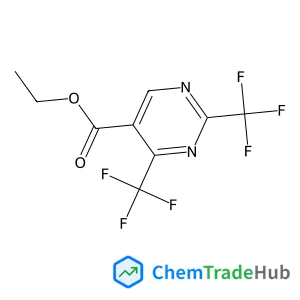
Ethyl 2,4-bis(trifluoromethyl)-5-pyrimidinecarboxylate
CAS Number:
188781-15-9
Molecular Formula:
C9H6F6N2O2
Yinan Cui, Xiuyu Jiang, Chun Feng, Guangxin Gu, Jie Xu, Xiaoyu Huang
Two well-defined double hydrophilic graft copolymers comprising a hydrophilic poly(2-hydroxyethyl acrylate) (PHEA) backbone and hydrophilic poly(N-isopropylacrylamide) (PNIPAM) side chains were synthesized by the combination of reversible addition–fragmentation chain transfer (RAFT) polymerization, single-electron-transfer living radical polymerization (SET-LRP), and a grafting-from strategy. A 2-hydroxyethyl 2-((2-chloropropanoyloxy)methyl)acrylate monomer containing an SET-LRP initiating group (–OCOCH(CH3)Cl) was first RAFT homopolymerized to provide a PHEA-based homopolymer bearing a Cl-containing SET-LRP initiating group in every repeated unit with a narrow molecular weight distribution (Mw/Mn = 1.17). This homopolymer directly initiated SET-LRP of N-isopropylacrylamide at ambient temperature to afford the desired well-defined poly(2-hydroxyethyl acrylate)-graft-poly(N-isopropylacrylamide) graft copolymers (Mw/Mn ≤ 1.33) with hydroxyl in every repeated unit of the backbone without polymeric functionality transformation. The thermo-responsive phase behavior of the obtained double hydrophilic graft copolymers was investigated by UV/vis spectroscopy, 1H NMR, and dynamic light scattering (DLS).

Journal of Chemical Sciences

Chinese Journal of Chemistry

Bioorganic & Medicinal Chemistry Letters

Colloid Journal

Heteroatom Chemistry

Electroanalysis

Acta Metallurgica Sinica-English Letters

Herald of the Russian Academy of Sciences

Bioorganic & Medicinal Chemistry

Journal of the Indian Institute of Science
Zongbao Li, Mingjie Feng, Bin Yan
DOI: 10.1039/D3TA04530G
Yu Shu, Ting Li, Naihua Miao, Jian Gou, Xiaochun Huang, Zhou Cui, Rui Xiong, Cuilian Wen, Jian Zhou, Baisheng Sa, Zhimei Sun
DOI: 10.1039/D3NH00450C
Mario Hofmann, Chi-Te Liang, Ya-Ping Hsieh
DOI: 10.1039/D3NH00420A
Mengyang Niu, Zheng Zhao, Baokai Wang, Chang Yu, Mengyi Li, Jiajun Hu, Lifeng Zhu, Xu Hao, Shiqin Wan, Ming Yue, Weiwei Xuan, Qipeng Lu, Wenbin Cao, Kexin Chen, Qi Wang
DOI: 10.1039/D3TA04770A
Chengwu Yang, Pattaraporn Woottapanit, Jin Cao, Yilei Yue, Dongdong Zhang, Jin Yi, Zhiyuan Zeng, Xinyu Zhang, Jiaqian Qin, Yonggang Wang
DOI: 10.1039/D3TA05650C
Zhihao Yang, Ying Yuan, Bin Wang, Xiaojun Shen, Xiluan Wang, Tong-Qi Yuan
DOI: 10.1039/D3TA04872A
Muhammad Kashif Naseem, Mian Azmat, Changliang Du, Rong Jiang, Hajra, Youqi Zhu, Meishuai Zou, Chuanbao Cao
DOI: 10.1039/D3TA04634F
Santhoshkumar Sundaramoorthy, Amitava Choudhury, Naresh C. Osti, Alexander I. Kolesnikov, Matthew B. Stone, Yongqiang Cheng
DOI: 10.1039/D3TA04479C
Pavel S. Slepov, Kristina E. Nikiruy
DOI: 10.1039/D3NH00421J
When handling lithium chloride hydrate (1:1:1) (CAS: 16712-20-2), it is importan...
4-(4H-1,2,4-Triazol-4-yl)piperidine is generally considered safe for use in phar...
Waste containing 1,3-Thiazole-2-carboxamide (CAS: 16733-85-0) should be collecte...
5-(Difluoromethyl)-2-fluorobenzonitrile (CAS: 934175-58-3) is subject to regulat...
Methyl 3-acetamido-2-thiophenecarboxylate can be synthesized by the reaction of ...
4-Isoquinolinecarbonitrile is a chemical compound with the CAS number 34846-65-6...
Store Methyl 1H-1,2,3-triazole-4-carboxylate (CAS: 877309-59-6) in a cool, dry p...
6-Bromo[1,3]thiazolo[5,4-b]pyridin-2-amine (CAS: 1160791-13-8) is subject to the...
(2S,3S)-2-Ammonio-3-(3,4-dihydroxyphenyl)-3-hydroxypropanoate (CAS: 23651-95-8) ...
7-Bromo-3-methyl-3,4-dihydroquinazolin-4-one is a solid with a crystalline form....

Polymer Chemistry welcomes submissions in all areas of polymer science that have a strong focus on macromolecular chemistry. Manuscripts may cover a broad range of fields, yet no direct application focus is required.
![[(2R)-6,6-Dimethyl-2-morpholinyl]methanol hydrochloride (1:1) structure](https://static.chemtradehub.com/structs/141/1416444-88-6-e06a.webp "[(2R)-6,6-Dimethyl-2-morpholinyl]methanol hydrochloride (1:1) structure")