












Catalyst-free iodine-mediated living radical polymerization under irradiation over a wide visible-light spectral scope
Literature Information
Publication Date
2016-04-25
DOI
10.1039/C6PY00444J
Impact Factor
5.582
Authors
Xiaodong Liu, Lifen Zhang, Zhenping Cheng, Xiulin Zhu
View Original
Abstract
Catalyst-free iodine-mediated living radical polymerization (LRP) employing the formation equilibrium between an alkyl iodide dormant species (Polymer-I) and a propagating radical (Polymer˙) over a wide visible light irradiation scope was studied with respect to its kinetics, mechanism and suitability. The polymerization of methyl methacrylate (MMA) or some functional methacrylates offered good control over the polymer molecular weights and distributions (Mw/Mn = 1.05–1.30) up to fairly high conversions (more than 95%). This polymerization system displayed instantaneous activation and deactivation in response to “on–off” switch of the irradiation source. The polymerization kinetic rate was sensitively modulated by tuning the irradiation wavelength. Attractive features of the developed polymerization system include the feasibility of use of irradiation in the visible light spectral scope, good polydispersity control, good tolerance to functional groups, satisfactory regulation over a wide range of wavelengths, environmental safety and external photo-irradiation response sensitivity. Sunlight was also proved to be an alternative illumination source for this iodine-mediated LRP.
Related Literature
Improvement of CO tolerance of proton exchange membrane (PEM) fuel cells by a pulsing technique
2000-11-02
Paper
DOI: 10.1039/B005843M
Distinguishing relaxation dynamics in transiently crosslinked polymeric networks
Ji Liu, Dominique Hoogland, Emma-Rose Janeček, Eric A. Appel, Oren A. Scherman
2017-06-28
Paper
DOI: 10.1039/C7PY00574A
Electrolyte composition and ionic mobility in micropores
Bertel Kastening, Matthias Heins
2000-10-27
Paper
DOI: 10.1039/B005206J
Reactions of Cl atoms with CH3I, C2H5I, 1-C3H7I, 2-C3H7I and CF3I: kinetics and atmospheric relevance
E. S. N. Cotter, N. J. Booth, C. E. Canosa-Mas, D. J. Gray, D. E. Shallcross, R. P. Wayne
2001-01-09
Paper
DOI: 10.1039/B007608M
The reactions of IO with HO2, NO and CH3SCH3: Flow tube studies of kinetics and product formation
Gary P. Knight, John N. Crowley
2001-01-08
Paper
DOI: 10.1039/B008447F
Cationic disulfide-functionalized worm gels
L. P. D. Ratcliffe, K. J. Bentley, R. Wehr, N. J. Warren, B. R. Saunders, S. P. Armes
2017-09-06
Paper
DOI: 10.1039/C7PY01306J
Synthesis of diblock copolymer nano-assemblies by PISA under dispersion polymerization: comparison between ATRP and RAFT
Ke Wang, Yixin Wang
2017-10-02
Paper
DOI: 10.1039/C7PY01618B
Controlling the melting transition of semi-crystalline self-assembled block copolymer aggregates: controlling release rates of ibuprofen
O. R. Monaghan, S. J. Holder
2017-08-03
Paper
DOI: 10.1039/C7PY01170A
A study of fused-ring thieno[3,4-e]pyrazine polymers as n-type materials for organic supercapacitors
Bryony T. McAllister, Tyler B. Schon, Paul M. DiCarmine, Dwight S. Seferos
2017-05-05
Paper
DOI: 10.1039/C7PY00512A
You might also like
Compound Q&A
Are there alternatives to 1-(4-Chlorophenyl)-N-hydroxymethanimine (CAS: 3848-36-0) in synthesis?
When considering alternatives to 1-(4-Chlorophenyl)-N-hydroxymethanimine (CAS: 3...
3848-36-01-(4-Chlorophenyl)-N...
Compound Q&A
How should (1R,9S,10S,12S,14E,16S,19R,20R,21S,22R)-3,9,21-Trihydroxy-5,10,12,14,16,20,22-heptamethyl-23,24-dioxatetracyclo[17.3.1.1~6,9~.0~2,7~]tetracosa-2,5,7,14-tetraen-4-one (CAS: 183202-73-5) be stored?
This compound should be stored in a cool, dry place away from direct sunlight. I...
183202-73-5(1R,9S,10S,12S,14E,1...
Compound Q&A
How is 3-(4-Bromophenyl)-5-(2-fluorophenyl)-1,2,4-oxadiazole (CAS: 419553-16-5) typically synthesized?
3-(4-Bromophenyl)-5-(2-fluorophenyl)-1,2,4-oxadiazole is synthesized through a m...
419553-16-53-(4-Bromophenyl)-5-...
Compound Q&A
How is 5-Chloro-2-(4-chlorophenyl)-4-methyl-6-[3-(1-piperidinyl)propoxy]pyrimidine (CAS: 1639220-19-1) typically synthesized?
5-Chloro-2-(4-chlorophenyl)-4-methyl-6-[3-(1-piperidinyl)propoxy]pyrimidine (CAS...
1639220-19-15-Chloro-2-(4-chloro...
Compound Q&A
What industries use 2-Chloro-4-(difluoromethoxy)pyridine (CAS: 1206978-15-5)?
2-Chloro-4-(difluoromethoxy)pyridine is used in the pharmaceutical industry for ...
1206978-15-52-Chloro-4-(difluoro...
Compound Q&A
What regulatory guidelines apply to 3-Chloro-6-methylpyridazine (CAS: 1121-79-5)?
3-Chloro-6-methylpyridazine (CAS: 1121-79-5) is classified under the Globally Ha...
1121-79-53-Chloro-6-methylpyr...
Compound Q&A
Are there alternatives to Methyl 4,5-dimethyl-2-nitrobenzoate in synthesis?
Several alternatives can be used in the synthesis of Methyl 4,5-dimethyl-2-nitro...
90922-74-0Methyl 4,5-dimethyl-...
Compound Q&A
Are there alternatives to (2E,2'E)-3,3'-(1,4-Phenylene)bisacrylaldehyde in synthesis?
Alternatives to (2E,2'E)-3,3'-(1,4-Phenylene)bisacrylaldehyde include other acry...
63405-68-5(2E,2'E)-3,3'-(1,4-P...
Compound Q&A
What is 3-Amino-5-chloropyridin-2-ol hydrochloride (CAS: 1261906-29-9)?
3-Amino-5-chloropyridin-2-ol hydrochloride is an organic compound with the CAS n...
1261906-29-93-Amino-5-chloropyri...
Compound Q&A
What precautions should be taken when handling 6,7-Difluoro-2,3-dihydro-4H-chromen-4-one (CAS: 1092349-93-3)?
When handling 6,7-Difluoro-2,3-dihydro-4H-chromen-4-one, it is essential to wear...
1092349-93-36,7-Difluoro-2,3-dih...
Source Journal
Polymer Chemistry

CiteScore:
8.6
Self-citation Rate:
7.3%
Articles per Year:
457
Polymer Chemistry welcomes submissions in all areas of polymer science that have a strong focus on macromolecular chemistry. Manuscripts may cover a broad range of fields, yet no direct application focus is required.
Recommended Compounds
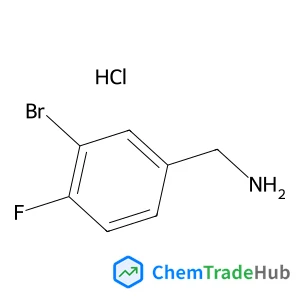
1-(3-Bromo-4-fluorophenyl)methanamine hydrochloride (1:1)
CAS Number:
202865-68-7
Molecular Formula:
C7H8BrClFN
Recommended Suppliers






Disclaimer
This page provides academic journal information for reference and research purposes only. We are not affiliated with any journal publishers and do not handle publication submissions. For publication-related inquiries, please contact the respective journal publishers directly.
If you notice any inaccuracies in the information displayed, please contact us at support@chemtradehub.com. We will promptly review and address your concerns.