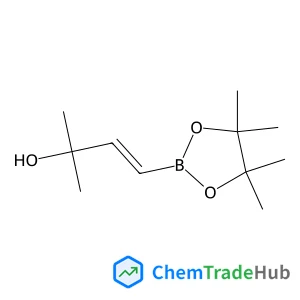
(E)-2-methyl-4-(4,4,5,5-tetramethyl-1,3,2-dioxaborolan-2-yl)but-3-en-2-ol
CAS Number:
581802-26-8
Molecular Formula:
C11H21BO3
Xiaohang Han, Yangguang Hu, Miao Tang, Huagao Fang, Qianghua Wu, Zhigang Wang
In this study a series of long chain branched polycarbonates (LCB-PCs) was prepared from linear PC precursors through gamma radiation with addition of a difunctional monomer, divinyl benzene (DVB) of varying amounts. The topological structures of the linear PCs and LCB-PCs were measured by size-exclusion chromatography coupled with a multiangle light scattering detector (SEC-MALLS) and rheology. SEC-MALLS measurements showed that the topological structures of the PCs were changed with the introduction of LCB structures. Rheological measurements showed that the LCB structures of the LCB-PCs contributed to enhancements of storage modulus, complex viscosity, shear-thinning behavior, and the deviation of phase angle, δ, from the “standard” curve of linear PCs in the δ − |G*| plots (van Gurp–Palmen plot). Modulated differential scanning calorimetry (MDSC) measurements showed that the glass transition temperature, Tg, of LCB-PCs decreases with increasing LCB degree, which is attributed to the combined effects of both increased branching density and free chain ends. LCB structures introduced into PCs did not apparently weaken the tensile properties of the PC materials, whereas the notched Izod impact strength could be obviously improved by the LCB structures. More importantly, the influence of LCB structures on the environmental stress cracking (ESC) behavior of LCB-PCs was explored and the results indicated that the ESC properties of LCB-PCs could be significantly enhanced with the introduction of LCB structures, which makes the application of LCB-PCs as the window view materials for helmets worn by astronauts while in outer space a possibility.
Ryo Kanzaki, Yasuhiro Umebayashi, Kenshi Uemura, Shin-ichi Ishiguro
DOI: 10.1039/B009132O
Lorenz Gubler, Günther G. Scherer, Alexander Wokaun
DOI: 10.1039/B007277J
Simon Kalvoda, Beate Paulus, Michael Dolg, Hermann Stoll, Hans-Joachim Werner
DOI: 10.1039/B007081P
J. Lacombe, C. Soulié-Ziakovic
DOI: 10.1039/C7PY01219E
Sofia Telitel, Benoît Éric Petit, Salomé Poyer, Laurence Charles, Jean-François Lutz
DOI: 10.1039/C7PY00496F
Zoe Terzopoulou, Elisavet Karakatsianopoulou, Nejib Kasmi, Vasileios Tsanaktsis, Nikolaos Nikolaidis, Margaritis Kostoglou, George Z. Papageorgiou, Dimitra A. Lambropoulou, Dimitrios N. Bikiaris
DOI: 10.1039/C7PY01171G
Feifei Xie, Wei Hu, Lei Ding, Ke Tian, Zhengchen Wu, Lei Li
DOI: 10.1039/C7PY01240C
G. Bartocci, G. Galiazzo, U. Mazzucato, A. Spalletti
DOI: 10.1039/B009107N
Marie A. F. Delgove, Juandré Luchies, Iris Wauters, Geert G. P. Deroover, Stefaan M. A. De Wildeman, Katrien V. Bernaerts
DOI: 10.1039/C7PY00976C
When considering alternatives to 1-(4-Chlorophenyl)-N-hydroxymethanimine (CAS: 3...
This compound should be stored in a cool, dry place away from direct sunlight. I...
3-(4-Bromophenyl)-5-(2-fluorophenyl)-1,2,4-oxadiazole is synthesized through a m...
5-Chloro-2-(4-chlorophenyl)-4-methyl-6-[3-(1-piperidinyl)propoxy]pyrimidine (CAS...
2-Chloro-4-(difluoromethoxy)pyridine is used in the pharmaceutical industry for ...
3-Chloro-6-methylpyridazine (CAS: 1121-79-5) is classified under the Globally Ha...
Several alternatives can be used in the synthesis of Methyl 4,5-dimethyl-2-nitro...
Alternatives to (2E,2'E)-3,3'-(1,4-Phenylene)bisacrylaldehyde include other acry...
3-Amino-5-chloropyridin-2-ol hydrochloride is an organic compound with the CAS n...
When handling 6,7-Difluoro-2,3-dihydro-4H-chromen-4-one, it is essential to wear...

Polymer Chemistry welcomes submissions in all areas of polymer science that have a strong focus on macromolecular chemistry. Manuscripts may cover a broad range of fields, yet no direct application focus is required.