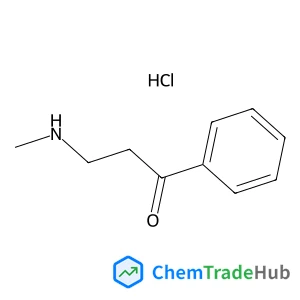
3-(Methylamino)-1-phenyl-1-propanone hydrochloride (1:1)
CAS Number:
2538-50-3
Molecular Formula:
C10H14ClNO
Baris Demir, Tiffany R. Walsh, Tom Welton
Correction for 'Determination of Kamlet–Taft parameters for selected solvate ionic liquids' by Daniel J. Eyckens et al., Phys. Chem. Chem. Phys., 2016, 18, 13153–13157.
L. A. Ferreira, V. N. Uversky, B. Y. Zaslavsky
DOI: 10.1039/C6CP08214A
Wook Lee, Spiridoula Matsika
DOI: 10.1039/C6CP05604K
Jennifer Wilcox, David W. Ball
DOI: 10.1039/C6CP07116C
M. Ziatdinov, H. Lim, S. Fujii, K. Kusakabe, M. Kiguchi, T. Enoki, Y. Kim
DOI: 10.1039/C6CP08352H
Pablo Gamallo, Sinan Akpinar, Paolo Defazio, Carlo Petrongolo
DOI: 10.1039/C6CP07756K
Dharmendar Kumar Sharma, Shuzo Hirata, Lukasz Bujak, Vasudevanpillai Biju, Tatsuya Kameyama, Marino Kishi, Tsukasa Torimoto, Martin Vacha
DOI: 10.1039/C6CP07550A
Arunkumar Kathiravan, Rajadurai Vijay Solomon
DOI: 10.1039/C6CP07768D
Tao Cheng, William A Goddard, III, Qi An, Hai Xiao, Boris Merinov, Sergey Morozov
DOI: 10.1039/C6CP08055C
Christof Drechsel-Grau, Dominik Marx
DOI: 10.1039/C6CP05679B
When handling 4-(2-Furylmethyl)thiomorpholine 1,1-dioxide (CAS: 79206-94-3), it ...
When handling 4-Chloro-N-[2-(4-morpholinyl)ethyl]benzamide (CAS: 71320-77-9), it...
Waste containing this compound (CAS: 62921-74-8) should be handled according to ...
Waste containing (S)-Methyl 2-amino-3-cyclohexylpropanoate should be collected i...
This compound can be synthesized using a multi-step process involving the conjug...
There are several alternatives to (2E)-3-(3,4-Dichlorophenyl)acrylic acid in syn...
Ethyl 6-(2-nitrophenyl)imidazo[2,1-b][1,3]thiazole-3-carboxylate (CAS: 925437-84...
Waste containing 2-(1,3-Thiazol-2-yl)ethanamine (CAS: 18453-07-1) should be coll...
Methyl 5-iodo-2-methylbenzoate can be synthesized through the iodination of meth...
5-Chloro[1,2,4]triazolo[1,5-a]pyridine is commonly synthesized via the condensat...

Physical Chemistry Chemical Physics (PCCP) is an international journal co-owned by 19 physical chemistry and physics societies from around the world. This journal publishes original, cutting-edge research in physical chemistry, chemical physics and biophysical chemistry. To be suitable for publication in PCCP, articles must include significant innovation and/or insight into physical chemistry; this is the most important criterion that reviewers and Editors will judge against when evaluating submissions. The journal has a broad scope and welcomes contributions spanning experiment, theory, computation and data science. Topical coverage includes spectroscopy, dynamics, kinetics, statistical mechanics, thermodynamics, electrochemistry, catalysis, surface science, quantum mechanics, quantum computing and machine learning. Interdisciplinary research areas such as polymers and soft matter, materials, nanoscience, energy, surfaces/interfaces, and biophysical chemistry are welcomed if they demonstrate significant innovation and/or insight into physical chemistry. Joined experimental/theoretical studies are particularly appreciated when complementary and based on up-to-date approaches.