












NMR of Na+, glycine and HDO in isotropic and anisotropic carrageenan gels
Literature Information
Publication Date
2010-06-01
DOI
10.1039/C0PY00038H
Impact Factor
5.582
Authors
Christoph Naumann, Philip William Kuchel
View Original
Abstract
The chemical-interaction environment of several gels made from carbohydrate polymers consisting of unmodified commercial-grade ι- and κ-carrageenan and varying in their NaCl and polysaccharide concentrations was studied by solution-state 1H, 2H, and 23Na NMR spectroscopy. All gels showed isotropic NMR spectra at low gel concentrations (1% ‘w/w’) inside 10 mm NMR tubes. Anisotropy was introduced by stretching the gels, and the degree of alignment depended on the extent of stretching as well as gel and NaCl concentration. For Na+ a strong binding component of the anisotropy in ι- and less in κ-carrageenan gels was found, in contrast to a partial binding of glycine, and a spatial and gel-concentration dependent anisotropic effect for deuterated water (HDO). This finding is explained by the possibility of electrostatic interaction between Na+ and ionic sulfate groups in the carrageenan polymer, HDO probably only interacts via hydrogen bonding, while glycine could interact by both means. The lifetime of bound Na+ is likely to be small but bigger than for hydrogen-bonded HDO; thus Na+ would be more exposed to the electric field gradient tensor (caused by stretching the gel) than HDO, resulting in larger anisotropic spectral splitting and explaining the strong NaCl-concentration dependence of 23Na+ NMR anisotropy, which was not evident with HDO in 2H NMR spectra.
Recommended Journals
Related Literature
Laser and electron beam-induced formation of Ag/Cr structures on Ag2CrO4
Lemos P. S., Silva G. S., Roca R. A., Assis M., Torres-Mendieta R., Beltrán-Mir H., Mínguez-Vega G., Cordoncillo E., Andrés J., Longo E.
2019-02-07
Paper
DOI: 10.1039/C8CP07263A
Infrared spectroscopic characterization of phosphate binding at the goethite–water interface
Stella Gypser, Peter Leinweber, Dirk Freese
2019-01-24
Paper
DOI: 10.1039/C8CP07168C
Electrical conductivity and oxygen diffusion behaviour of the (La0.8Sr0.2)0.95CrxFe1−xO3−δ (x = 0.3, 0.5 and 0.7) A-site deficient perovskites
Zonghao Shen, John A. Kilner, Stephen J. Skinner
2018-06-21
Paper
DOI: 10.1039/C8CP02797H
Effect of intermediate phases on the optical properties of PbI2-rich CH3NH3PbI3 organic–inorganic hybrid perovskite
Alonso W. P. Sanches, Marco A. T. da Silva, Neusmar J. A. Cordeiro, Alexandre Urbano, Sidney A. Lourenço
2019-02-11
Paper
DOI: 10.1039/C8CP06916F
An ab initio study of sensing applications of MoB2 monolayer: a potential gas sensor
Amreen Bano, Jyoti Krishna, Devendra K. Pandey, N. K. Gaur
2019-01-29
Paper
DOI: 10.1039/C8CP07038E
Extending the scope of the carbonyl facilitated triplet excited state towards visible light excitation
Shinaj K. Rajagopal, Nagaraj K., Somadrita Deb, Vinayak Bhat, Devika Sasikumar, Ebin Sebastian, Mahesh Hariharan
2018-06-18
Paper
DOI: 10.1039/C8CP01023D
A computational study on the electrified Pt(111) surface by the cluster model
2019-02-28
Paper
DOI: 10.1039/C8CP07241H
Bile acid derivative-based catanionic mixtures: versatile tools for superficial charge modulation of supramolecular lamellae and nanotubes
Maria Chiara di Gregorio, Emilia Severoni, Leana Travaglini, Marta Gubitosi, Simona Sennato, Francesco Mura, Carlos Redondo-Gómez, Aida Jover, Nicolae Viorel Pavel, Luciano Galantini
2018-06-26
Paper
DOI: 10.1039/C8CP02745E
You might also like
Compound Q&A
Is 6-(3-Fluorophenyl)picolinic acid (CAS: 887982-40-3) safe?
6-(3-Fluorophenyl)picolinic acid is generally considered safe for laboratory use...
887982-40-36-(3-Fluorophenyl)pi...
Compound Q&A
What industries use (3R)-3-Pyrrolidinol (CAS: 2799-21-5)?
(3R)-3-Pyrrolidinol is used in the pharmaceutical industry as a precursor for dr...
2799-21-5(3R)-3-Pyrrolidinol
Compound Q&A
What precautions should be taken when handling (4R,5R)-4,5-Diethoxycarbonyl-2,2-dimethyldioxolane (CAS: 59779-75-8)?
When handling (4R,5R)-4,5-Diethoxycarbonyl-2,2-dimethyldioxolane (CAS: 59779-75-...
59779-75-8(4R,5R)-4,5-Diethoxy...
Compound Q&A
How is 1-(6-Chloroimidazo[1,2-b]pyridazin-3-yl)ethanone (CAS: 90734-71-7) typically synthesized?
1-(6-Chloroimidazo[1,2-b]pyridazin-3-yl)ethanone is often synthesized via a mult...
90734-71-71-(6-Chloroimidazo[1...
Compound Q&A
What is the market or research trend for N-Ethyl-3,4-dimethylbenzylamine (CAS: 39180-83-1)?
The market for N-Ethyl-3,4-dimethylbenzylamine (CAS: 39180-83-1) remains steady,...
39180-83-1N-Ethyl-3,4-dimethyl...
Compound Q&A
What is Tert-butyl 3-(pyrrolidin-1-yl)azetidine-1-carboxylate (CAS: 1019008-21-9)?
Tert-butyl 3-(pyrrolidin-1-yl)azetidine-1-carboxylate is a chemical compound wit...
1019008-21-9Tert-butyl 3-(pyrrol...
Compound Q&A
What regulatory guidelines apply to 1-Bromo-3-chloro-2,4-dimethoxybenzene (CAS: 1228956-93-1)?
1-Bromo-3-chloro-2,4-dimethoxybenzene (CAS: 1228956-93-1) falls under the classi...
1228956-93-11-Bromo-3-chloro-2,4...
Compound Q&A
Is 8-Bromo-2-methyl-3,4-dihydroisoquinolin-1(2H)-one (CAS: 1368622-07-4) safe?
The safety of 8-Bromo-2-methyl-3,4-dihydroisoquinolin-1(2H)-one (CAS: 1368622-07...
1368622-07-48-Bromo-2-methyl-3,4...
Compound Q&A
Is Benzyl [(3S)-2,6-dioxo-3-piperidinyl]carbamate (CAS: 22785-43-9) safe?
Benzyl [(3S)-2,6-dioxo-3-piperidinyl]carbamate is generally safe when handled wi...
22785-43-9Benzyl [(3S)-2,6-dio...
Compound Q&A
How should 1-{[4-(4,4,5,5-Tetramethyl-1,3,2-dioxaborolan-2-yl)phenyl]sulfonyl}pyrrolidine (CAS: 928657-21-0) be stored?
1-{[4-(4,4,5,5-Tetramethyl-1,3,2-dioxaborolan-2-yl)phenyl]sulfonyl}pyrrolidine s...
928657-21-01-{[4-(4,4,5,5-Tetra...
Source Journal
Polymer Chemistry

CiteScore:
8.6
Self-citation Rate:
7.3%
Articles per Year:
457
Polymer Chemistry welcomes submissions in all areas of polymer science that have a strong focus on macromolecular chemistry. Manuscripts may cover a broad range of fields, yet no direct application focus is required.
Recommended Compounds
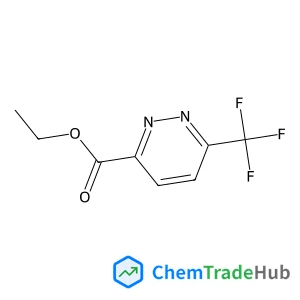
Ethyl 6-(trifluoromethyl)pyridazine-3-carboxylate
CAS Number:
1192155-06-8
Molecular Formula:
C8H7F3N2O2

Recommended Suppliers





Disclaimer
This page provides academic journal information for reference and research purposes only. We are not affiliated with any journal publishers and do not handle publication submissions. For publication-related inquiries, please contact the respective journal publishers directly.
If you notice any inaccuracies in the information displayed, please contact us at support@chemtradehub.com. We will promptly review and address your concerns.