


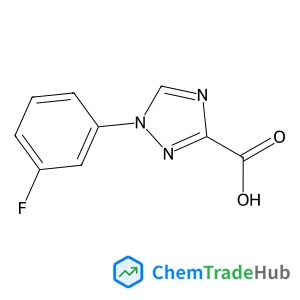
1-(3-Fluorophenyl)-1H-1,2,4-triazole-3-carboxylic acid
CAS Number:
1292369-51-7
Molecular Formula:
C9H6FN3O2
Diego Cortés-Arriagada, Nery Villegas-Escobar, Sebastián Miranda-Rojas, Alejandro Toro-Labbé
The interaction of formaldehyde (H2CO) onto Fe-doped graphene (FeG) was studied in detail from density functional theory calculations and electronic structure analyses. Our aim was to obtain insights into the adsorption, desorption and sensing properties of FeG towards H2CO, a hazardous organic compound. The adsorption of H2CO was shown to be energetically stable onto FeG, with adsorption energies of up to 1.45 eV and favored in different conformations. This interaction was determined to be mostly electrostatic in nature, where the oxygen plays an important role in this contribution; besides, our quantum molecular dynamics results showed the high stability of the FeG–H2CO interaction at ambient temperature (300 K). All the interactions were determined to be accompanied by an increase in the HOMO–LUMO energy gap with respect to the isolated adsorbent, indicating that FeG is highly sensitive to H2CO with respect to pristine graphene. Finally, it was found that external electric fields of 0.04–0.05 a.u. were able to induce the pollutant desorption from the adsorbent, allowing the adsorbent reactivation for repetitive applications. These results indicate that FeG could be a promising candidate for adsorption/sensing platforms of H2CO.

Medicinal Chemistry Research

Journal of Asian Natural Products Research

Journal of the Indian Institute of Science

Biocatalysis and Biotransformation

Polycyclic Aromatic Compounds

Colloid Journal

NDT & E International

Herald of the Russian Academy of Sciences

Bioorganic & Medicinal Chemistry

Heteroatom Chemistry
Ilaria Ciofini, Li Rao, Christian Amatore
DOI: 10.1039/C3CP54839B
Michael Kagan, Glenn K. Lockwood, Stephen H. Garofalini
DOI: 10.1039/C4CP00030G
David Ferro-Costas, Ángel Martín Pendás, Leticia González, Ricardo A. Mosquera
DOI: 10.1039/C4CP00431K
Yavar T. Azar, Mahmoud Payami
DOI: 10.1039/C4CP00598H
Hisato Yasumatsu, Nobuyuki Fukui
DOI: 10.1039/C4CP02221A
Benjamin G. Harvey, Heather A. Meylemans, Raina V. Gough, Roxanne L. Quintana, Michael D. Garrison, Thomas J. Bruno
DOI: 10.1039/C3CP55349C
Davide Carboni, Barbara Lasio, Valeria Alzari, Alberto Mariani, Danilo Loche, Maria F. Casula, Luca Malfatti, Plinio Innocenzi
DOI: 10.1039/C4CP03582H
Michael Marek Koza, Andreas Leithe-Jasper, Erik Sischka, Walter Schnelle, Horst Borrmann, Hannu Mutka, Yuri Grin
DOI: 10.1039/C4CP04097J
Valery G. Shtyrlin, Anvar Sh. Mukhtarov, Georgy V. Mamin, Siegfried Stapf, Carlos Mattea, Alexander A. Krutikov, Alexander N. Il'in, Nikita Yu. Serov
DOI: 10.1039/C4CP00255E
M. A. López-Quintela
DOI: 10.1039/C4CP02148G
Waste containing N-Methoxy-N-methyl-1,3-thiazole-5-carboxamide (CAS: 898825-89-3...
N-(4-Biphenylyl)dibenzo[b,d]furan-4-amine should be stored in a tightly sealed c...
The market for 3-Acetamido-5-amino-2,4,6-triiodobenzoic acid (CAS: 1713-07-1) is...
Benzyl 2-O-acetyl-3,4,6-tri-O-benzyl-beta-D-galactopyranoside (CAS: 61820-03-9) ...
2-Ethylpiperazine dihydrochloride (CAS: 438050-52-3) is regulated under the Glob...
1,1'-[1,3-Phenylenebis(methylene)]bis(3-methyl-1H-pyrrole-2,5-dione) (CAS: 11946...
Several alternatives can be used in the synthesis of 5-Fluoro-2-(1-pyrrolidinyl)...
Proper personal protective equipment (PPE) must be worn when handling this compo...
When handling 6-Bromoimidazo[1,2-a]pyridin-8-amine, it is important to wear appr...
Alternatives to (2S,4R)-4-(4-Nitrobenzyl)pyrrolidine-2-carboxylic acid hydrochlo...

Physical Chemistry Chemical Physics (PCCP) is an international journal co-owned by 19 physical chemistry and physics societies from around the world. This journal publishes original, cutting-edge research in physical chemistry, chemical physics and biophysical chemistry. To be suitable for publication in PCCP, articles must include significant innovation and/or insight into physical chemistry; this is the most important criterion that reviewers and Editors will judge against when evaluating submissions. The journal has a broad scope and welcomes contributions spanning experiment, theory, computation and data science. Topical coverage includes spectroscopy, dynamics, kinetics, statistical mechanics, thermodynamics, electrochemistry, catalysis, surface science, quantum mechanics, quantum computing and machine learning. Interdisciplinary research areas such as polymers and soft matter, materials, nanoscience, energy, surfaces/interfaces, and biophysical chemistry are welcomed if they demonstrate significant innovation and/or insight into physical chemistry. Joined experimental/theoretical studies are particularly appreciated when complementary and based on up-to-date approaches.
![tert-Butyl 6-chloro-4-oxospiro[chroman-2,4'-piperidine]-1'-carboxylate structure](https://static.chemtradehub.com/structs/101/1011482-37-3-88a5.webp "tert-Butyl 6-chloro-4-oxospiro[chroman-2,4'-piperidine]-1'-carboxylate structure")
![[(5-Methyl-1,3,4-thiadiazol-2-yl)sulfanyl]acetic acid structure](https://static.chemtradehub.com/structs/509/50918-26-8-4ce8.webp "[(5-Methyl-1,3,4-thiadiazol-2-yl)sulfanyl]acetic acid structure")





