












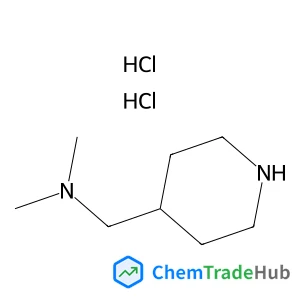
N,N-dimethyl(piperidin-4-yl)methanamine hydrochloride
CAS Number:
172281-72-0
Molecular Formula:
C8H20Cl2N2
Jia Lin Zhang, Tian Chao Niu, Andrew T. S. Wee
The controlled positioning and assembly of functional molecules into ordered nanostructures on surfaces depends on the interplay of multiple interactions on different strength and length scales. On metal surfaces, the relatively strong molecule–substrate interactions can constrain the molecules to adsorb in registry with the surface periodicity and lock them into specific adsorption sites. This can significantly reduce the structural tunability of the molecular nanostructure arrays formed. Inert graphite has a smooth potential-energy surface as well as relatively weak interfacial interactions with adsorbed molecules, and is therefore chosen as a supporting substrate for constructing molecular nanostructures with a high degree of controllability and tunability. The aim of this article is to highlight recent progress in the fabrication of self-assembled molecular nanostructures on inert graphite surfaces in ultra-high vacuum, with particular emphasis on the role of intermolecular interactions in the self-assembly process. We describe the formation of tunable two-dimensional (2D) binary molecular networks by directional and selective hydrogen bonding, as well as the templating effect of these 2D molecular networks, demonstrating the rational design and construction of long-range ordered 2D molecular nanostructures with desired functionality.
Yongnan Xiong, Xiaofan Li, Shifang Xiao, Huiqiu Deng, Bowen Huang, Wenjun Zhu, Wangyu Hu
DOI: 10.1039/C8CP06497K
Nina Auerhammer, Alexander Schulz, Alexander Schmiedel, Marco Holzapfel, Joscha Hoche, Roland Mitric, Christoph Lambert
DOI: 10.1039/C9CP00908F
Haiyan Xue, Ruifang Cao, Weihua Li
DOI: 10.1039/C9CP00227H
Subhasish Mallick, Amit Kumar, Pradeep Kumar
DOI: 10.1039/C8CP07536K
David L. Patrick, Cyrus Schaaf, Robell Morehouse, Brad L. Johnson
DOI: 10.1039/C9CP01238A
Daniel Reuter, Catharina Binder, Peter Lunkenheimer, Alois Loidl
DOI: 10.1039/C9CP00742C
David Semrouni, Hsiu-Wen Wang, Carolyn I. Pearce, Katharine Page, David J. Wesolowski, Andrew G. Stack
DOI: 10.1039/C8CP06802J
Dilek Yalcin, Calum J. Drummond, Tamar L. Greaves
DOI: 10.1039/C8CP05894F
Pavel Kocán, Barbara Pieczyrak, Leszek Jurczyszyn, Yoshihide Yoshimoto, Kazuma Yagyu, Hiroshi Tochihara, Takayuki Suzuki
DOI: 10.1039/C9CP01335K
Ethyl 4-chlorothieno[2,3-b]pyridine-5-carboxylate (CAS: 59713-58-5) can be synth...
5-Methyl-1H-indole-3-carbaldehyde (CAS: 52562-50-2) is subject to various regula...
(1,3-Dimethyl-2,4-dioxo-1,2,3,4-tetrahydro-5-pyrimidinyl)boronic acid is a white...
Waste containing Sulfocostunolide A (CAS: 1016983-51-9) should be handled with c...
When handling Murraxocin (CAS: 88478-44-8), ensure proper personal protective eq...
Formvar (CAS: 63148-64-1) is an alkyd resin characterized by a high molecular we...
(S)-4-benzyl-2-((benzyloxy)methyl)morpholine is generally safe when handled with...
Methyl 1-(5-bromo-2-pyrimidinyl)cyclopropanecarboxylate (CAS: 1447607-69-3) is p...
2-Methyl-1-phenyl-1-propanamine hydrochloride (CAS: 24290-47-9) is generally con...
3-(4-Bromophenyl)-2-methylpropanoic acid is synthesized through a multi-step pro...

Physical Chemistry Chemical Physics (PCCP) is an international journal co-owned by 19 physical chemistry and physics societies from around the world. This journal publishes original, cutting-edge research in physical chemistry, chemical physics and biophysical chemistry. To be suitable for publication in PCCP, articles must include significant innovation and/or insight into physical chemistry; this is the most important criterion that reviewers and Editors will judge against when evaluating submissions. The journal has a broad scope and welcomes contributions spanning experiment, theory, computation and data science. Topical coverage includes spectroscopy, dynamics, kinetics, statistical mechanics, thermodynamics, electrochemistry, catalysis, surface science, quantum mechanics, quantum computing and machine learning. Interdisciplinary research areas such as polymers and soft matter, materials, nanoscience, energy, surfaces/interfaces, and biophysical chemistry are welcomed if they demonstrate significant innovation and/or insight into physical chemistry. Joined experimental/theoretical studies are particularly appreciated when complementary and based on up-to-date approaches.
![9,9'-Spirobi[fluoren]-2-amine structure](https://static.chemtradehub.com/structs/118/118951-68-1-0d14.webp "9,9'-Spirobi[fluoren]-2-amine structure")
![Sodium 6-amino-3-[(E)-{4-[(E)-(4-aminophenyl)diazenyl]-2-methoxy-5-methylphenyl}diazenyl]-4-hydroxy-2-naphthalenesulfonate structure](https://static.chemtradehub.com/structs/294/2945-96-2-092f.webp "Sodium 6-amino-3-[(E)-{4-[(E)-(4-aminophenyl)diazenyl]-2-methoxy-5-methylphenyl}diazenyl]-4-hydroxy-2-naphthalenesulfonate structure")





