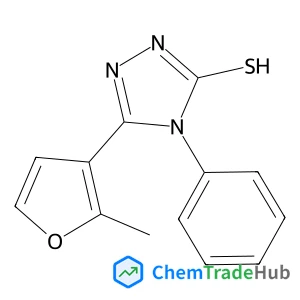
5-(2-Methyl-3-furyl)-4-phenyl-2,4-dihydro-3H-1,2,4-triazole-3-thione
CAS Number:
346464-59-3
Molecular Formula:
C13H11N3OS
Xiejun Xu, Xingqing Xiao, Shouhong Xu, Honglai Liu
Recent experiments in our lab (Phys. Chem. Chem. Phys., 2016, 18, 10129–10137) suggested using leucine zipper peptides to enhance the thermosensitivity of liposomes. To understand the mechanisms of temperature-responsive control by the leucine zipper peptide in liposomes, we firstly performed quantum mechanics calculations and implicit-solvent replica exchange molecular dynamics simulations to study the thermo-stability of two leucine zipper peptides, CH3(CH2)4–CO–[VAQLEVK-VAQLESK-VSKLESK-VSSLESK] (termed the capped peptide) and A-[VAQLEVK-VAQLESK-VSKLESK-VSSLESK] (termed the ALA peptide). The analysis of dihedral angle principal components and protein secondary structures was conducted to determine the temperature-dependence conformation transition of the two peptides. Simulation results revealed that our computed transition temperature of the capped peptide is 319.1 K that accords with experimental measurement, 321.1 K. Later, explicit-solvent conventional molecular dynamics simulations were carried out to examine the process of folding and unfolding of the ALA and capped peptides complexed with a lipid bilayer and water in the vicinity of their transition temperatures. A further analysis of conformation and energy of the folded peptides showed that the increase of temperature gives rise to a notable decrease in the number of intra-chain hydrogen bonds and a significant increase in the potential energy of the peptides, thereby reducing the folding stability of the two peptides. As compared to the ALA peptide, a lower transition temperature caused by less intra-chain hydrogen bonds was observed in the capped peptide, which is closer to the temperature of tumor cells. This fact suggests that the capped peptide is more suitable to produce highly sensitive liposomes for the delivery of cancer drugs.
Lisa K. Knight, V. Nicholas Vukotic, Elizabeth Viljoen, Christopher B. Caputo, Stephen J. Loeb
DOI: 10.1039/B911889F
Junji Kobayashi, Yuya Domoto, Takayuki Kawashima
DOI: 10.1039/B909881J
Gang Zou, Hao Jiang, Hideki Kohn, Takaaki Manaka, Mitsumasa Iwamoto
DOI: 10.1039/B909085A
Xin Shu, Zhe An, Lianying Wang, Jing He
DOI: 10.1039/B909301J
Xiaoru Zhang, Huanran Zhou, Caifeng Ding, Shusheng Zhang
DOI: 10.1039/B907844D
Le-Le Li, Wen-Tao Duan, Quan Yuan, Zhen-Xing Li, Hao-Hong Duan, Chun-Hua Yan
DOI: 10.1039/B912495K
Huifang-Jie Li, De-Hui Wang, Liang-Jun Zhou, Li Li, Xin Gan, Quan-Qing Xu, Hai-Bin Song
DOI: 10.1039/B906910K
Nicolas A. Uhlich, Peter Sommer, Claudia Bühr, Stefan Schürch, Jean-Louis Reymond, Tamis Darbre
DOI: 10.1039/B912291E
Shengqing Ye, Ke Gao, Haibo Zhou, Xiaodi Yang
DOI: 10.1039/B909178E
When handling lithium chloride hydrate (1:1:1) (CAS: 16712-20-2), it is importan...
4-(4H-1,2,4-Triazol-4-yl)piperidine is generally considered safe for use in phar...
Waste containing 1,3-Thiazole-2-carboxamide (CAS: 16733-85-0) should be collecte...
5-(Difluoromethyl)-2-fluorobenzonitrile (CAS: 934175-58-3) is subject to regulat...
Methyl 3-acetamido-2-thiophenecarboxylate can be synthesized by the reaction of ...
4-Isoquinolinecarbonitrile is a chemical compound with the CAS number 34846-65-6...
Store Methyl 1H-1,2,3-triazole-4-carboxylate (CAS: 877309-59-6) in a cool, dry p...
6-Bromo[1,3]thiazolo[5,4-b]pyridin-2-amine (CAS: 1160791-13-8) is subject to the...
(2S,3S)-2-Ammonio-3-(3,4-dihydroxyphenyl)-3-hydroxypropanoate (CAS: 23651-95-8) ...
7-Bromo-3-methyl-3,4-dihydroquinazolin-4-one is a solid with a crystalline form....

Physical Chemistry Chemical Physics (PCCP) is an international journal co-owned by 19 physical chemistry and physics societies from around the world. This journal publishes original, cutting-edge research in physical chemistry, chemical physics and biophysical chemistry. To be suitable for publication in PCCP, articles must include significant innovation and/or insight into physical chemistry; this is the most important criterion that reviewers and Editors will judge against when evaluating submissions. The journal has a broad scope and welcomes contributions spanning experiment, theory, computation and data science. Topical coverage includes spectroscopy, dynamics, kinetics, statistical mechanics, thermodynamics, electrochemistry, catalysis, surface science, quantum mechanics, quantum computing and machine learning. Interdisciplinary research areas such as polymers and soft matter, materials, nanoscience, energy, surfaces/interfaces, and biophysical chemistry are welcomed if they demonstrate significant innovation and/or insight into physical chemistry. Joined experimental/theoretical studies are particularly appreciated when complementary and based on up-to-date approaches.
![8-Bromo-6-fluoro[1,2,4]triazolo[1,5-a]pyridin-2-amine structure](https://static.chemtradehub.com/structs/125/1257705-51-3-9f4a.webp "8-Bromo-6-fluoro[1,2,4]triazolo[1,5-a]pyridin-2-amine structure")