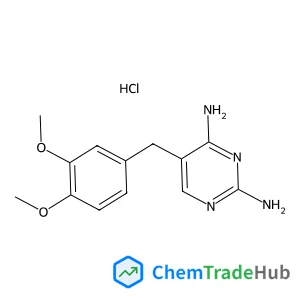
5-(3,4-Dimethoxybenzyl)-2,4-pyrimidinediamine hydrochloride (1:1)
CAS Number:
2507-23-5
Molecular Formula:
C13H17ClN4O2
Yi-Jung Tu, Matthew J. Allen, G. Andrés Cisneros
The dynamics of ligand exchange on lanthanide ions is important for catalysis and organic reactions. Recent 17O-NMR experiments have shown that water-exchange rates of lanthanide ions in water/1-ethyl-3-methylimidazolium ethyl sulfate (water/[EMIm][EtSO4]) increase as a function of increasing charge density. The trend of water-exchange rates in this solvent is opposite to that observed in water. Since the lanthanide ions and ionic liquids investigated in that work were highly charged, an advanced polarizable potential is desirable for accurate simulations. To this end, we have developed atomic multipole optimized energetics for biomolecular applications (AMOEBA) parameters for all lanthanides and [EMIm][EtSO4], and molecular dynamics simulations with the optimized parameters have been carried out to provide possible explanations for these observed behaviors from the experiments. In water, the association of a water molecule with the first hydration shell can lead to water exchange. Smaller lanthanide ions exhibit slower water-exchange rates than larger ones because they form smaller aqua complexes, preventing the binding of incoming water molecules from the outer hydration shells. By contrast, smaller lanthanide ions undergo faster water exchange in water/[EMIm][EtSO4] because the dissociation of a water molecule is a key step for water-exchange events in this solvent. The first shell [EtSO4]− anions bind closer to the smaller lanthanide ions, resulting in more steric crowding effects on the surrounding water and facilitating the release of water molecules.
Hirohisa Todo, Jun Terao, Hideyuki Watanabe, Hitoshi Kuniyasu, Nobuaki Kambe
DOI: 10.1039/B716678H
Thomas Rehm, Carsten Schmuck
DOI: 10.1039/B710951M
Othman Bouloussa
DOI: 10.1039/B716026G
Dejun Xiong, Mingliang Chen, Haibing Li
DOI: 10.1039/B716270G
Laurent El Kaïm, Rocio Gamez-Montaño, Laurence Grimaud, Tannya Ibarra-Rivera
DOI: 10.1039/B716849G
Pradeep S. Pallan, Damian Ittig, Annie Héroux, Zdzislaw Wawrzak, Christian J. Leumann, Martin Egli
DOI: 10.1039/B716390H
Tianming Zuo, Kenneth Walker, Marilyn M. Olmstead, Frederic Melin, Brian C. Holloway, Luis Echegoyen, Harry C. Dorn, Manuel N. Chaur, Christopher J. Chancellor, Christine M. Beavers, Alan L. Balch, Andreas J. Athans
DOI: 10.1039/B716037B
Anupama Ranganathan, Abdelkrim El-Ghayoury, Cécile Mézière, Etienne Harté, Rodolphe Clérac, Patrick Batail
DOI: 10.1039/B600159A
Ezequiel Perez-Inestrosa, Jose-María Montenegro, Daniel Collado, Rafael Suau
DOI: 10.1039/B717690B
When considering alternatives to 1-(4-Chlorophenyl)-N-hydroxymethanimine (CAS: 3...
This compound should be stored in a cool, dry place away from direct sunlight. I...
3-(4-Bromophenyl)-5-(2-fluorophenyl)-1,2,4-oxadiazole is synthesized through a m...
5-Chloro-2-(4-chlorophenyl)-4-methyl-6-[3-(1-piperidinyl)propoxy]pyrimidine (CAS...
2-Chloro-4-(difluoromethoxy)pyridine is used in the pharmaceutical industry for ...
3-Chloro-6-methylpyridazine (CAS: 1121-79-5) is classified under the Globally Ha...
Several alternatives can be used in the synthesis of Methyl 4,5-dimethyl-2-nitro...
Alternatives to (2E,2'E)-3,3'-(1,4-Phenylene)bisacrylaldehyde include other acry...
3-Amino-5-chloropyridin-2-ol hydrochloride is an organic compound with the CAS n...
When handling 6,7-Difluoro-2,3-dihydro-4H-chromen-4-one, it is essential to wear...

Physical Chemistry Chemical Physics (PCCP) is an international journal co-owned by 19 physical chemistry and physics societies from around the world. This journal publishes original, cutting-edge research in physical chemistry, chemical physics and biophysical chemistry. To be suitable for publication in PCCP, articles must include significant innovation and/or insight into physical chemistry; this is the most important criterion that reviewers and Editors will judge against when evaluating submissions. The journal has a broad scope and welcomes contributions spanning experiment, theory, computation and data science. Topical coverage includes spectroscopy, dynamics, kinetics, statistical mechanics, thermodynamics, electrochemistry, catalysis, surface science, quantum mechanics, quantum computing and machine learning. Interdisciplinary research areas such as polymers and soft matter, materials, nanoscience, energy, surfaces/interfaces, and biophysical chemistry are welcomed if they demonstrate significant innovation and/or insight into physical chemistry. Joined experimental/theoretical studies are particularly appreciated when complementary and based on up-to-date approaches.