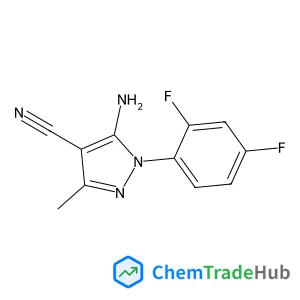
5-Amino-1-(2,4-difluorophenyl)-3-methyl-1H-pyrazole-4-carbonitrile
CAS Number:
1020057-92-4
Molecular Formula:
C11H8F2N4
Asif Iqbal, Md. Sazzad Hossain, Kirk H. Bevan
In this work, we present a theoretical study of surface state occupation statistics at semiconductor–liquid interfaces, as it pertains to the evolution of H2 and O2 through water splitting. Our approach combines semiclassical charge transport and electrostatics at the semiconductor–liquid junction, with a master rate equation describing surface state mediated electron/hole transfer. As a model system we have studied the TiO2–water junction in the absence of illumination, where it is shown that surface states might not always equilibrate with the semiconductor. Non-trivial electrostatics, for example including a shifting of the Mott–Schottky plateau in capacitive measurements, are explored when deep-level surface states partially equilibrate with the liquid. We also endeavor to explain observations of non-linearity present in Mott–Schottky plots, as they pertain to surface state occupation statistics. In general, it is intended that the results of this work will serve to further the use and development of quantitative device modeling techniques in the description of H2 evolution at semiconductor–liquid junctions.
Wenliang Wang, Daodao Hu, Jian Lü
DOI: 10.1039/C3CP51275D
Ju-Won Jeon, Yuguang Ma, Jared F. Mike, Lin Shao, Perla B. Balbuena, Jodie L. Lutkenhaus
DOI: 10.1039/C3CP51620B
Jose Tharun, George Mathai, Roshith Roshan, Amal Cherian Kathalikkattil, Kim Bomi, Dae-Won Park
DOI: 10.1039/C3CP51158H
Michiel J. J. Coenen, Duncan den Boer, Fieke J. van den Bruele, Thomas Habets, Koen A. A. M. Timmers, Minko van der Maas, Tony Khoury, Dwi Panduwinata, Maxwell J. Crossley, Jeffrey R. Reimers, Willem J. P. van Enckevort, Bas L. M. Hendriksen, Johannes A. A. W. Elemans, Sylvia Speller
DOI: 10.1039/C3CP50829C
Dan Bai, Andrew C. Benniston, Jerry Hagon, Helge Lemmetyinen, Nikolai V. Tkachenko, Ross W. Harrington
DOI: 10.1039/C3CP50173F
Cheng-Tar Wu, Jin Qu, Joseph Elliott, Kai Man Kerry Yu, Shik Chi Edman Tsang
DOI: 10.1039/C3CP51619A
Christopher W. Harmon, Christopher R. Ruehl, Christopher D. Cappa, Kevin R. Wilson
DOI: 10.1039/C3CP50347J
Sumio Kaizaki, Dai Shirotani, Hisako Sato
DOI: 10.1039/C3CP50509J
Aidi Zhao, Shijing Tan, Bin Li, Bing Wang, Jinlong Yang, J. G. Hou
DOI: 10.1039/C3CP51446C
Ethyl 4-chlorothieno[2,3-b]pyridine-5-carboxylate (CAS: 59713-58-5) can be synth...
5-Methyl-1H-indole-3-carbaldehyde (CAS: 52562-50-2) is subject to various regula...
(1,3-Dimethyl-2,4-dioxo-1,2,3,4-tetrahydro-5-pyrimidinyl)boronic acid is a white...
Waste containing Sulfocostunolide A (CAS: 1016983-51-9) should be handled with c...
When handling Murraxocin (CAS: 88478-44-8), ensure proper personal protective eq...
Formvar (CAS: 63148-64-1) is an alkyd resin characterized by a high molecular we...
(S)-4-benzyl-2-((benzyloxy)methyl)morpholine is generally safe when handled with...
Methyl 1-(5-bromo-2-pyrimidinyl)cyclopropanecarboxylate (CAS: 1447607-69-3) is p...
2-Methyl-1-phenyl-1-propanamine hydrochloride (CAS: 24290-47-9) is generally con...
3-(4-Bromophenyl)-2-methylpropanoic acid is synthesized through a multi-step pro...

Physical Chemistry Chemical Physics (PCCP) is an international journal co-owned by 19 physical chemistry and physics societies from around the world. This journal publishes original, cutting-edge research in physical chemistry, chemical physics and biophysical chemistry. To be suitable for publication in PCCP, articles must include significant innovation and/or insight into physical chemistry; this is the most important criterion that reviewers and Editors will judge against when evaluating submissions. The journal has a broad scope and welcomes contributions spanning experiment, theory, computation and data science. Topical coverage includes spectroscopy, dynamics, kinetics, statistical mechanics, thermodynamics, electrochemistry, catalysis, surface science, quantum mechanics, quantum computing and machine learning. Interdisciplinary research areas such as polymers and soft matter, materials, nanoscience, energy, surfaces/interfaces, and biophysical chemistry are welcomed if they demonstrate significant innovation and/or insight into physical chemistry. Joined experimental/theoretical studies are particularly appreciated when complementary and based on up-to-date approaches.