


Photocycloaddition reaction of atropisomeric maleimides: mechanism and selectivity
Literature Information
Publication Date
2016-08-16
DOI
10.1039/C6CP04919B
Impact Factor
3.676
Authors
Xue-Ping Chang, Yiying Zheng, Ganglong Cui, Wei-Hai Fang, Walter Thiel
View Original
Abstract
We report a density functional study on the mechanism of the [2+2] photocyclization of atropisomeric maleimides. Experimentally, the reaction is known to proceed through the triplet state. We have located all relevant S0 and T1 minima and transition states, as well as the T1/S0 crossing points, and mapped eight stepwise photocyclization pathways for four different conformers in the T1 state that lead to distinct regioisomers. In the preferred four pathways (one for each conformer) the initially formed C–C bond involves the terminal carbon atom of the alkene moiety. This regioselectivity originates from electrostatic preferences (arising from the charge distribution in the polarized CC double bonds) and from the different thermodynamic stability of the resulting triplet diradical intermediates (caused by electron donation effects that stabilize the radical centers). The formation of the second C–C bond is blocked in the T1 state by prohibitively high barriers and thus occurs after intersystem crossing to the ground state. Furthermore, we rationalize substitution effects on enantioselectivity and diastereoselectivity and identify their origin.
Recommended Journals

Physical Chemistry Chemical Physics

Lab on a Chip

Current Pharmaceutical Biotechnology

Photochemical & Photobiological Sciences

CrystEngComm

Angewandte Chemie International Edition

Journal of Enzyme inhibition and Medicinal Chemistry

Faraday Discussions

Advanced Engineering Materials

Journal of Medical Biochemistry
Related Literature
Mycoprotein: production and nutritional aspects: a review
Reshab Majumder, Saptadip Miatur, Akash Saha, Shamim Hossain
2023-11-17
Review Article
DOI: 10.1039/D3FB00169E
Bias switchable narrowband/broadband NIR organic photodetector fabricated with a scalable technique
Lai-Hung Lai, Wei-Hsiang Lin, Chin-Chuan Hsieh, Maria Antonietta Loi
2023-09-11
Paper
DOI: 10.1039/D3LF00089C
Co-Al-CO3 layered double hydroxide: an efficient and regenerable catalyst for glycolysis of polyethylene terephthalate
Rakesh Ranjan, Benny Kattikanal George
2023-10-16
Paper
DOI: 10.1039/D3SU00304C
Optimization of Pavlova gyrans biomass production and the fatty acid profile using a two-step approach
Filipe Maciel, Hugo Pereira, Joana Silva
2023-09-25
Paper
DOI: 10.1039/D3FB00110E
Effect of chloride salts and microwaves on polyethylene terephthalate (PET) hydrolysis by iron chloride/acetic acid Lewis/Brønsted acidic deep eutectic solvent
Marco Rollo, Massimo A. G. Perini, Alessandro Sanzone, Lorenzo Polastri, Matteo Tiecco, Alejandro Torregrosa-Chinillach, Elisa Martinelli, Gianluca Ciancaleoni
2023-11-21
Paper
DOI: 10.1039/D3SU00205E
The effects of lignin source and extraction on the composition and properties of biorefined depolymerization products
Natalia Obrzut, Rob Hickmott, Lily Shure, Kimberly A. Gray
2023-10-27
Paper
DOI: 10.1039/D3SU00262D
You might also like
Compound Q&A
Is 2-(2-chloroacetamido)-3-phenylpropanoic acid (CAS: 7765-11-9) safe?
2-(2-Chloroacetamido)-3-phenylpropanoic acid (CAS: 7765-11-9) is generally consi...
7765-11-92-(2-chloroacetamido...
Compound Q&A
Is 2-(Benzyloxy)-5-bromobenzoic acid (CAS: 62176-31-2) safe?
2-(Benzyloxy)-5-bromobenzoic acid can be handled safely if appropriate precautio...
62176-31-22-(Benzyloxy)-5-brom...
Compound Q&A
What is (4-Methyl-1,2,5-oxadiazol-3-yl)methanamine hydrochloride (CAS: 1159825-48-5)?
(4-Methyl-1,2,5-oxadiazol-3-yl)methanamine hydrochloride is a chemical compound ...
1159825-48-5(4-Methyl-1,2,5-oxad...
Compound Q&A
What is 2-(5-Hexylthiophen-2-yl)-4,4,5,5-tetramethyl-1,3,2-dioxaborolane (CAS: 917985-54-7)?
2-(5-Hexylthiophen-2-yl)-4,4,5,5-tetramethyl-1,3,2-dioxaborolane (CAS: 917985-54...
917985-54-72-(5-Hexylthiophen-2...
Compound Q&A
Are there alternatives to 4-(8-Methyl-9H-1,3-dioxolo[4,5-h][2,3]benzodiazepin-5-yl)benzenamine (CAS: 102771-26-6) in synthesis?
While 4-(8-Methyl-9H-1,3-dioxolo[4,5-h][2,3]benzodiazepin-5-yl)benzenamine (CAS:...
102771-26-64-(8-Methyl-9H-1,3-d...
Compound Q&A
What is the market or research trend for tert-butyl 3-hydroxy-4,5,7,8-tetrahydro-2H-pyrazolo[3,4-d]azepine-6-carboxylate (CAS: 851376-80-2)?
The market for tert-butyl 3-hydroxy-4,5,7,8-tetrahydro-2H-pyrazolo[3,4-d]azepine...
851376-80-2tert-butyl 3-hydroxy...
Compound Q&A
How should waste containing 3,5-Diamino-1H-pyrazole-4-carbonitrile (CAS: 6844-58-2) be handled?
Waste containing 3,5-Diamino-1H-pyrazole-4-carbonitrile (CAS: 6844-58-2) should ...
6844-58-23,5-Diamino-1H-pyraz...
Compound Q&A
How is (6-Fluoro-3-pyridinyl)boronic acid (CAS: 351019-18-6) typically synthesized?
(6-Fluoro-3-pyridinyl)boronic acid can be synthesized through the reaction of 6-...
351019-18-6(6-Fluoro-3-pyridiny...
Compound Q&A
What industries use Dibenzyl carbonimidoylbiscarbamate (CAS: 10065-79-9)?
Dibenzyl carbonimidoylbiscarbamate (CAS: 10065-79-9) finds applications in vario...
10065-79-9Dibenzyl carbonimido...
Compound Q&A
What is the market or research trend for (beta,beta,2,3,4,5,6-~2~H_7_)Phenylalanine (CAS: 74228-83-4)?
The market for (beta,beta,2,3,4,5,6-~2~H_7_)Phenylalanine (CAS: 74228-83-4) is g...
74228-83-4(beta,beta,2,3,4,5,6...
Source Journal
Physical Chemistry Chemical Physics
CiteScore:
5.5
Self-citation Rate:
10.3%
Articles per Year:
3036
Physical Chemistry Chemical Physics (PCCP) is an international journal co-owned by 19 physical chemistry and physics societies from around the world. This journal publishes original, cutting-edge research in physical chemistry, chemical physics and biophysical chemistry. To be suitable for publication in PCCP, articles must include significant innovation and/or insight into physical chemistry; this is the most important criterion that reviewers and Editors will judge against when evaluating submissions. The journal has a broad scope and welcomes contributions spanning experiment, theory, computation and data science. Topical coverage includes spectroscopy, dynamics, kinetics, statistical mechanics, thermodynamics, electrochemistry, catalysis, surface science, quantum mechanics, quantum computing and machine learning. Interdisciplinary research areas such as polymers and soft matter, materials, nanoscience, energy, surfaces/interfaces, and biophysical chemistry are welcomed if they demonstrate significant innovation and/or insight into physical chemistry. Joined experimental/theoretical studies are particularly appreciated when complementary and based on up-to-date approaches.
Recommended Compounds
![Ethyl thieno[3,2-f]quinoline-2-carboxylate structure](https://static.chemtradehub.com/structs/299/29948-26-3-f62b.webp "Ethyl thieno[3,2-f]quinoline-2-carboxylate structure")
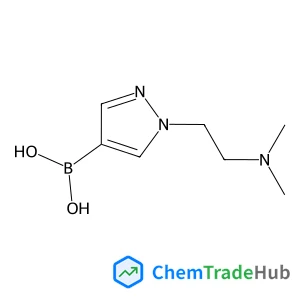
(1-(2-(Dimethylamino)ethyl)-1H-pyrazol-4-yl)boronic acid
CAS Number:
1086063-73-1
Molecular Formula:
C7H14BN3O2
Recommended Suppliers





Disclaimer
This page provides academic journal information for reference and research purposes only. We are not affiliated with any journal publishers and do not handle publication submissions. For publication-related inquiries, please contact the respective journal publishers directly.
If you notice any inaccuracies in the information displayed, please contact us at support@chemtradehub.com. We will promptly review and address your concerns.