












EPR characterization of Mn(ii) complexes for distance determination with pulsed dipolar spectroscopy
Literature Information
Publication Date
2016-08-16
DOI
10.1039/C6CP04884F
Impact Factor
3.676
Authors
Katharina Keller, Mian Qi, Vanessa Koch, Julia Wegner, Henrik Hintz, Adelheid Godt, Gunnar Jeschke, Anton Savitsky, Maxim Yulikov
View Original
Abstract
The four Mn(II) complexes Mn-DOTA, Mn-TAHA, Mn-PyMTA, and Mn-NO3Py were characterized by electron paramagnetic resonance (EPR), electron–nuclear double resonance (ENDOR), and relaxation measurements, to predict their relative performance in the EPR pulse dipolar spectroscopy (PDS) experiments. High spin density localization on the metal ions was proven by ENDOR on 1H, D, 14N, and 55Mn nuclei. The transverse relaxation of the Mn(II) complexes appears to be slow enough for PDS-based spin–spin distance determination. Rather advantageous ratios of T1/Tm were measured allowing for good relaxation induced dipolar modulation enhancement (RIDME) performance and, in general, fast shot repetitions in any PDS experiment. Relaxation properties of the Mn(II) complexes correlate with the strengths of their zero field splitting (ZFS). Further, a comparison of Mn(II)-DOTA and Gd(III)-DOTA based spin labels is presented. The RIDME technique to measure nanometer-range Mn(II)–Mn(II) distances in biomolecules is discussed as an alternative to the well-known DEER technique that often appears challenging in cases of metal–metal distance measurements. The use of a modified kernel function that includes dipolar harmonic overtones allows model-free computation of the Mn(II)–Mn(II) distance distributions. Mn(II)–Mn(II) distances are computed from RIDME data of Mn-rulers consisting of two Mn-PyMTA complexes connected by a rodlike spacer of defined length. Level crossing effects seem to have only a weak influence on the distance distributions computed from this set of Mn(II)–Mn(II) RIDME data.
Related Literature
Discrimination of cryptochirality in chiral isotactic polystyrene by asymmetric autocatalysis
Christiane Hohberger, Yuko Araki, Kunihiko Hatase, Klaus Beckerle, Jun Okuda
2009-08-21
Communication
DOI: 10.1039/B912813A
Palladium-catalysed arylative cyclisation of N-allylacetamides with aryl halides yielding benzyl-substituted oxazolines‡
Daishi Fujino, Sayuri Hayashi, Hideki Yorimitsu, Koichiro Oshima
2009-09-03
Communication
DOI: 10.1039/B912895F
Dialysis process for the removal of surfactants to form colloidal mesoporous silica nanoparticles
Chihiro Urata, Yuko Aoyama, Akihisa Tonegawa, Kazuyuki Kuroda
2009-07-29
Communication
DOI: 10.1039/B908625K
Stable silver nanoparticle–DNA conjugates for directed self-assembly of core-satellite silver–gold nanoclusters
Suchetan Pal, Jaswinder Sharma, Hao Yan, Yan Liu
2009-08-25
Communication
DOI: 10.1039/B911069K
Charge photogeneration in polythiophene–perylene diimide blend films
Safa Shoaee, Zesheng An, Xuan Zhang, Stephen Barlow, Seth R. Marder, Warren Duffy, James R. Durrant
2009-07-29
Communication
DOI: 10.1039/B909071A
Catalytic membrane-installed microchannel reactors for one-second allylic arylation
Yoichi M. A. Yamada, Kaoru Torii
2009-08-18
Communication
DOI: 10.1039/B912696A
Barriers to enantiocontrol in Lewis acid catalyzed hetero-Diels–Alder reactions‡
Xiaochen Wang, Zhuoyan Li, Michael P. Doyle
2009-08-26
Communication
DOI: 10.1039/B913019E
A dicopper complex chemiluminescence probe for the determination of thiols in the extracts of murine P388 lymphocytic leukemia cell
Xiaoru Zhang, Huanran Zhou, Caifeng Ding, Shusheng Zhang
2009-08-18
Communication
DOI: 10.1039/B907844D
Solid-phase synthesis of homodimeric peptides: preparation of covalently-linked dimers of amyloid β peptide
John A. Karas
2009-09-01
Communication
DOI: 10.1039/B912784D
Self-assembly of double hydrophobic block copolymers in water–ethanol mixtures: from micelles to thermoresponsive micellar gels
Sarah Rogers, Stephanie Hoeppener
2009-08-13
Communication
DOI: 10.1039/B911858F
You might also like
Compound Q&A
What precautions should be taken when handling lithium chloride hydrate (1:1:1) (CAS: 16712-20-2)?
When handling lithium chloride hydrate (1:1:1) (CAS: 16712-20-2), it is importan...
16712-20-2Lithium chloride hyd...
Compound Q&A
Is 4-(4H-1,2,4-Triazol-4-yl)piperidine (CAS: 690261-92-8) safe?
4-(4H-1,2,4-Triazol-4-yl)piperidine is generally considered safe for use in phar...
690261-92-84-(4H-1,2,4-Triazol-...
Compound Q&A
How should waste containing 1,3-Thiazole-2-carboxamide (CAS: 16733-85-0) be handled?
Waste containing 1,3-Thiazole-2-carboxamide (CAS: 16733-85-0) should be collecte...
16733-85-01,3-Thiazole-2-carbo...
Compound Q&A
What regulatory guidelines apply to 5-(Difluoromethyl)-2-fluorobenzonitrile (CAS: 934175-58-3)?
5-(Difluoromethyl)-2-fluorobenzonitrile (CAS: 934175-58-3) is subject to regulat...
934175-58-35-(Difluoromethyl)-2...
Compound Q&A
How is Methyl 3-acetamido-2-thiophenecarboxylate (CAS: 22288-79-5) typically synthesized?
Methyl 3-acetamido-2-thiophenecarboxylate can be synthesized by the reaction of ...
22288-79-5Methyl 3-acetamido-2...
Compound Q&A
What is 4-Isoquinolinecarbonitrile (CAS: 34846-65-6)?
4-Isoquinolinecarbonitrile is a chemical compound with the CAS number 34846-65-6...
34846-65-64-Isoquinolinecarbon...
Compound Q&A
How should Methyl 1H-1,2,3-triazole-4-carboxylate (CAS: 877309-59-6) be stored?
Store Methyl 1H-1,2,3-triazole-4-carboxylate (CAS: 877309-59-6) in a cool, dry p...
877309-59-6Methyl 1H-1,2,3-tria...
Compound Q&A
What regulatory guidelines apply to 6-Bromo[1,3]thiazolo[5,4-b]pyridin-2-amine (CAS: 1160791-13-8)?
6-Bromo[1,3]thiazolo[5,4-b]pyridin-2-amine (CAS: 1160791-13-8) is subject to the...
1160791-13-86-Bromo[1,3]thiazolo...
Compound Q&A
Is (2S,3S)-2-Ammonio-3-(3,4-dihydroxyphenyl)-3-hydroxypropanoate (CAS: 23651-95-8) safe?
(2S,3S)-2-Ammonio-3-(3,4-dihydroxyphenyl)-3-hydroxypropanoate (CAS: 23651-95-8) ...
23651-95-8(2S,3S)-2-Ammonio-3-...
Compound Q&A
What are the physical and chemical properties of 7-bromo-3-methyl-3,4-dihydroquinazolin-4-one (CAS: 1293987-84-4)?
7-Bromo-3-methyl-3,4-dihydroquinazolin-4-one is a solid with a crystalline form....
1293987-84-47-bromo-3-methyl-3,4...
Source Journal
Physical Chemistry Chemical Physics

CiteScore:
5.5
Self-citation Rate:
10.3%
Articles per Year:
3036
Physical Chemistry Chemical Physics (PCCP) is an international journal co-owned by 19 physical chemistry and physics societies from around the world. This journal publishes original, cutting-edge research in physical chemistry, chemical physics and biophysical chemistry. To be suitable for publication in PCCP, articles must include significant innovation and/or insight into physical chemistry; this is the most important criterion that reviewers and Editors will judge against when evaluating submissions. The journal has a broad scope and welcomes contributions spanning experiment, theory, computation and data science. Topical coverage includes spectroscopy, dynamics, kinetics, statistical mechanics, thermodynamics, electrochemistry, catalysis, surface science, quantum mechanics, quantum computing and machine learning. Interdisciplinary research areas such as polymers and soft matter, materials, nanoscience, energy, surfaces/interfaces, and biophysical chemistry are welcomed if they demonstrate significant innovation and/or insight into physical chemistry. Joined experimental/theoretical studies are particularly appreciated when complementary and based on up-to-date approaches.
Recommended Compounds

![6-(Benzyloxy)-8-(2-bromoacetyl)-2H-benzo[b][1,4]oxazin-3(4H)-one structure](https://static.chemtradehub.com/structs/926/926319-53-1-2287.webp "6-(Benzyloxy)-8-(2-bromoacetyl)-2H-benzo[b][1,4]oxazin-3(4H)-one structure")
6-(Benzyloxy)-8-(2-bromoacetyl)-2H-benzo[b][1,4]oxazin-3(4H)-one
CAS Number:
926319-53-1
Molecular Formula:
C17H14BrNO4
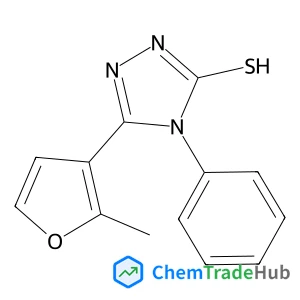
5-(2-Methyl-3-furyl)-4-phenyl-2,4-dihydro-3H-1,2,4-triazole-3-thione
CAS Number:
346464-59-3
Molecular Formula:
C13H11N3OS
Recommended Suppliers





Disclaimer
This page provides academic journal information for reference and research purposes only. We are not affiliated with any journal publishers and do not handle publication submissions. For publication-related inquiries, please contact the respective journal publishers directly.
If you notice any inaccuracies in the information displayed, please contact us at support@chemtradehub.com. We will promptly review and address your concerns.