












![(1S)-1,5-Anhydro-2-O-alpha-L-arabinopyranosyl-1-[5-hydroxy-7-({6-O-[3-(4-hydroxy-3-methoxyphenyl)propanoyl]-beta-D-glucopyranosyl}oxy)-2-(4-hydroxyphenyl)-4-oxo-4H-chromen-6-yl]-D-glucitol structure](https://static.chemtradehub.com/structs/225/2252345-81-4-bcff.webp "(1S)-1,5-Anhydro-2-O-alpha-L-arabinopyranosyl-1-[5-hydroxy-7-({6-O-[3-(4-hydroxy-3-methoxyphenyl)propanoyl]-beta-D-glucopyranosyl}oxy)-2-(4-hydroxyphenyl)-4-oxo-4H-chromen-6-yl]-D-glucitol structure")
Solvent effects on the properties of hyperbranched polythiophenes
Literature Information
Publication Date
2016-08-11
DOI
10.1039/C6CP04812A
Impact Factor
3.676
Authors
Juan Torras, David Zanuy
View Original
Abstract
The structural and electronic properties of all-thiophene dendrimers and dendrons in solution have been evaluated using very different theoretical approaches based on quantum mechanical (QM) and hybrid QM/molecular mechanics (MM) methodologies: (i) calculations on minimum energy conformations using an implicit solvation model in combination with density functional theory (DFT) or time-dependent DFT (TD-DFT) methods; (ii) hybrid QM/MM calculations, in which the solute and solvent molecules are represented at the DFT level as point charges, respectively, on snapshots extracted from classical molecular dynamics (MD) simulations using explicit solvent molecules, and (iii) QM/MM-MD trajectories in which the solute is described at the DFT or TD-DFT level and the explicit solvent molecules are represented using classical force-fields. Calculations have been performed in dichloromethane, tetrahydrofuran and dimethylformamide. A comparison of the results obtained using the different approaches with the available experimental data indicates that the incorporation of effects associated with both the conformational dynamics of the dendrimer and the explicit solvent molecules is strictly necessary to satisfactorily reproduce the properties of the investigated systems. Accordingly, QM/MM-MD simulations are able to capture such effects providing a reliable description of electronic properties–conformational flexibility relationships in all-Th dendrimers.
Related Literature
Pristine coconut husk biowaste and 2-ethylhexyl acrylate/methyl acrylate-based novel oleophilic gels for oil spill cleanup
Kavita Devi, Ghanshyam S. Chauhan, Sunita Ranote, Sandeep Chauhan, Kiran Kumar
2023-10-13
Paper
DOI: 10.1039/D3LP00118K
Recent advances in semiconductor heterojunctions: a detailed review of the fundamentals of photocatalysis, charge transfer mechanism and materials
Aniket Balapure, Jayati Ray Dutta, Ramakrishnan Ganesan
2023-09-27
Review Article
DOI: 10.1039/D3LF00126A
Direct re-lithiation strategy for spent lithium iron phosphate battery in Li-based eutectic using organic reducing agents
Tanongsak Yingnakorn, Jennifer Hartley, Jason S. Terreblanche, Chunhong Lei, Andrew P. Abbott
2023-11-02
Paper
DOI: 10.1039/D3SU00237C
Life cycle optimisation tool development for process systems and centralised supply chain design
Xinyang Sun, Alex Durkin, Miao Guo
2023-10-16
Paper
DOI: 10.1039/D3SU00251A
Exploring sustenance: cereal legume combinations for vegan meat development
Kannan Vignesh, Dev Kumar Yadav, D. D. Wadikar, A. D. Semwal
2023-10-26
Review Article
DOI: 10.1039/D3FB00074E
New sources of genipin-rich substances for crosslinking future manufactured bio-based materials
Maryam Nejati, Yuan Fang, Boyang Guo, Amparo Jiménez-Quero, Antonio J. Capezza, Marcos A. Sabino
2023-11-09
Paper
DOI: 10.1039/D3SU00303E
Correction: Synthesis of green fluorescent carbon dots from Moringa oleifera for sensing of deltamethrin and fenvalerate in vegetables and rice
Foziya Yusuf Vadia, Jinet Susan Johny, Naved I. Malek, Suresh Kumar Kailasa
2023-10-19
Correction
DOI: 10.1039/D3FB90017G
Biological and postharvest interventions to manage the ethylene in fruit: a review
Ram Asrey, Swati Sharma, Kalyan Barman, Uma Prajapati, Narender Negi
2023-06-29
Review Article
DOI: 10.1039/D3FB00037K
Effects of different microwave power on the drying kinetics and physicochemical quality of brown shrimp (Metapenaeus dobsoni)
Sumit Kumar Verma, Remya Sasikala, Pankaj Kishore, C. O. Mohan, P. Ganesan, Pandurengan Padmavathy, Nagarajan Muralidharan, Bindu Jaganath, Soottawat Benjakul
2023-10-17
Paper
DOI: 10.1039/D3FB00144J
You might also like
Compound Q&A
Is 2-(2-chloroacetamido)-3-phenylpropanoic acid (CAS: 7765-11-9) safe?
2-(2-Chloroacetamido)-3-phenylpropanoic acid (CAS: 7765-11-9) is generally consi...
7765-11-92-(2-chloroacetamido...
Compound Q&A
Is 2-(Benzyloxy)-5-bromobenzoic acid (CAS: 62176-31-2) safe?
2-(Benzyloxy)-5-bromobenzoic acid can be handled safely if appropriate precautio...
62176-31-22-(Benzyloxy)-5-brom...
Compound Q&A
What is (4-Methyl-1,2,5-oxadiazol-3-yl)methanamine hydrochloride (CAS: 1159825-48-5)?
(4-Methyl-1,2,5-oxadiazol-3-yl)methanamine hydrochloride is a chemical compound ...
1159825-48-5(4-Methyl-1,2,5-oxad...
Compound Q&A
What is 2-(5-Hexylthiophen-2-yl)-4,4,5,5-tetramethyl-1,3,2-dioxaborolane (CAS: 917985-54-7)?
2-(5-Hexylthiophen-2-yl)-4,4,5,5-tetramethyl-1,3,2-dioxaborolane (CAS: 917985-54...
917985-54-72-(5-Hexylthiophen-2...
Compound Q&A
Are there alternatives to 4-(8-Methyl-9H-1,3-dioxolo[4,5-h][2,3]benzodiazepin-5-yl)benzenamine (CAS: 102771-26-6) in synthesis?
While 4-(8-Methyl-9H-1,3-dioxolo[4,5-h][2,3]benzodiazepin-5-yl)benzenamine (CAS:...
102771-26-64-(8-Methyl-9H-1,3-d...
Compound Q&A
What is the market or research trend for tert-butyl 3-hydroxy-4,5,7,8-tetrahydro-2H-pyrazolo[3,4-d]azepine-6-carboxylate (CAS: 851376-80-2)?
The market for tert-butyl 3-hydroxy-4,5,7,8-tetrahydro-2H-pyrazolo[3,4-d]azepine...
851376-80-2tert-butyl 3-hydroxy...
Compound Q&A
How should waste containing 3,5-Diamino-1H-pyrazole-4-carbonitrile (CAS: 6844-58-2) be handled?
Waste containing 3,5-Diamino-1H-pyrazole-4-carbonitrile (CAS: 6844-58-2) should ...
6844-58-23,5-Diamino-1H-pyraz...
Compound Q&A
How is (6-Fluoro-3-pyridinyl)boronic acid (CAS: 351019-18-6) typically synthesized?
(6-Fluoro-3-pyridinyl)boronic acid can be synthesized through the reaction of 6-...
351019-18-6(6-Fluoro-3-pyridiny...
Compound Q&A
What industries use Dibenzyl carbonimidoylbiscarbamate (CAS: 10065-79-9)?
Dibenzyl carbonimidoylbiscarbamate (CAS: 10065-79-9) finds applications in vario...
10065-79-9Dibenzyl carbonimido...
Compound Q&A
What is the market or research trend for (beta,beta,2,3,4,5,6-~2~H_7_)Phenylalanine (CAS: 74228-83-4)?
The market for (beta,beta,2,3,4,5,6-~2~H_7_)Phenylalanine (CAS: 74228-83-4) is g...
74228-83-4(beta,beta,2,3,4,5,6...
Source Journal
Physical Chemistry Chemical Physics

CiteScore:
5.5
Self-citation Rate:
10.3%
Articles per Year:
3036
Physical Chemistry Chemical Physics (PCCP) is an international journal co-owned by 19 physical chemistry and physics societies from around the world. This journal publishes original, cutting-edge research in physical chemistry, chemical physics and biophysical chemistry. To be suitable for publication in PCCP, articles must include significant innovation and/or insight into physical chemistry; this is the most important criterion that reviewers and Editors will judge against when evaluating submissions. The journal has a broad scope and welcomes contributions spanning experiment, theory, computation and data science. Topical coverage includes spectroscopy, dynamics, kinetics, statistical mechanics, thermodynamics, electrochemistry, catalysis, surface science, quantum mechanics, quantum computing and machine learning. Interdisciplinary research areas such as polymers and soft matter, materials, nanoscience, energy, surfaces/interfaces, and biophysical chemistry are welcomed if they demonstrate significant innovation and/or insight into physical chemistry. Joined experimental/theoretical studies are particularly appreciated when complementary and based on up-to-date approaches.
Recommended Compounds

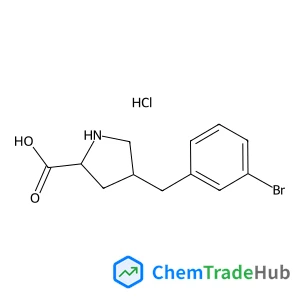
(2S,4R)-4-(3-Bromobenzyl)pyrrolidine-2-carboxylic acid hydrochloride
CAS Number:
1049734-10-2
Molecular Formula:
C12H15BrClNO2
Recommended Suppliers






Disclaimer
This page provides academic journal information for reference and research purposes only. We are not affiliated with any journal publishers and do not handle publication submissions. For publication-related inquiries, please contact the respective journal publishers directly.
If you notice any inaccuracies in the information displayed, please contact us at support@chemtradehub.com. We will promptly review and address your concerns.