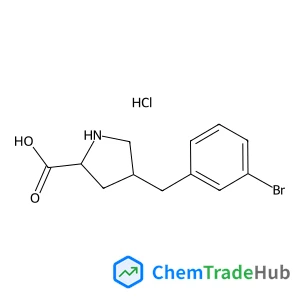
(2S,4R)-4-(3-Bromobenzyl)pyrrolidine-2-carboxylic acid hydrochloride
CAS Number:
1049734-10-2
Molecular Formula:
C12H15BrClNO2
Minsup Kim, Art E. Cho
A great number of GPCR crystal structures have been solved in recent years, enabling GPCR-targeted drug discovery using structure-based approaches such as docking. GPCRs generally have wide and open entrances to the binding sites, which render the binding sites readily accessible to solvent. GPCRs are also populated with hydrophilic residues in the extracellular regions. Thus, including solvent and polarization effects can be important for accurate GPCR docking. To test this hypothesis, a new docking protocol which incorporates quantum mechanical/molecular mechanical (QM/MM) calculations along with an implicit solvent model is developed. The new docking method treats the ligands and the protein residues in the binding sites as QM regions and performs QM/MM calculations with implicit solvent. The results of a test on all solved GPCR cocrystals show a significant improvement over the conventional docking method.

Crystallography Reports

Chemistry Education Research and Practice

Journal of Saudi Chemical Society

Russian Journal of Bioorganic Chemistry

Russian Journal of Applied Chemistry

Russian Chemical Bulletin

New Journal of Chemistry

Acta Materialia

Russian Journal of Organic Chemistry

Russian Journal of Coordination Chemistry
Kunfeng Chen, Congting Sun, Dongfeng Xue
DOI: 10.1039/C4CP03888F
Ming-Ming Jiang, Chong-Xin Shan, De-Zhen Shen
DOI: 10.1039/C4CP01437E
K. Zberecki, R. Swirkowicz, M. Wierzbicki
DOI: 10.1039/C4CP04884A
R. A. Rosenberg, J. M. Symonds, K. Vijayalakshmi, Debabrata Mishra, T. M. Orlando, R. Naaman
DOI: 10.1039/C4CP01649A
Zhong-Hua Pan, Jing-Wei Zhou, Geng-Geng Luo
DOI: 10.1039/C4CP02151G
M. Vogrin, M. M. Wojcik, J. Mieczkowski, K. Madrak, D. Pociecha, E. Gorecka
DOI: 10.1039/C4CP01641F
Zaiping Zeng, Alexia Petoni, Christos S. Garoufalis, Sotirios Baskoutas, Gabriel Bester
DOI: 10.1039/C4CP04551C
M. Yu. Lavrentiev, J. S. Wróbel, D. Nguyen-Manh, S. L. Dudarev
DOI: 10.1039/C4CP01366B
Christoph Richter, Max Beu, Derck Schlettwein
DOI: 10.1039/C4CP00723A
Hazim F. EL-Sharif, Daniel M. Hawkins, Derek Stevenson, Subrayal M. Reddy
DOI: 10.1039/C4CP01798F
2-(2-Chloroacetamido)-3-phenylpropanoic acid (CAS: 7765-11-9) is generally consi...
2-(Benzyloxy)-5-bromobenzoic acid can be handled safely if appropriate precautio...
(4-Methyl-1,2,5-oxadiazol-3-yl)methanamine hydrochloride is a chemical compound ...
2-(5-Hexylthiophen-2-yl)-4,4,5,5-tetramethyl-1,3,2-dioxaborolane (CAS: 917985-54...
While 4-(8-Methyl-9H-1,3-dioxolo[4,5-h][2,3]benzodiazepin-5-yl)benzenamine (CAS:...
The market for tert-butyl 3-hydroxy-4,5,7,8-tetrahydro-2H-pyrazolo[3,4-d]azepine...
Waste containing 3,5-Diamino-1H-pyrazole-4-carbonitrile (CAS: 6844-58-2) should ...
(6-Fluoro-3-pyridinyl)boronic acid can be synthesized through the reaction of 6-...
Dibenzyl carbonimidoylbiscarbamate (CAS: 10065-79-9) finds applications in vario...
The market for (beta,beta,2,3,4,5,6-~2~H_7_)Phenylalanine (CAS: 74228-83-4) is g...

Physical Chemistry Chemical Physics (PCCP) is an international journal co-owned by 19 physical chemistry and physics societies from around the world. This journal publishes original, cutting-edge research in physical chemistry, chemical physics and biophysical chemistry. To be suitable for publication in PCCP, articles must include significant innovation and/or insight into physical chemistry; this is the most important criterion that reviewers and Editors will judge against when evaluating submissions. The journal has a broad scope and welcomes contributions spanning experiment, theory, computation and data science. Topical coverage includes spectroscopy, dynamics, kinetics, statistical mechanics, thermodynamics, electrochemistry, catalysis, surface science, quantum mechanics, quantum computing and machine learning. Interdisciplinary research areas such as polymers and soft matter, materials, nanoscience, energy, surfaces/interfaces, and biophysical chemistry are welcomed if they demonstrate significant innovation and/or insight into physical chemistry. Joined experimental/theoretical studies are particularly appreciated when complementary and based on up-to-date approaches.
![3-[4-(difluoromethoxy)phenyl]-2-({[(9H-fluoren-9-yl)methoxy]carbonyl}amino)propanoic acid structure](https://static.chemtradehub.com/structs/149/1496564-27-2-952e.webp "3-[4-(difluoromethoxy)phenyl]-2-({[(9H-fluoren-9-yl)methoxy]carbonyl}amino)propanoic acid structure")
![2-[(E)-(2-Methoxyphenyl)diazenyl]-3-oxo-N-(2-oxo-2,3-dihydro-1H-benzimidazol-5-yl)butanamide structure](https://static.chemtradehub.com/structs/821/82199-12-0-f1d0.webp "2-[(E)-(2-Methoxyphenyl)diazenyl]-3-oxo-N-(2-oxo-2,3-dihydro-1H-benzimidazol-5-yl)butanamide structure")