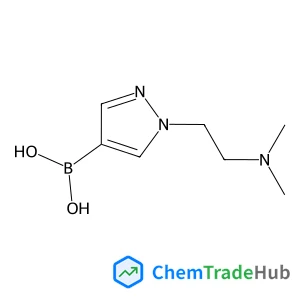
(1-(2-(Dimethylamino)ethyl)-1H-pyrazol-4-yl)boronic acid
CAS Number:
1086063-73-1
Molecular Formula:
C7H14BN3O2
A. B. Stephansen, M. A. B. Larsen, T. I. Sølling
The photoinduced processes of methyl formate and methyl acetate have been probed by femtosecond time-resolved mass spectrometry and photoelectron spectroscopy experiments supported by quantum chemical calculations. Upon excitation to a vibrationally hot S1 state both molecules were found to relax away from the Franck–Condon geometry faster than the cross-correlation (≈170 fs). During relaxation of the S1 surface intersystem crossing to the triplet manifold is possible via the T2 state which enables an El-Sayed allowed transition. The time-resolved photoelectron spectra show indications of a triplet state formed on an ultrafast timescale. We suggest that the ultrafast timescale of the intersystem crossing process is possible due to the shape of the potential energy surface directing and restricting the dynamics along the carbonyl group de-planarization coordinate, where an El-Sayed allowed intersystem crossing is possible at all times, and where the S1 and T2 states are nearly iso-energetic all the way along the reaction coordinate.
Jiayin Zhou, Jihong Ni, Xiaofei Guan
DOI: 10.1039/D3SU00201B
Tanya Singh Raghuvanshi, Bhanu Prakash
DOI: 10.1039/D3FB00098B
Marco Rollo, Massimo A. G. Perini, Alessandro Sanzone, Lorenzo Polastri, Matteo Tiecco, Alejandro Torregrosa-Chinillach, Elisa Martinelli, Gianluca Ciancaleoni
DOI: 10.1039/D3SU00205E
Soumya Ranjan Mishra, Vishal Gadore, Md. Ahmaruzzaman
DOI: 10.1039/D3SU00384A
Weiliang Han, Weigao Han, Zhicheng Tang
DOI: 10.1039/D3LF00147D
Adithya Sridhar, Muthamilselvi Ponnuchamy, P. Senthil Kumar, Ashish Kapoor, Dai-Viet Nguyen Vo
DOI: 10.1039/D3FB00124E
Ganeswar Dalei, Swagat Kumar Das, Susri Sangita Mohapatra
DOI: 10.1039/D3FB00096F
2-(2-Chloroacetamido)-3-phenylpropanoic acid (CAS: 7765-11-9) is generally consi...
2-(Benzyloxy)-5-bromobenzoic acid can be handled safely if appropriate precautio...
(4-Methyl-1,2,5-oxadiazol-3-yl)methanamine hydrochloride is a chemical compound ...
2-(5-Hexylthiophen-2-yl)-4,4,5,5-tetramethyl-1,3,2-dioxaborolane (CAS: 917985-54...
While 4-(8-Methyl-9H-1,3-dioxolo[4,5-h][2,3]benzodiazepin-5-yl)benzenamine (CAS:...
The market for tert-butyl 3-hydroxy-4,5,7,8-tetrahydro-2H-pyrazolo[3,4-d]azepine...
Waste containing 3,5-Diamino-1H-pyrazole-4-carbonitrile (CAS: 6844-58-2) should ...
(6-Fluoro-3-pyridinyl)boronic acid can be synthesized through the reaction of 6-...
Dibenzyl carbonimidoylbiscarbamate (CAS: 10065-79-9) finds applications in vario...
The market for (beta,beta,2,3,4,5,6-~2~H_7_)Phenylalanine (CAS: 74228-83-4) is g...

Physical Chemistry Chemical Physics (PCCP) is an international journal co-owned by 19 physical chemistry and physics societies from around the world. This journal publishes original, cutting-edge research in physical chemistry, chemical physics and biophysical chemistry. To be suitable for publication in PCCP, articles must include significant innovation and/or insight into physical chemistry; this is the most important criterion that reviewers and Editors will judge against when evaluating submissions. The journal has a broad scope and welcomes contributions spanning experiment, theory, computation and data science. Topical coverage includes spectroscopy, dynamics, kinetics, statistical mechanics, thermodynamics, electrochemistry, catalysis, surface science, quantum mechanics, quantum computing and machine learning. Interdisciplinary research areas such as polymers and soft matter, materials, nanoscience, energy, surfaces/interfaces, and biophysical chemistry are welcomed if they demonstrate significant innovation and/or insight into physical chemistry. Joined experimental/theoretical studies are particularly appreciated when complementary and based on up-to-date approaches.