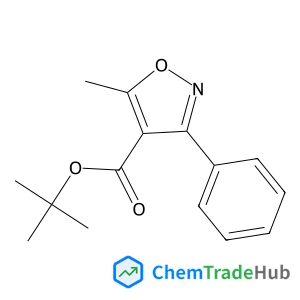
2-Methyl-2-propanyl 5-methyl-3-phenyl-1,2-oxazole-4-carboxylate
CAS Number:
211429-79-7
Molecular Formula:
C15H17NO3
Saurabh Chauhan, David F. Watson
Colloidal semiconductor quantum dots (QDs) exhibit excitonic and surface states, both of which may participate in charge-transfer processes relevant to solar energy conversion. To explore this inherent complexity of the charge-transfer mechanisms of QDs, we used steady-state and time-resolved emission measurements to characterize excited-state electron transfer (ET) from core-only CdSe QDs and core/shell CdSe/ZnS QDs to TiO2 nanoparticles (NPs). Core-only QDs transferred electrons from both excitonic and surface states to TiO2 with rate constants of ET (ket) of approximately (1–3) × 108 s−1 and (4–7) × 107 s−1, respectively. Efficiencies of ET (ηet) from excitonic and surface states were approximately 71–82% and 64–76%, respectively. Thus, trapping of electrons lowered their potential energy but did not greatly affect the efficiency of their transfer to TiO2. Photogenerated holes were transferred from core-only CdSe QDs to adsorbed 3-mercaptopropionic acid (MPA), which linked the QDs to TiO2. We characterized core/shell CdSe/ZnS QDs as alternatives to core-only QDs. The ZnS shell eliminated the undesirable trapping of electrons and transfer of photogenerated holes to MPA. We measured ket of approximately (1–3) × 108 s−1 and ηet of approximately 66–85% for ET from excitonic states of core/shell CdSe/ZnS QDs to TiO2 NPs. The insensitivity of ket to the presence of the ZnS shell may have arisen from increased cross-linking of core/shell QDs to TiO2. Our results highlight the involvement of surface states in excited-state ET processes of core-only QDs and, for the heterostructures reported here, the improved performance of core/shell CdSe/ZnS QDs relative to core-only CdSe QDs.
YoungAh Kwon
DOI: 10.1039/C5CP02833G
Djemel Hamdane, Christophe Velours, David Cornu, Magali Nicaise, Murielle Lombard, Marc Fontecave
DOI: 10.1039/C6CP03635J
Przemysław Borys, Zbigniew J. Grzywna
DOI: 10.1039/C6CP03356C
Niloy Kundu, Debasis Banik, Arpita Roy, Jagannath Kuchlyan, Nilmoni Sarkar
DOI: 10.1039/C5CP03906A
Wenjuan Yu, Xu Jia, Mengnan Yao, Linghui Zhu, Yongbing Long, Liang Shen
DOI: 10.1039/C5CP03467A
M. T. Greiner, T. E. Jones, B. E. Johnson, T. C. R. Rocha, Z. J. Wang, M. Armbrüster, M. Willinger, A. Knop-Gericke, R. Schlögl
DOI: 10.1039/C5CP03722K
L. Rosales, M. Pacheco, A. Ayuela
DOI: 10.1039/C5CP03061G
Nikita L. La Cruz, Danna Qasim, Heather Abbott-Lyon, Claire Pirim, Aaron D. McKee, Thomas Orlando, Maheen Gull, Danny Lindsay, Matthew A. Pasek
DOI: 10.1039/C6CP00836D
Hui Yu, Jose A. Sanchez-Rodriguez, Marvin Pollum, Carlos E. Crespo-Hernández, Sebastian Mai, Philipp Marquetand, Leticia González, Susanne Ullrich
DOI: 10.1039/C6CP01790H
Naoko Kono, Takeshi Furukawa, Hajime Tanuma, Jun Matsumoto, Haruo Shiromaru, Toshiyuki Azuma, Kaveh Najafian, Maria Susanne Pettersson, Bertil Dynefors, Klavs Hansen
DOI: 10.1039/C5CP02549D
When handling 4-Methyl-6-(trifluoromethyl)quinoline (CAS: 40716-16-3), safety go...
4-(3,5-Difluorophenyl)aniline is an aromatic organic compound with the CAS numbe...
5-{[4-(Trifluoromethyl)phenyl]sulfanyl}-1,2,3-thiadiazole-4-carboxylic acid can ...
The market for 4-Benzylaniline hydrochloride (CAS: 6317-57-3) is steadily growin...
[3-(Diethylsulfamoyl)phenyl]boronic acid is generally considered safe when handl...
3-Bromo-2,5-dimethoxyaniline is mainly used in the pharmaceutical and chemical i...
N-Methyl-1-(5-methyl-1H-indol-3-yl)methanamine (CAS: 915922-67-7) is subject to ...
This compound is primarily used in the pharmaceutical industry for the synthesis...
2-Methyl-2-propanyl [(1S,3R)-3-aminocyclohexyl]carbamate (CAS: 1298101-47-9) sho...
Ethyl 2-bromo-4,4,4-trifluorobutanoate (CAS: 367-33-9) is utilized in the pharma...

Physical Chemistry Chemical Physics (PCCP) is an international journal co-owned by 19 physical chemistry and physics societies from around the world. This journal publishes original, cutting-edge research in physical chemistry, chemical physics and biophysical chemistry. To be suitable for publication in PCCP, articles must include significant innovation and/or insight into physical chemistry; this is the most important criterion that reviewers and Editors will judge against when evaluating submissions. The journal has a broad scope and welcomes contributions spanning experiment, theory, computation and data science. Topical coverage includes spectroscopy, dynamics, kinetics, statistical mechanics, thermodynamics, electrochemistry, catalysis, surface science, quantum mechanics, quantum computing and machine learning. Interdisciplinary research areas such as polymers and soft matter, materials, nanoscience, energy, surfaces/interfaces, and biophysical chemistry are welcomed if they demonstrate significant innovation and/or insight into physical chemistry. Joined experimental/theoretical studies are particularly appreciated when complementary and based on up-to-date approaches.
![2,4-Dichloro-6-isopropyl-5H-pyrrolo[3,4-d]pyrimidin-7(6H)-one structure](https://static.chemtradehub.com/structs/107/1079649-94-7-ad4a.webp "2,4-Dichloro-6-isopropyl-5H-pyrrolo[3,4-d]pyrimidin-7(6H)-one structure")