












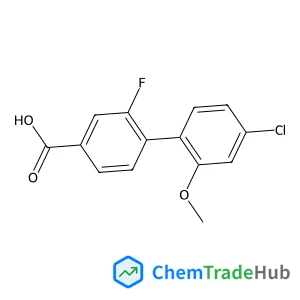
4-(4-Chloro-2-methoxyphenyl)-3-fluorobenzoic acid
CAS Number:
1261970-23-3
Molecular Formula:
C14H10ClFO3
Hannah C. Price, Johan Mattsson, Benjamin J. Murray
The diffusion of sugar in aqueous solution is important both in nature and in technological applications, yet measurements of diffusion coefficients at low water content are scarce. We report directly measured sucrose diffusion coefficients in aqueous solution. Our technique utilises a Raman isotope tracer method to monitor the diffusion of non-deuterated and deuterated sucrose across a boundary between the two aqueous solutions. At a water activity of 0.4 (equivalent to 90 wt% sucrose) at room temperature, the diffusion coefficient of sucrose was determined to be approximately four orders of magnitude smaller than that of water in the same material. Using literature viscosity data, we show that, although inappropriate for the prediction of water diffusion, the Stokes–Einstein equation works well for predicting sucrose diffusion under the conditions studied. As well as providing information of importance to the fundamental understanding of diffusion in binary solutions, these data have technological, pharmaceutical and medical implications, for example in cryopreservation. Moreover, in the atmosphere, slow organic diffusion may have important implications for aerosol growth, chemistry and evaporation, where processes may be limited by the inability of a molecule to diffuse between the bulk and the surface of a particle.
Xueli Guo, Lihui Fang, Yiwei Tan
DOI: 10.1039/C4CP04051A
Joseph H. Montoya, Monica Garcia-Mota
DOI: 10.1039/C4CP05259E
Thaís C. F. Oliveira, Luiz F. V. Carmo, Bárbara Murta, Luís G.T.A. Duarte, Rene A. Nome, Willian R. Rocha, Tiago A. S. Brandão
DOI: 10.1039/C4CP04337E
Alexandra Lambrou, Eftychia Pinakoulaki
DOI: 10.1039/C4CP04352A
Miguel Vilas, Marisa A. A. Rocha, Ana M. Fernandes, Emilia Tojo, Luís M. N. B. F. Santos
DOI: 10.1039/C4CP05191B
Celesta Fong, Lynne J. Waddington, Anita J. Hill
DOI: 10.1039/C4CP04343J
R. A. Mondal, B. S. Murty, V. R. K. Murthy
DOI: 10.1039/C4CP04398G
Marina Fedoseeva, Milan Delor, Simon C. Parker, Igor V. Sazanovich, Michael Towrie, Anthony W. Parker, Julia A. Weinstein
DOI: 10.1039/C4CP04166F
Dong-Chan Lee, Lacie V. Brownell, Kyoungmi Jang, Seung Ju Han, Kathleen A. Robins
DOI: 10.1039/C4CP05090H
Haifeng Wang
DOI: 10.1039/C4CP04159C
(5-Sulfamoyl-3-pyridinyl)boronic acid is primarily used in chemical synthesis, p...
Benzyl 2-methyl-2-(methylsulfonyl)-4-pentenoate is typically synthesized via est...
When handling 8-Fluoroquinolin-6-ol (CAS: 209353-22-0), it is important to use p...
1,3-Dibromo-5-(2-methyl-2-propanyl)benzene (CAS: 129316-09-2) is a crystalline c...
Ethyl 7-chloro-4-oxo-1-(1,3-thiazol-2-yl)-1,4-dihydro-1,8-naphthyridine-3-carbox...
When handling Delta-7-Avenasterol (CAS: 23290-26-8), it is important to wear app...
Proper handling involves the use of personal protective equipment such as gloves...
When handling 2-Methyl-2-proanyl 4-[(2-aminophenyl)amino]-1-piperidinecarboxylat...
N-Methyl-4-chlorobenzylamine hydrochloride (CAS: 65542-24-7) is a organic compou...
[2-(Dodecyloxy)ethoxy]acetic acid (CAS: 27306-90-7) is generally considered safe...

Physical Chemistry Chemical Physics (PCCP) is an international journal co-owned by 19 physical chemistry and physics societies from around the world. This journal publishes original, cutting-edge research in physical chemistry, chemical physics and biophysical chemistry. To be suitable for publication in PCCP, articles must include significant innovation and/or insight into physical chemistry; this is the most important criterion that reviewers and Editors will judge against when evaluating submissions. The journal has a broad scope and welcomes contributions spanning experiment, theory, computation and data science. Topical coverage includes spectroscopy, dynamics, kinetics, statistical mechanics, thermodynamics, electrochemistry, catalysis, surface science, quantum mechanics, quantum computing and machine learning. Interdisciplinary research areas such as polymers and soft matter, materials, nanoscience, energy, surfaces/interfaces, and biophysical chemistry are welcomed if they demonstrate significant innovation and/or insight into physical chemistry. Joined experimental/theoretical studies are particularly appreciated when complementary and based on up-to-date approaches.
![[3-Fluoro-4-(1-pyrrolidinylcarbonyl)phenyl]boronic acid structure](https://static.chemtradehub.com/structs/874/874289-09-5-e3d4.webp "[3-Fluoro-4-(1-pyrrolidinylcarbonyl)phenyl]boronic acid structure")
![5-Chloropyrrolo[2,1-f][1,2,4]triazin-4(3H)-one structure](https://static.chemtradehub.com/structs/888/888720-60-3-4f7c.webp "5-Chloropyrrolo[2,1-f][1,2,4]triazin-4(3H)-one structure")


