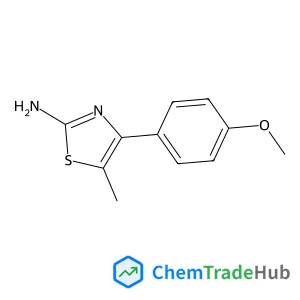
4-(4-Methoxyphenyl)-5-methyl-1,3-thiazol-2-amine
CAS Number:
105512-88-7
Molecular Formula:
C11H12N2OS
Marina Fedoseeva, Milan Delor, Simon C. Parker, Igor V. Sazanovich, Michael Towrie, Anthony W. Parker, Julia A. Weinstein
Understanding the dynamics of the initial stages of vibrational energy transfer in transition metal complexes is a challenging fundamental question which is also of crucial importance for many applications, such as improving the performance of solar devices or photocatalysis. The present study investigates vibrational energy transport in the ground and the electronic excited state of Ru(4,4′-(COOEt)2-2,2-bpy)2(NCS)2, a close relative of the efficient “N3” dye used in dye-sensitized solar cells. Using the emerging technique of ultrafast two-dimensional infrared spectroscopy, we show that, similarly to other transition-metal complexes, the central Ru heavy atom acts as a “bottleneck” making the energy transfer from small ligands with high energy vibrational stretching frequencies less favorable and thereby affecting the efficiency of vibrational energy flow in the complex. Comparison of the vibrational relaxation times in the electronic ground and excited state of Ru(4,4′-(COOEt)2-2,2-bpy)2(NCS)2 shows that it is dramatically faster in the latter. We propose to explain this observation by the intramolecular electrostatic interactions between the thiocyanate group and partially oxidised Ru metal center, which increase the degree of vibrational coupling between CN and Ru–N modes in the excited state thus reducing structural and thermodynamic barriers that slow down vibrational relaxation and energy transport in the electronic ground state. As a very similar behavior was earlier observed in another transition-metal complex, Re(4,4′-(COOEt)2-2,2′-bpy)(CO)3Cl, we suggest that this effect in vibrational energy dynamics might be common for transition-metal complexes with heavy central atoms.
Prativa Mazumdar, Debasish Das, Gobinda Prasad Sahoo, Guillermo Salgado-Morán, Ajay Misra
DOI: 10.1039/C3CP54563F
Yichun Xu, Chi Song, Yange Zhang, C. S. Liu, B. C. Pan, Zhiguang Wang
DOI: 10.1039/C4CP01224K
G. Barratt Park, Rachel G. Shaver, AnGayle K. Vasiliou, James M. Oldham, Donald E. David, John S. Muenter, John F. Stanton, Arthur G. Suits, G. Barney Ellison, Robert W. Field
DOI: 10.1039/C3CP55352C
A. Watras, A. Matraszek, P. Godlewska, I. Szczygieł, J. Wojtkiewicz, B. Brzostowski, G. Banach, P. J. Dereń
DOI: 10.1039/C3CP54875A
Qin Li, Yanke Che, Hongwei Ji, Chuncheng Chen, Huaiyong Zhu, Wanhong Ma, Jincai Zhao
DOI: 10.1039/C4CP00626G
Luisa Schöne, Janine Schindelka, Edyta Szeremeta, Thomas Schaefer, Dirk Hoffmann, Krzysztof J. Rudzinski, Rafal Szmigielski, Hartmut Herrmann
DOI: 10.1039/C3CP54859G
Iker León, Imanol Usabiaga, Judith Millán, Emilio J. Cocinero, Alberto Lesarri, José A. Fernández
DOI: 10.1039/C4CP01702A
(5-Sulfamoyl-3-pyridinyl)boronic acid is primarily used in chemical synthesis, p...
Benzyl 2-methyl-2-(methylsulfonyl)-4-pentenoate is typically synthesized via est...
When handling 8-Fluoroquinolin-6-ol (CAS: 209353-22-0), it is important to use p...
1,3-Dibromo-5-(2-methyl-2-propanyl)benzene (CAS: 129316-09-2) is a crystalline c...
Ethyl 7-chloro-4-oxo-1-(1,3-thiazol-2-yl)-1,4-dihydro-1,8-naphthyridine-3-carbox...
When handling Delta-7-Avenasterol (CAS: 23290-26-8), it is important to wear app...
Proper handling involves the use of personal protective equipment such as gloves...
When handling 2-Methyl-2-proanyl 4-[(2-aminophenyl)amino]-1-piperidinecarboxylat...
N-Methyl-4-chlorobenzylamine hydrochloride (CAS: 65542-24-7) is a organic compou...
[2-(Dodecyloxy)ethoxy]acetic acid (CAS: 27306-90-7) is generally considered safe...

Physical Chemistry Chemical Physics (PCCP) is an international journal co-owned by 19 physical chemistry and physics societies from around the world. This journal publishes original, cutting-edge research in physical chemistry, chemical physics and biophysical chemistry. To be suitable for publication in PCCP, articles must include significant innovation and/or insight into physical chemistry; this is the most important criterion that reviewers and Editors will judge against when evaluating submissions. The journal has a broad scope and welcomes contributions spanning experiment, theory, computation and data science. Topical coverage includes spectroscopy, dynamics, kinetics, statistical mechanics, thermodynamics, electrochemistry, catalysis, surface science, quantum mechanics, quantum computing and machine learning. Interdisciplinary research areas such as polymers and soft matter, materials, nanoscience, energy, surfaces/interfaces, and biophysical chemistry are welcomed if they demonstrate significant innovation and/or insight into physical chemistry. Joined experimental/theoretical studies are particularly appreciated when complementary and based on up-to-date approaches.