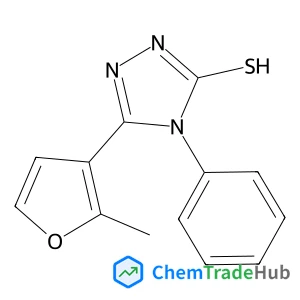
5-(2-Methyl-3-furyl)-4-phenyl-2,4-dihydro-3H-1,2,4-triazole-3-thione
CAS Number:
346464-59-3
Molecular Formula:
C13H11N3OS
Xingju Zhao, Jinlei Shi, Yu Jia, Zhengxiao Guo, Jun-Hyung Cho, Zhenyu Zhang
Exploration of the catalytic activity of low-dimensional transition metal (TM) or noble metal catalysts is a vital subject of modern materials science because of their instrumental role in numerous industrial applications. Recent experimental advances have demonstrated the utilization of single atoms on different substrates as effective catalysts, which exhibit amazing catalytic properties such as more efficient catalytic performance and higher selectivity in chemical reactions as compared to their nanostructured counterparts; however, the underlying microscopic mechanisms operative in these single atom catalysts still remain elusive. Based on first-principles calculations, herein, we present a comparative study of the key kinetic rate processes involved in CO oxidation using a monomer or dimer of two representative TMs (Pd and Ni) on defective TiO2(110) substrates (TMn@TiO2(110), n = 1, 2) to elucidate the underlying mechanism of single-atom catalysis. We reveal that the O2 activation rates of the single atom TM catalysts deposited on TiO2(110) are governed cooperatively by the classic spin-selection rule and the well-known frontier orbital theory (or generalized d-band picture) that emphasizes the energy gap between the frontier orbitals of the TM catalysts and O2 molecule. We further illuminate that the subsequent CO oxidation reactions proceed via the Langmuir–Hinshelwood mechanism with contrasting reaction barriers for the Pd monomer and dimer catalysts. These findings not only provide an explanation for existing observations of distinctly different catalytic activities of Pd@TiO2(110) and Pd2@TiO2(110) [Kaden et al., Science, 2009, 326, 826–829] but also shed new insights into future utilization and optimization of single-atom catalysis.
Cai Wang, Yudong Zheng, Yi Sun, Jinsheng Fan, Qiujing Qin, Zhenjiang Zhao
DOI: 10.1039/C6PY01131D
J. I. Hare, P. D. Kemmitt, K. E. Treacher, M. J. Waring, S. T. Barry, C. Alexander, M. Ashford
DOI: 10.1039/C6PY00478D
Yingying Teng, Chuanxiong Nie
DOI: 10.1039/C7PY00071E
Yang Xu, Tianqi Wang, Zidong He, Aiqing Zhong, Wei Yu, Buyin Shi, Kun Huang
DOI: 10.1039/C6PY01706A
Yuxiang Li, Tack Ho Lee, Song Yi Park, Mohammad Afsar Uddin, Taehyo Kim, Sungu Hwang, Jin Young Kim, Han Young Woo
DOI: 10.1039/C6PY00674D
Yasuhiro Kohsaka, Keito Hagiwara, Keiichiro Ito
DOI: 10.1039/C6PY02145J
Xiaotian Ji, Li Liu
DOI: 10.1039/C7PY00315C
Nemal S. Gobalasingham, Robert M. Pankow, Barry C. Thompson
DOI: 10.1039/C7PY00181A
When handling lithium chloride hydrate (1:1:1) (CAS: 16712-20-2), it is importan...
4-(4H-1,2,4-Triazol-4-yl)piperidine is generally considered safe for use in phar...
Waste containing 1,3-Thiazole-2-carboxamide (CAS: 16733-85-0) should be collecte...
5-(Difluoromethyl)-2-fluorobenzonitrile (CAS: 934175-58-3) is subject to regulat...
Methyl 3-acetamido-2-thiophenecarboxylate can be synthesized by the reaction of ...
4-Isoquinolinecarbonitrile is a chemical compound with the CAS number 34846-65-6...
Store Methyl 1H-1,2,3-triazole-4-carboxylate (CAS: 877309-59-6) in a cool, dry p...
6-Bromo[1,3]thiazolo[5,4-b]pyridin-2-amine (CAS: 1160791-13-8) is subject to the...
(2S,3S)-2-Ammonio-3-(3,4-dihydroxyphenyl)-3-hydroxypropanoate (CAS: 23651-95-8) ...
7-Bromo-3-methyl-3,4-dihydroquinazolin-4-one is a solid with a crystalline form....

Physical Chemistry Chemical Physics (PCCP) is an international journal co-owned by 19 physical chemistry and physics societies from around the world. This journal publishes original, cutting-edge research in physical chemistry, chemical physics and biophysical chemistry. To be suitable for publication in PCCP, articles must include significant innovation and/or insight into physical chemistry; this is the most important criterion that reviewers and Editors will judge against when evaluating submissions. The journal has a broad scope and welcomes contributions spanning experiment, theory, computation and data science. Topical coverage includes spectroscopy, dynamics, kinetics, statistical mechanics, thermodynamics, electrochemistry, catalysis, surface science, quantum mechanics, quantum computing and machine learning. Interdisciplinary research areas such as polymers and soft matter, materials, nanoscience, energy, surfaces/interfaces, and biophysical chemistry are welcomed if they demonstrate significant innovation and/or insight into physical chemistry. Joined experimental/theoretical studies are particularly appreciated when complementary and based on up-to-date approaches.
![6-(Benzyloxy)-8-(2-bromoacetyl)-2H-benzo[b][1,4]oxazin-3(4H)-one structure](https://static.chemtradehub.com/structs/926/926319-53-1-2287.webp "6-(Benzyloxy)-8-(2-bromoacetyl)-2H-benzo[b][1,4]oxazin-3(4H)-one structure")
![[(2R)-6,6-Dimethyl-2-morpholinyl]methanol hydrochloride (1:1) structure](https://static.chemtradehub.com/structs/141/1416444-88-6-e06a.webp "[(2R)-6,6-Dimethyl-2-morpholinyl]methanol hydrochloride (1:1) structure")