













New insights into the vibrational and optical signatures of trans-stilbene via integrated experimental and quantum mechanical approaches
Literature Information
Publication Date
2016-06-24
DOI
10.1039/C6CP02787C
Impact Factor
3.676
Authors
Florian Massuyeau, Eric Faulques, Camille Latouche, Vincenzo Barone
View Original
Abstract
The structure, spectroscopic parameters and optical properties of stilbene have been investigated by a computational protocol including suitable treatment of anharmonic contributions together with new experimental results. A full reproduction of the 500–3500 cm−1 IR spectrum has been possible using the VPT2 approach and new insights are provided in the 6000 cm−1 region where typical signatures have been characterized as a set of overtones and combination bands. Vibrational contributions to electronic transitions have been taken into account to simulate the optical (absorption and emission) properties of stilbene. Spectra simulated by employing the state-of-the-art Adiabatic Hessian model coupled to global hybrid functionals are in remarkable agreement with their experimental counterparts and the inclusion of Herzberg–Teller contributions further improves the results with respect to those delivered by the basic Franck–Condon model.
Related Literature
Elastic strain effects on catalysis of a PdCuSi metallic glass thin film
Yiyi Yang, Tuhina Adit Maark, Andrew Peterson, Sharvan Kumar
2014-12-02
Paper
DOI: 10.1039/C4CP04924A
Cross-diffusion-induced convective patterns in microemulsion systems
M. A. Budroni, L. Lemaigre, A. De Wit, F. Rossi
2014-08-20
Paper
DOI: 10.1039/C4CP02196G
Protic ionic liquids (PILs) nanostructure and physicochemical properties: development of high-throughput methodology for PIL creation and property screens
Benjamin W. Muir, Shaun C. Howard, Nigel Kirby
2014-11-14
Paper
DOI: 10.1039/C4CP04241G
Functionalization of nanostructured cerium oxide films with histidine
Nataliya Tsud, Sofiia Bercha, Robert G. Acres, Mykhailo Vorokhta, Ivan Khalakhan, Vladimír Matolín
2014-12-01
Paper
DOI: 10.1039/C4CP03780D
A multinuclear solid state NMR spectroscopic study of the structural evolution of disordered calcium silicate sol–gel biomaterials
Zhongjie Lin, Julian R. Jones, John V. Hanna
2014-12-02
Paper
DOI: 10.1039/C4CP04492D
A new scoring function for protein–protein docking that identifies native structures with unprecedented accuracy
Irina S. Moreira, João M. Martins, João T. S. Coimbra, Maria J. Ramos, Pedro A. Fernandes
2014-11-26
Paper
DOI: 10.1039/C4CP04688A
Chromium deposition and poisoning at La0.6Sr0.4Co0.2Fe0.8O3−δ oxygen electrodes of solid oxide electrolysis cells
Kongfa Chen, Ling Zhao, Zhe Lü, San Ping Jiang
2014-11-27
Paper
DOI: 10.1039/C4CP05110F
Zero thermal expansion in NaZn13-type La(Fe,Si)13 compounds
Wei Wang, Rongjin Huang, Chuanjun Huang, Laifeng Li
2014-11-27
Communication
DOI: 10.1039/C4CP04672B
Ultrafast dynamics of a new class of highly fluorescent boron difluoride dyes
L. Wang, I.-S. Tamgho, L. A. Crandall, J. J. Rack, C. J. Ziegler
2014-12-04
Communication
DOI: 10.1039/C4CP04737K
Vibrational energy transfer dynamics in ruthenium polypyridine transition metal complexes
Marina Fedoseeva, Milan Delor, Simon C. Parker, Igor V. Sazanovich, Michael Towrie, Anthony W. Parker, Julia A. Weinstein
2014-11-24
Paper
DOI: 10.1039/C4CP04166F
You might also like
Compound Q&A
What are the main uses of (5-Sulfamoyl-3-pyridinyl)boronic acid (CAS: 951233-61-7)?
(5-Sulfamoyl-3-pyridinyl)boronic acid is primarily used in chemical synthesis, p...
951233-61-7(5-Sulfamoyl-3-pyrid...
Compound Q&A
How is Benzyl 2-methyl-2-(methylsulfonyl)-4-pentenoate (CAS: 1942858-50-5) typically synthesized?
Benzyl 2-methyl-2-(methylsulfonyl)-4-pentenoate is typically synthesized via est...
1942858-50-5Benzyl 2-methyl-2-(m...
Compound Q&A
What precautions should be taken when handling 8-Fluoroquinolin-6-ol (CAS: 209353-22-0)?
When handling 8-Fluoroquinolin-6-ol (CAS: 209353-22-0), it is important to use p...
209353-22-08-Fluoroquinolin-6-o...
Compound Q&A
What are the physical and chemical properties of 1,3-Dibromo-5-(2-methyl-2-propanyl)benzene (CAS: 129316-09-2)?
1,3-Dibromo-5-(2-methyl-2-propanyl)benzene (CAS: 129316-09-2) is a crystalline c...
129316-09-21,3-Dibromo-5-(2-met...
Compound Q&A
What industries use Ethyl 7-chloro-4-oxo-1-(1,3-thiazol-2-yl)-1,4-dihydro-1,8-naphthyridine-3-carboxylate (CAS: 174726-87-5)?
Ethyl 7-chloro-4-oxo-1-(1,3-thiazol-2-yl)-1,4-dihydro-1,8-naphthyridine-3-carbox...
174726-87-5Ethyl 7-chloro-4-oxo...
Compound Q&A
What precautions should be taken when handling Delta-7-Avenasterol (CAS: 23290-26-8)?
When handling Delta-7-Avenasterol (CAS: 23290-26-8), it is important to wear app...
23290-26-8Delta-7-Avenasterol
Compound Q&A
What precautions should be taken when handling N-({(5R)-3-[3-Fluoro-4-(4-morpholinyl)phenyl]-2-oxo-1,3-oxazolidin-5-yl}methyl)acetamide (CAS: 872992-20-6)?
Proper handling involves the use of personal protective equipment such as gloves...
872992-20-6N-({(5R)-3-[3-Fluoro...
Compound Q&A
What precautions should be taken when handling 2-Methyl-2-proanyl 4-[(2-aminophenyl)amino]-1-piperidinecarboxylate (CAS: 79099-00-6)?
When handling 2-Methyl-2-proanyl 4-[(2-aminophenyl)amino]-1-piperidinecarboxylat...
79099-00-62-Methyl-2-propanyl ...
Compound Q&A
What is N-Methyl-4-chlorobenzylamine hydrochloride (CAS: 65542-24-7)?
N-Methyl-4-chlorobenzylamine hydrochloride (CAS: 65542-24-7) is a organic compou...
65542-24-7N-Methyl-4-chloroben...
Compound Q&A
Is [2-(Dodecyloxy)ethoxy]acetic acid (CAS: 27306-90-7) safe?
[2-(Dodecyloxy)ethoxy]acetic acid (CAS: 27306-90-7) is generally considered safe...
27306-90-7[2-(Dodecyloxy)ethox...
Source Journal
Physical Chemistry Chemical Physics

CiteScore:
5.5
Self-citation Rate:
10.3%
Articles per Year:
3036
Physical Chemistry Chemical Physics (PCCP) is an international journal co-owned by 19 physical chemistry and physics societies from around the world. This journal publishes original, cutting-edge research in physical chemistry, chemical physics and biophysical chemistry. To be suitable for publication in PCCP, articles must include significant innovation and/or insight into physical chemistry; this is the most important criterion that reviewers and Editors will judge against when evaluating submissions. The journal has a broad scope and welcomes contributions spanning experiment, theory, computation and data science. Topical coverage includes spectroscopy, dynamics, kinetics, statistical mechanics, thermodynamics, electrochemistry, catalysis, surface science, quantum mechanics, quantum computing and machine learning. Interdisciplinary research areas such as polymers and soft matter, materials, nanoscience, energy, surfaces/interfaces, and biophysical chemistry are welcomed if they demonstrate significant innovation and/or insight into physical chemistry. Joined experimental/theoretical studies are particularly appreciated when complementary and based on up-to-date approaches.
Recommended Compounds
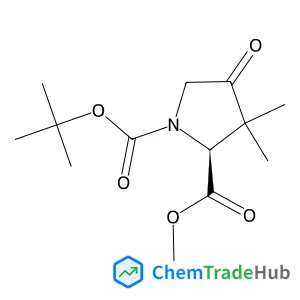
2-Methyl 1-(2-methyl-2-propanyl) (2S)-3,3-dimethyl-4-oxo-1,2-pyrrolidinedicarboxylate
CAS Number:
478698-30-5
Molecular Formula:
C13H21NO5
Recommended Suppliers




Disclaimer
This page provides academic journal information for reference and research purposes only. We are not affiliated with any journal publishers and do not handle publication submissions. For publication-related inquiries, please contact the respective journal publishers directly.
If you notice any inaccuracies in the information displayed, please contact us at support@chemtradehub.com. We will promptly review and address your concerns.