











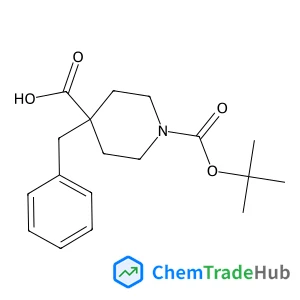
4-Benzyl-1-(tert-butoxycarbonyl)piperidine-4-carboxylic acid
CAS Number:
170838-87-6
Molecular Formula:
C18H25NO4
Tatyana I. Rokitskaya, Ljudmila S. Khailova, Anton V. Makarenkov, Valentina A. Ol'shevskaya, Valery N. Kalinin, Yuri N. Antonenko
ortho-Carborane (1,2-C2B10H12) was found to be a carrier of protons in both mitochondrial and artificial lipid membranes, suggesting that this dicarborane can reversibly release hydrogen ions and diffuse through the membranes in neutral and anionic forms. Similar to conventional uncouplers (e.g. 2,4-dinitrophenol), o-carborane stimulated mitochondrial respiration and decreased the membrane potential at concentrations of tens of micromoles. Protonophoric activity of o-carborane was observed both by a fluorometric assay using pyranine-loaded liposomes and electrical current measurements across planar lipid bilayers. Substantial contribution of the proton flux to the o-carborane-mediated current was proved by a shift of the zero current voltage upon imposing a pH gradient across the membrane. Meta-carborane (1,7-C2B10H12) lacked the protonophoric activity in line with its reduced C–H acidity. The results suggest that weak C–H acids can exhibit protonophoric activity in the biological environment. The finding of a new class of protonophoric compounds is of substantial interest due to promising anti-obesity and anti-diabetic properties of uncouplers.
Li-Hong Wang, Xian-Jie Chen, Dong-Nai Ye, Hui Liu, Yan Chen, Ai-Guo Zhong, Chang-Zhi Li, Shi-Yong Liu
DOI: 10.1039/D2PY00139J
Julien Thuilliez
DOI: 10.1039/D2PY00155A
Taehun Chung, Jihoon Han, Young Jae Kim, Kyeong-Jun Jeong, Jun Mo Koo, Jemin Lee, Hyung Gyu Park, Taiha Joo
DOI: 10.1039/D2PY00543C
Claudio Cappelletti, Luis M. Olaechea, Alessandro Ianiro, Cristina Prado-Martínez, Emad Oveisi, Christoph Weder, Stephen Schrettl
DOI: 10.1039/D2PY00071G
Wiktoria Tomal, Patryk Szymaszek, Magdalena Bilut, Roman Popielarz, Tomasz Świergosz, Joanna Ortyl
DOI: 10.1039/D2PY00525E
Michael Klein
DOI: 10.1039/D2PY00611A
Victor A. Rozentsvet, Daria M. Ulyanova, Nelly A. Sablina, Peter M. Tolstoy, Ivan A. Novakov
DOI: 10.1039/D1PY01684A
Margaret C. Gerthoffer, Bohan Xu, Sikai Wu, Jordan Cox, Steven Huss, Shalisa M. Oburn, Steven A. Lopez, Elizabeth Elacqua
DOI: 10.1039/D1PY01387D
This compound is mainly used as an intermediate in the synthesis of antipsychoti...
Waste containing 1-(D-Ribofuranosyl)-1,4-dihydro-3-pyridinecarboxamide (CAS: 191...
2-Methyl-2-propanyl 3-bromo-3-(hydroxymethyl)-1-azetidinecarboxylate (CAS: 20079...
N-(4-Chloro-2-pyridinyl)acetamide (CAS: 245056-66-0) is a chemical compound with...
5-Chloro-2-hydroxybenzoic acid, also known as 5-chlorosalicylic acid, is an arom...
When handling 1,1-Dichloro-1-fluoroethane (CAS: 1717-00-6), it is important to u...
Fmoc-(2S,3R)-3-phenylpyrrolidine-2-carboxylic acid is a white crystalline solid ...
4-Amino-5-bromo-2-pyridinecarboxylic acid is primarily used as a precursor in th...
Handling this compound should be done with personal protective equipment (PPE) i...
When handling 8-bromo-2,2-dimethyl-3,4-dihydro-2H-1,4-benzoxazin-3-one, use prop...

Physical Chemistry Chemical Physics (PCCP) is an international journal co-owned by 19 physical chemistry and physics societies from around the world. This journal publishes original, cutting-edge research in physical chemistry, chemical physics and biophysical chemistry. To be suitable for publication in PCCP, articles must include significant innovation and/or insight into physical chemistry; this is the most important criterion that reviewers and Editors will judge against when evaluating submissions. The journal has a broad scope and welcomes contributions spanning experiment, theory, computation and data science. Topical coverage includes spectroscopy, dynamics, kinetics, statistical mechanics, thermodynamics, electrochemistry, catalysis, surface science, quantum mechanics, quantum computing and machine learning. Interdisciplinary research areas such as polymers and soft matter, materials, nanoscience, energy, surfaces/interfaces, and biophysical chemistry are welcomed if they demonstrate significant innovation and/or insight into physical chemistry. Joined experimental/theoretical studies are particularly appreciated when complementary and based on up-to-date approaches.

![tert-Butyl N-[(2-chloropyridin-4-yl)methyl]carbamate structure](https://static.chemtradehub.com/structs/916/916210-27-0-9f95.webp "tert-Butyl N-[(2-chloropyridin-4-yl)methyl]carbamate structure")




