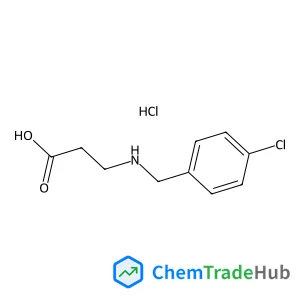
N-(4-Chlorobenzyl)-beta-alanine hydrochloride (1:1)
CAS Number:
1172479-10-5
Molecular Formula:
C10H13Cl2NO2
O. Kuzmina, E. Bordes, J. Schmauck, P. A. Hunt, J. P. Hallett, T. Welton
The solubilities of the metal halides LiF, LiCl, LiBr, LiI, NaF, NaCl, NaBr, NaI, KF, KCl, KBr, KI, RbCl, CsCl, CsI, were measured at temperatures ranging from 298.15 to 378.15 K in the ionic liquid 1-butyl-3-methylimidazolium trifluoromethanesulfonate ([C4C1im][OTf]). Li+, Na+ and K+ salts with anions matching the ionic liquid have also been investigated to determine how well these cations dissolve in [C4C1im][OTf]. This study compares the influence of metal cation and halide anion on the solubility of salts within this ionic liquid. The highest solubility found was for iodide salts, and the lowest solubility for the three fluoride salts. There is no outstanding difference in the solubility of salts with matching anions in comparison to halide salts. The experimental data were correlated employing several phase equilibria models, including ideal mixtures, van't Hoff, the λh (Buchowski) equation, the modified Apelblat equation, and the non-random two-liquid model (NRTL). It was found that the van't Hoff model gave the best correlation results. On the basis of the experimental data the thermodynamic dissolution parameters (ΔH, ΔS, and ΔG) were determined for the studied systems together with computed gas phase metathesis parameters. Dissolution depends on the energy difference between enthalpies of fusion and dissolution of the solute salt. This demonstrates that overcoming the lattice energy of the solid matrix is the key to the solubility of inorganic salts in ionic liquids.
Hainan Jiang, Yaolong He, Xiaolin Li, Zhiyao Jin, Huijie Yu, Dawei Li
DOI: 10.1039/D3CP04274J
Meixin Cheng
DOI: 10.1039/D3CP04975B
Yi Zeng, Wen Shi, Qian Peng, Yingli Niu, Zhiying Ma, Xiaoyan Zheng
DOI: 10.1039/D3CP03852A
Siqi Wang, Mingmin Zhong, Haibo Liu, Meng Ju
DOI: 10.1039/D3CP03678B
Jing Xie, Dongni Wu, Yangfang Liao, Xiaolong Cao, Shiyou Zhou
DOI: 10.1039/D3CP04382G
Chiara Liliana Boldrini, Andrea Francesca Quivelli, Filippo Maria Perna, Paolo Biagini, Vito Capriati, Alessandro Abbotto, Norberto Manfredi
DOI: 10.1039/D3SE00949A
Nicolas Velasquez, Fernanda B. Nunes, Jessica B. Martins, Denis Céolin, Laure Fillaud, Ralph Püttner, Maria Novella Piancastelli, Michael Odelius, Marcella Iannuzzi
DOI: 10.1039/D3CP04303G
Ting Li, Zhongfu Yan, Mengjiao Liu, Xinyu Liu, Liang Liu, Jiahao Chen, Jianping Long
DOI: 10.1039/D3SE01334K
Waste containing N-Methoxy-N-methyl-1,3-thiazole-5-carboxamide (CAS: 898825-89-3...
N-(4-Biphenylyl)dibenzo[b,d]furan-4-amine should be stored in a tightly sealed c...
The market for 3-Acetamido-5-amino-2,4,6-triiodobenzoic acid (CAS: 1713-07-1) is...
Benzyl 2-O-acetyl-3,4,6-tri-O-benzyl-beta-D-galactopyranoside (CAS: 61820-03-9) ...
2-Ethylpiperazine dihydrochloride (CAS: 438050-52-3) is regulated under the Glob...
1,1'-[1,3-Phenylenebis(methylene)]bis(3-methyl-1H-pyrrole-2,5-dione) (CAS: 11946...
Several alternatives can be used in the synthesis of 5-Fluoro-2-(1-pyrrolidinyl)...
Proper personal protective equipment (PPE) must be worn when handling this compo...
When handling 6-Bromoimidazo[1,2-a]pyridin-8-amine, it is important to wear appr...
Alternatives to (2S,4R)-4-(4-Nitrobenzyl)pyrrolidine-2-carboxylic acid hydrochlo...

Physical Chemistry Chemical Physics (PCCP) is an international journal co-owned by 19 physical chemistry and physics societies from around the world. This journal publishes original, cutting-edge research in physical chemistry, chemical physics and biophysical chemistry. To be suitable for publication in PCCP, articles must include significant innovation and/or insight into physical chemistry; this is the most important criterion that reviewers and Editors will judge against when evaluating submissions. The journal has a broad scope and welcomes contributions spanning experiment, theory, computation and data science. Topical coverage includes spectroscopy, dynamics, kinetics, statistical mechanics, thermodynamics, electrochemistry, catalysis, surface science, quantum mechanics, quantum computing and machine learning. Interdisciplinary research areas such as polymers and soft matter, materials, nanoscience, energy, surfaces/interfaces, and biophysical chemistry are welcomed if they demonstrate significant innovation and/or insight into physical chemistry. Joined experimental/theoretical studies are particularly appreciated when complementary and based on up-to-date approaches.
![[5-fluoro-2-(morpholine-4-carbonyl)phenyl]boronic acid structure](https://static.chemtradehub.com/structs/121/1217501-26-2-505c.webp "[5-fluoro-2-(morpholine-4-carbonyl)phenyl]boronic acid structure")