












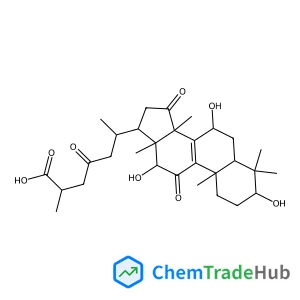
(3beta,7beta,12beta)-3,7,12-Trihydroxy-11,15,23-trioxolanost-8-en-26-oic acid
CAS Number:
98665-22-6
Molecular Formula:
C30H44O8
Tapabrata Dam, Sidhartha S. Jena, Dillip K. Pradhan
A series of ion conducting polymer–clay composites has been prepared using a solution casting technique. Relaxation dynamics and the ionic transport mechanism are systematically studied employing broadband dielectric spectroscopy over a wide frequency and temperature range. Among different phenomenological and theoretical models for ion conduction in disordered ionic conductors, conductivity isotherm spectra are analysed using the modified Almond–West and random free energy barrier model. Conductivity scaling suggests that the ionic transport mechanism is independent of temperature, and a similar inference is also obtained using scaled electrical modulus spectra. DC conductivity along with conductivity and segmental relaxation time following the Vogel–Tammann–Fulcher relationship suggests coupling between the ionic transport and segmental relaxation processes. Electrical modulus and dielectric formalism are used to understand the conductivity and segmental relaxation processes, respectively. The presence of first and second universality in the ionic transport mechanism is discussed using the real part of conductivity spectra and dielectric loss spectra. The crossover between the first and second universality is explained using the Kramer-Krönig approach. The ion diffusion coefficient is investigated using Ratner's classical approach in combination with the modified Stokes–Einstein relationship to correlate the coupled nature of the ion conduction mechanism and polymer segmental motion.
Ryansu Sai, Kazuhide Ueno, Kenta Fujii, Yohei Nakano, Naho Shigaki, Hiromori Tsutsumi
DOI: 10.1039/C6CP08386B
G. W. Driver, Y. Huang, A. Laaksonen, T. Sparrman, Y.-L. Wang, P.-O. Westlund
DOI: 10.1039/C6CP05801A
Carlie M. Novak, Ryan C. Fortenberry
DOI: 10.1039/C6CP08140A
Christof Drechsel-Grau, Dominik Marx
DOI: 10.1039/C6CP05679B
Claudio L. A. Berli, Magalí Mercuri, Martín G. Bellino
DOI: 10.1039/C6CP06602J
Alexandra R. McIsaac, David A. Mazziotti
DOI: 10.1039/C6CP07563K
DOI: 10.1039/C6CP06939H
K. E. A. Hooper, H. K. H. Lee, M. J. Newman, S. Meroni, J. Baker, T. M. Watson, W. C. Tsoi
DOI: 10.1039/C6CP05123E
Hao Jin, Jianwei Li, Ying Dai, Yadong Wei
DOI: 10.1039/C6CP08158D
When handling 4-(2-Furylmethyl)thiomorpholine 1,1-dioxide (CAS: 79206-94-3), it ...
When handling 4-Chloro-N-[2-(4-morpholinyl)ethyl]benzamide (CAS: 71320-77-9), it...
Waste containing this compound (CAS: 62921-74-8) should be handled according to ...
Waste containing (S)-Methyl 2-amino-3-cyclohexylpropanoate should be collected i...
This compound can be synthesized using a multi-step process involving the conjug...
There are several alternatives to (2E)-3-(3,4-Dichlorophenyl)acrylic acid in syn...
Ethyl 6-(2-nitrophenyl)imidazo[2,1-b][1,3]thiazole-3-carboxylate (CAS: 925437-84...
Waste containing 2-(1,3-Thiazol-2-yl)ethanamine (CAS: 18453-07-1) should be coll...
Methyl 5-iodo-2-methylbenzoate can be synthesized through the iodination of meth...
5-Chloro[1,2,4]triazolo[1,5-a]pyridine is commonly synthesized via the condensat...

Physical Chemistry Chemical Physics (PCCP) is an international journal co-owned by 19 physical chemistry and physics societies from around the world. This journal publishes original, cutting-edge research in physical chemistry, chemical physics and biophysical chemistry. To be suitable for publication in PCCP, articles must include significant innovation and/or insight into physical chemistry; this is the most important criterion that reviewers and Editors will judge against when evaluating submissions. The journal has a broad scope and welcomes contributions spanning experiment, theory, computation and data science. Topical coverage includes spectroscopy, dynamics, kinetics, statistical mechanics, thermodynamics, electrochemistry, catalysis, surface science, quantum mechanics, quantum computing and machine learning. Interdisciplinary research areas such as polymers and soft matter, materials, nanoscience, energy, surfaces/interfaces, and biophysical chemistry are welcomed if they demonstrate significant innovation and/or insight into physical chemistry. Joined experimental/theoretical studies are particularly appreciated when complementary and based on up-to-date approaches.
![1-Naphthalenesulfonic acid, 2-[(2-hydroxy-1-naphthalenyl)azo]-, bariumsalt (2:1) structure](https://static.chemtradehub.com/structs/110/1103-38-4-0b33.webp "1-Naphthalenesulfonic acid, 2-[(2-hydroxy-1-naphthalenyl)azo]-, bariumsalt (2:1) structure")





