












Large spin-filtering effect in Ti-doped defective zigzag graphene nanoribbon
Literature Information
Publication Date
2016-05-26
DOI
10.1039/C6CP01601D
Impact Factor
3.676
Authors
Sherif Abdulkader Tawfik, X. Y. Cui, S. P. Ringer, C. Stampfl
View Original
Abstract
Through first-principles calculations using the nonequilibrium Green's function formalism together with density functional theory, we study the conductance of double-vacancy zigzag graphene nanoribbons doped with four transition metal atoms Ti, V, Cr and Fe. We show that Ti doping induces large spin-filtering with an efficiency in excess of 90% for bias voltages below 0.5 V, while the other metal adatoms do not induce large spin filtering. This is despite the fact that the Ti dopant possesses small spin moment, while large moments reside on V, Cr and Fe dopants. Our analysis shows that the suppression of transmission in the spin-down channel in the Ti-doped graphene nanoribbon, thus the large spin filtering efficiency, is due to transmission anti-resonance arising from destructive quantum interference. These findings suggest that the decoration of graphene with titanium, and possibly other transition metals, can act as effective spin filters for nanospintronic applications.
Related Literature
The copolymerization of SO2 with propylene oxide mediated by organic ammonium salts: a comprehensive study of the main-chain structure, living polymerization character and regioselectivity
Xian-Chao Jin, Bai-Hao Ren, Ge-Ge Gu, Tian-Jun Yue, Wei-Min Ren
2022-04-30
Paper
DOI: 10.1039/D2PY00185C
Synthesis of block copolymers containing 3-chloro-2-hydroxypropyl methacrylate by NMP – a versatile platform for functionalization
Michael Klein
2022-07-08
Paper
DOI: 10.1039/D2PY00611A
Effect of radical copolymerization of the (oxa)norbornene end-group of RAFT-prepared macromonomers on bottlebrush copolymer synthesis via ROMP
Daniel J. Keddie
2022-02-02
Paper
DOI: 10.1039/D1PY01599K
Ruthenium-catalyzed diazoacetate/cyclooctene metathesis copolymerization
Minghang Ji, Shengquan Zheng, Chen Zou, Min Chen
2022-07-30
Paper
DOI: 10.1039/D2PY00886F
Microfluidic-supported synthesis of anisotropic polyvinyl methacrylate nanoparticles via interfacial agents
Nikunjkumar R. Visaveliya, Firdaus Khatoon, Jin Xu, Kelvin Leo, Lauren St. Peter, Christopher Chan, Tatiana Mikhailova, Visar Bexheti, Ashni Kapadia, Piyali Maity, William P. Carbery
2022-04-11
Paper
DOI: 10.1039/D1PY01729B
Cross-linked supramolecular polymer networks constructed by pillar[5]arene-based host–guest recognition and coordination/oxidation of catechol
Yuezhou Liu, Baodong Zhao, Bin Chen, Bingbing Shi
2022-06-01
Paper
DOI: 10.1039/D2PY00476C
Chain-folding regulated self-assembly, outstanding bactericidal activity and biofilm eradication by biomimetic amphiphilic polymers
Ranajit Barman, Debes Ray, V. K. Aswal, Suhrit Ghosh
2022-07-01
Paper
DOI: 10.1039/D2PY00625A
High-efficiency solution-processed green thermally activated delayed fluorescence OLEDs using a polymer-small molecule mixed host
Seunguk Cho, Na Yeon Kwon, Chai Won Kim, Hyoseong Lee, Jung Min Ha, Hyung Jong Kim, Han Young Woo, Sungnam Park, Min Ju Cho, Dong Hoon Choi
2022-02-25
Paper
DOI: 10.1039/D1PY01700D
Effect of anions on the phase transition temperature of two structurally isomeric polymers: poly(N-isopropylacrylamide) and poly(2-isopropyl-2-oxazoline)
Taehun Chung, Jihoon Han, Young Jae Kim, Kyeong-Jun Jeong, Jun Mo Koo, Jemin Lee, Hyung Gyu Park, Taiha Joo
2022-07-06
Paper
DOI: 10.1039/D2PY00543C
You might also like
Compound Q&A
What are the main uses of 1-(3-Aminophenyl)-3-[(3R)-1-(3,3-dimethyl-2-oxobutyl)-2-oxo-5-(2-pyridinyl)-2,3-dihydro-1H-1,4-benzodiazepin-3-yl]urea (CAS: 155412-88-7)?
This compound is mainly used as an intermediate in the synthesis of antipsychoti...
155412-88-71-(3-Aminophenyl)-3-...
Compound Q&A
How should waste containing 1-(D-Ribofuranosyl)-1,4-dihydro-3-pyridinecarboxamide (CAS: 19132-12-8) be handled?
Waste containing 1-(D-Ribofuranosyl)-1,4-dihydro-3-pyridinecarboxamide (CAS: 191...
19132-12-81-(D-Ribofuranosyl)-...
Compound Q&A
What regulatory guidelines apply to 2-Methyl-2-propanyl 3-bromo-3-(hydroxymethyl)-1-azetidinecarboxylate (CAS: 2007919-81-3)?
2-Methyl-2-propanyl 3-bromo-3-(hydroxymethyl)-1-azetidinecarboxylate (CAS: 20079...
2007919-81-32-Methyl-2-propanyl ...
Compound Q&A
What is N-(4-Chloro-2-pyridinyl)acetamide (CAS: 245056-66-0)?
N-(4-Chloro-2-pyridinyl)acetamide (CAS: 245056-66-0) is a chemical compound with...
245056-66-0N-(4-Chloro-2-pyridi...
Compound Q&A
What is 5-Chloro-2-hydroxybenzoic acid (CAS: 321-14-2)?
5-Chloro-2-hydroxybenzoic acid, also known as 5-chlorosalicylic acid, is an arom...
321-14-25-Chloro-2-hydroxybe...
Compound Q&A
What precautions should be taken when handling 1,1-Dichloro-1-fluoroethane (CAS: 1717-00-6)?
When handling 1,1-Dichloro-1-fluoroethane (CAS: 1717-00-6), it is important to u...
1717-00-61,1-Dichloro-1-fluor...
Compound Q&A
What are the physical and chemical properties of Fmoc-(2S,3R)-3-phenylpyrrolidine-2-carboxylic acid (CAS: 281655-32-1)?
Fmoc-(2S,3R)-3-phenylpyrrolidine-2-carboxylic acid is a white crystalline solid ...
281655-32-1Fmoc-(2S,3R)-3-pheny...
Compound Q&A
What are the main uses of 4-Amino-5-bromo-2-pyridinecarboxylic acid (CAS: 1363381-01-4)?
4-Amino-5-bromo-2-pyridinecarboxylic acid is primarily used as a precursor in th...
1363381-01-44-Amino-5-bromo-2-py...
Compound Q&A
What precautions should be taken when handling (S)-tert-butyl 2-((2-(4-bromophenyl)-2-oxoethyl)carbamoyl)pyrrolidine-1-carboxylate (CAS: 1007881-98-2)?
Handling this compound should be done with personal protective equipment (PPE) i...
1007881-98-2(S)-tert-butyl 2-((2...
Compound Q&A
What precautions should be taken when handling 8-bromo-2,2-dimethyl-3,4-dihydro-2H-1,4-benzoxazin-3-one (CAS: 688363-73-7)?
When handling 8-bromo-2,2-dimethyl-3,4-dihydro-2H-1,4-benzoxazin-3-one, use prop...
688363-73-78-bromo-2,2-dimethyl...
Source Journal
Physical Chemistry Chemical Physics

CiteScore:
5.5
Self-citation Rate:
10.3%
Articles per Year:
3036
Physical Chemistry Chemical Physics (PCCP) is an international journal co-owned by 19 physical chemistry and physics societies from around the world. This journal publishes original, cutting-edge research in physical chemistry, chemical physics and biophysical chemistry. To be suitable for publication in PCCP, articles must include significant innovation and/or insight into physical chemistry; this is the most important criterion that reviewers and Editors will judge against when evaluating submissions. The journal has a broad scope and welcomes contributions spanning experiment, theory, computation and data science. Topical coverage includes spectroscopy, dynamics, kinetics, statistical mechanics, thermodynamics, electrochemistry, catalysis, surface science, quantum mechanics, quantum computing and machine learning. Interdisciplinary research areas such as polymers and soft matter, materials, nanoscience, energy, surfaces/interfaces, and biophysical chemistry are welcomed if they demonstrate significant innovation and/or insight into physical chemistry. Joined experimental/theoretical studies are particularly appreciated when complementary and based on up-to-date approaches.
Recommended Compounds
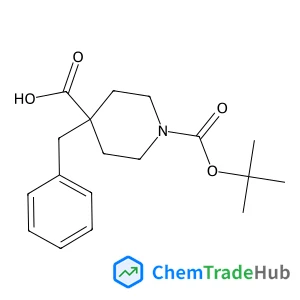
4-Benzyl-1-(tert-butoxycarbonyl)piperidine-4-carboxylic acid
CAS Number:
170838-87-6
Molecular Formula:
C18H25NO4
Recommended Suppliers






Disclaimer
This page provides academic journal information for reference and research purposes only. We are not affiliated with any journal publishers and do not handle publication submissions. For publication-related inquiries, please contact the respective journal publishers directly.
If you notice any inaccuracies in the information displayed, please contact us at support@chemtradehub.com. We will promptly review and address your concerns.