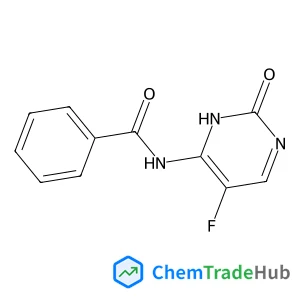
N-(5-Fluoro-2-oxo-2,3-dihydro-4-pyrimidinyl)benzamide
CAS Number:
10357-07-0
Molecular Formula:
C11H8FN3O2
Sonia Marggi Poullain, David V. Chicharro, Alexandre Zanchet, Marta G. González, Luis Rubio-Lago, María L. Senent, Alberto García-Vela, Luis Bañares
The photodissociation dynamics of the methyl radical from the 3s and 3pz Rydberg states have been studied using the velocity map and slice ion imaging in combination with pump–probe nanosecond laser pulses. The reported translational energy and angular distributions of the H(2S) photofragment detected by (2+1) REMPI highlight different dissociation mechanisms for the 3s and 3pz Rydberg states. A narrow peak in the translational energy distribution and an anisotropic angular distribution characterize the fast 3s photodissociation, while for the 3pz state Boltzmann-type translational energy and isotropic angular distributions are found. High level ab initio calculations have been performed in order to elucidate the photodissociation mechanisms from the two Rydberg states and to rationalize the experimental results. The calculated potential energy curves highlight a typical predissociation mechanism for the 3s state, characterized by the coupling between the 3s Rydberg state and a valence repulsive state. On the other hand, the photodissociation on the 3pz state is initiated by a predissociation process due to the coupling between the 3pz Rydberg state and a valence repulsive state and constrained, later on, by two conical intersections that allow the system to relax to lower electronic states. Such a mechanism opens up different reaction pathways leading to CH2 photofragments in different electronic states and inducing a transfer of energy between translational and internal modes.
Patrick J. Hrdlicka, T. Santhosh Kumar, Jesper Wengel
DOI: 10.1039/B506986F
Takashi Jin, Fumihiko Fujii, Hiroshi Sakata, Mamoru Tamura, Masataka Kinjo
DOI: 10.1039/B506608E
Sayam Sen Gupta, Krishnaswami S. Raja, Eiton Kaltgrad, Erica Strable, M. G. Finn
DOI: 10.1039/B502444G
Frank Hauke, Andrew J. Myles, Julius Rebek Jr.
DOI: 10.1039/B506048F
Dirk Jan V. C. van Steenis, Olivier R. P. David, Gino P. F. van Strijdonck, Jan H. van Maarseveen, Joost N. H. Reek
DOI: 10.1039/B507776A
Tsutomu Kimura, Toshiaki Murai
DOI: 10.1039/B507755A
Steven Dickson, Darrell Dean, Robert. D. Singer
DOI: 10.1039/B508400H
Waste containing N-Methoxy-N-methyl-1,3-thiazole-5-carboxamide (CAS: 898825-89-3...
N-(4-Biphenylyl)dibenzo[b,d]furan-4-amine should be stored in a tightly sealed c...
The market for 3-Acetamido-5-amino-2,4,6-triiodobenzoic acid (CAS: 1713-07-1) is...
Benzyl 2-O-acetyl-3,4,6-tri-O-benzyl-beta-D-galactopyranoside (CAS: 61820-03-9) ...
2-Ethylpiperazine dihydrochloride (CAS: 438050-52-3) is regulated under the Glob...
1,1'-[1,3-Phenylenebis(methylene)]bis(3-methyl-1H-pyrrole-2,5-dione) (CAS: 11946...
Several alternatives can be used in the synthesis of 5-Fluoro-2-(1-pyrrolidinyl)...
Proper personal protective equipment (PPE) must be worn when handling this compo...
When handling 6-Bromoimidazo[1,2-a]pyridin-8-amine, it is important to wear appr...
Alternatives to (2S,4R)-4-(4-Nitrobenzyl)pyrrolidine-2-carboxylic acid hydrochlo...

Physical Chemistry Chemical Physics (PCCP) is an international journal co-owned by 19 physical chemistry and physics societies from around the world. This journal publishes original, cutting-edge research in physical chemistry, chemical physics and biophysical chemistry. To be suitable for publication in PCCP, articles must include significant innovation and/or insight into physical chemistry; this is the most important criterion that reviewers and Editors will judge against when evaluating submissions. The journal has a broad scope and welcomes contributions spanning experiment, theory, computation and data science. Topical coverage includes spectroscopy, dynamics, kinetics, statistical mechanics, thermodynamics, electrochemistry, catalysis, surface science, quantum mechanics, quantum computing and machine learning. Interdisciplinary research areas such as polymers and soft matter, materials, nanoscience, energy, surfaces/interfaces, and biophysical chemistry are welcomed if they demonstrate significant innovation and/or insight into physical chemistry. Joined experimental/theoretical studies are particularly appreciated when complementary and based on up-to-date approaches.