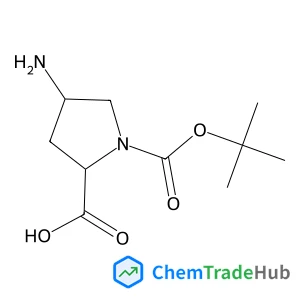
(2R,4R)-1-Boc-4-Aminopyrrolidine-2-carboxylic acid
CAS Number:
132622-98-1
Molecular Formula:
C10H18N2O4
The first page of this article is displayed as the abstract.

Bioorganic & Medicinal Chemistry Letters

Medicinal Chemistry Research

Electroanalysis

Critical Reviews in Solid State and Materials Sciences

Herald of the Russian Academy of Sciences

Colloid Journal

Acta Metallurgica Sinica-English Letters

Atomization and Sprays

Chinese Journal of Chemistry

Journal of Asian Natural Products Research
Diako Ebrahimi, Edith Chow, Justin J. Gooding, David B. Hibbert
DOI: 10.1039/B804811H
Aiping Fan, Choiwan Lau, Jianzhong Lu
DOI: 10.1039/B817047A
Fan Yang
DOI: 10.1039/B903434J
Ross Stevenson, Robert J. Stokes, Donna MacMillan, David Armstrong, Karen Faulds, Roger Wadsworth, Suma Kunuthur, Colin J. Suckling, Duncan Graham
DOI: 10.1039/B905562B
Dong Xiang, Michele Konigsberger, Busolo Wabuyele, Karl Hornung, James Cheney
DOI: 10.1039/B821836F
Pablo Domínguez de María, Alexandra Martinsson
DOI: 10.1039/B815740E
Antti Valanne, Jouko Peltonen, Tero Soukka, Pekka Hänninen, Harri Härmä
DOI: 10.1039/B821210D
Rosaria Ciriminna, Mario Pagliaro
DOI: 10.1039/B819417C
When considering alternatives to 1-(4-Chlorophenyl)-N-hydroxymethanimine (CAS: 3...
This compound should be stored in a cool, dry place away from direct sunlight. I...
3-(4-Bromophenyl)-5-(2-fluorophenyl)-1,2,4-oxadiazole is synthesized through a m...
5-Chloro-2-(4-chlorophenyl)-4-methyl-6-[3-(1-piperidinyl)propoxy]pyrimidine (CAS...
2-Chloro-4-(difluoromethoxy)pyridine is used in the pharmaceutical industry for ...
3-Chloro-6-methylpyridazine (CAS: 1121-79-5) is classified under the Globally Ha...
Several alternatives can be used in the synthesis of Methyl 4,5-dimethyl-2-nitro...
Alternatives to (2E,2'E)-3,3'-(1,4-Phenylene)bisacrylaldehyde include other acry...
3-Amino-5-chloropyridin-2-ol hydrochloride is an organic compound with the CAS n...
When handling 6,7-Difluoro-2,3-dihydro-4H-chromen-4-one, it is essential to wear...

ChemComm publishes urgent research which is of outstanding significance and interest to experts in the field, while also appealing to the journal’s broad chemistry readership. Our communication format is ideally suited to short, urgent studies that are of such importance that they require accelerated publication. Our scope covers all topics in chemistry, and research at the interface of chemistry and other disciplines (such as materials science, nanoscience, physics, engineering and biology) where there is a significant novelty in the chemistry aspects. Major topic areas covered include: Analytical Chemistry Catalysis Chemical Biology and medicinal chemistry Computational Chemistry and Machine Learning Energy and sustainable chemistry Environmental Chemistry Green Chemistry Inorganic Chemistry Materials Chemistry Nanoscience Organic Chemistry Physical Chemistry Polymer Chemistry Supramolecular Chemistry