


Is the manifestation of the local dynamics in the spin–lattice NMR relaxation in dendrimers sensitive to excluded volume interactions?
Literature Information
Publication Date
2016-08-17
DOI
10.1039/C6CP01520D
Impact Factor
3.676
Authors
View Original
Abstract
The effect of excluded volume (EV) interactions on the manifestation of the local dynamics in the spin–lattice NMR relaxation in dendrimers has been studied by using Brownian dynamics simulations. The study was motivated by the theory developed by Markelov et al., [J. Chem. Phys., 2014, 140, 244904] for a Gaussian dendrimer model without EV interactions. The theory connects the experimentally observed dependence of the spin–lattice relaxation rate 1/T1H on the location of NMR active groups with the restricted flexibility (semiflexibility) of dendrimers. Semiflexibility was introduced through the correlations between the orientations of different segments. However, these correlations exist even in flexible dendrimer models with EV interactions. We have simulated coarse-grained flexible and semiflexible dendrimer models with and without EV interactions. Every dendrimer segment consisted of two rigid bonds. Semiflexibility was introduced through a potential which restricts the fluctuations of angles between neighboring bonds but does not change orientational correlations in the EV model as compared to the flexible case. The frequency dependence of the reduced 1/T1H(ωH) for segments and bonds belonging to different dendrimer shells was calculated. It was shown that the main effect of EV interactions consists of a much stronger contribution of the overall dendrimer rotation to the dynamics of dendrimer segments as compared to phantom models. After the exclusion of this contribution the manifestation of internal dynamics in spin–lattice NMR relaxation appears to be practically insensitive to EV interactions. For the flexible models, the position ωmax of the peak of the modified 1/T1H(ωH) does not depend on the shell number. For semiflexible models, the maximum of 1/T1H(ωH) for internal segments or bonds shifts to lower frequencies as compared to outer ones. The dependence of ωmax on the number of dendrimer shells appears to be universal for segments and bonds in dendrimer models with and without EV interactions.
Recommended Journals

Mini-Reviews in Medicinal Chemistry

Advanced Engineering Materials

Coloration Technology

Angewandte Chemie International Edition

Green Chemistry

Journal of Enzyme inhibition and Medicinal Chemistry

Current Pharmaceutical Biotechnology

Environmental Toxicology and Pharmacology

Lab on a Chip

European Journal of Organic Chemistry
Related Literature
Construction of Pd–TiOx interfaces for selective hydrodeoxygenation of CO bonds in vanillin by supporting Pd nanoparticles on ETS-10 zeolite
Jianbin Huang, Chang Zhou, Jian Zhang, Hao Meng, Shiyao Lu
2023-11-14
Paper
DOI: 10.1039/D3SU00271C
Pulsed electric field assisted extraction of soluble proteins from nettle leaves (Urtica dioica L.): kinetics and optimization using temperature and specific energy
Ivan Shorstkii, Suse Botelho da Silva, Stefan Toepfl, Alica Lammerskitten, Claudia Siemer
2023-09-19
Paper
DOI: 10.1039/D3FB00053B
Formation of nanoporous aerogels from defatted rice bran via supercritical carbon dioxide drying
Sumanjot Kaur, Jingyi Chen
2023-10-25
Paper
DOI: 10.1039/D3FB00069A
Effect of temperature and packaging materials on the shelf-life stability and in vitro properties of microencapsulated and spray-dried synbiotic legume-based instant beverage powder
Smriti Chaturvedi, Snehasis Chakraborty
2023-10-27
Paper
DOI: 10.1039/D3FB00094J
New buffer systems for photopainting of single biomolecules
Christoph Naderer, Heinrich Krobath, Dmitry Sivun, Georgii Gvindzhiliia, Thomas A. Klar, Jaroslaw Jacak
2023-10-07
Paper
DOI: 10.1039/D3LF00125C
New sources of genipin-rich substances for crosslinking future manufactured bio-based materials
Maryam Nejati, Yuan Fang, Boyang Guo, Amparo Jiménez-Quero, Antonio J. Capezza, Marcos A. Sabino
2023-11-09
Paper
DOI: 10.1039/D3SU00303E
Encapsulation of fish oil and essential fatty acids by spray drying
Afroza Sultana, Shuji Adachi, Hidefumi Yoshii
2023-08-25
Review Article
DOI: 10.1039/D3FB00099K
N-doped graphene nanosheets-based optical nano switch for the selective detection of guanine and Pb2+
Gouri Sankar Das, Manish Srivastava, Kumud Malika Tripathi
2023-10-17
Paper
DOI: 10.1039/D3SU00328K
A green process for the specific decomposition of chicken feather keratin into polythiol building blocks
Julia Diener, Christian Bartsch, Florian Dietrich, Claudia Falcke, Iva Anic, Steffen Roth, Andreas Taden, Michael Richter
2023-12-07
Paper
DOI: 10.1039/D3SU00269A
Recent advancements towards the green synthesis of carbon quantum dots as an innovative and eco-friendly solution for metal ion sensing and monitoring
Jyoti Dhariwal, Gyandshwar K. Rao, Dipti Vaya
2023-12-14
Critical Review
DOI: 10.1039/D3SU00375B
You might also like
Compound Q&A
Is 2-(2-chloroacetamido)-3-phenylpropanoic acid (CAS: 7765-11-9) safe?
2-(2-Chloroacetamido)-3-phenylpropanoic acid (CAS: 7765-11-9) is generally consi...
7765-11-92-(2-chloroacetamido...
Compound Q&A
Is 2-(Benzyloxy)-5-bromobenzoic acid (CAS: 62176-31-2) safe?
2-(Benzyloxy)-5-bromobenzoic acid can be handled safely if appropriate precautio...
62176-31-22-(Benzyloxy)-5-brom...
Compound Q&A
What is (4-Methyl-1,2,5-oxadiazol-3-yl)methanamine hydrochloride (CAS: 1159825-48-5)?
(4-Methyl-1,2,5-oxadiazol-3-yl)methanamine hydrochloride is a chemical compound ...
1159825-48-5(4-Methyl-1,2,5-oxad...
Compound Q&A
What is 2-(5-Hexylthiophen-2-yl)-4,4,5,5-tetramethyl-1,3,2-dioxaborolane (CAS: 917985-54-7)?
2-(5-Hexylthiophen-2-yl)-4,4,5,5-tetramethyl-1,3,2-dioxaborolane (CAS: 917985-54...
917985-54-72-(5-Hexylthiophen-2...
Compound Q&A
Are there alternatives to 4-(8-Methyl-9H-1,3-dioxolo[4,5-h][2,3]benzodiazepin-5-yl)benzenamine (CAS: 102771-26-6) in synthesis?
While 4-(8-Methyl-9H-1,3-dioxolo[4,5-h][2,3]benzodiazepin-5-yl)benzenamine (CAS:...
102771-26-64-(8-Methyl-9H-1,3-d...
Compound Q&A
What is the market or research trend for tert-butyl 3-hydroxy-4,5,7,8-tetrahydro-2H-pyrazolo[3,4-d]azepine-6-carboxylate (CAS: 851376-80-2)?
The market for tert-butyl 3-hydroxy-4,5,7,8-tetrahydro-2H-pyrazolo[3,4-d]azepine...
851376-80-2tert-butyl 3-hydroxy...
Compound Q&A
How should waste containing 3,5-Diamino-1H-pyrazole-4-carbonitrile (CAS: 6844-58-2) be handled?
Waste containing 3,5-Diamino-1H-pyrazole-4-carbonitrile (CAS: 6844-58-2) should ...
6844-58-23,5-Diamino-1H-pyraz...
Compound Q&A
How is (6-Fluoro-3-pyridinyl)boronic acid (CAS: 351019-18-6) typically synthesized?
(6-Fluoro-3-pyridinyl)boronic acid can be synthesized through the reaction of 6-...
351019-18-6(6-Fluoro-3-pyridiny...
Compound Q&A
What industries use Dibenzyl carbonimidoylbiscarbamate (CAS: 10065-79-9)?
Dibenzyl carbonimidoylbiscarbamate (CAS: 10065-79-9) finds applications in vario...
10065-79-9Dibenzyl carbonimido...
Compound Q&A
What is the market or research trend for (beta,beta,2,3,4,5,6-~2~H_7_)Phenylalanine (CAS: 74228-83-4)?
The market for (beta,beta,2,3,4,5,6-~2~H_7_)Phenylalanine (CAS: 74228-83-4) is g...
74228-83-4(beta,beta,2,3,4,5,6...
Source Journal
Physical Chemistry Chemical Physics

CiteScore:
5.5
Self-citation Rate:
10.3%
Articles per Year:
3036
Physical Chemistry Chemical Physics (PCCP) is an international journal co-owned by 19 physical chemistry and physics societies from around the world. This journal publishes original, cutting-edge research in physical chemistry, chemical physics and biophysical chemistry. To be suitable for publication in PCCP, articles must include significant innovation and/or insight into physical chemistry; this is the most important criterion that reviewers and Editors will judge against when evaluating submissions. The journal has a broad scope and welcomes contributions spanning experiment, theory, computation and data science. Topical coverage includes spectroscopy, dynamics, kinetics, statistical mechanics, thermodynamics, electrochemistry, catalysis, surface science, quantum mechanics, quantum computing and machine learning. Interdisciplinary research areas such as polymers and soft matter, materials, nanoscience, energy, surfaces/interfaces, and biophysical chemistry are welcomed if they demonstrate significant innovation and/or insight into physical chemistry. Joined experimental/theoretical studies are particularly appreciated when complementary and based on up-to-date approaches.
Recommended Compounds

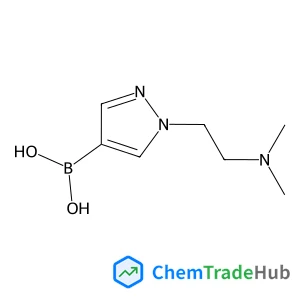
(1-(2-(Dimethylamino)ethyl)-1H-pyrazol-4-yl)boronic acid
CAS Number:
1086063-73-1
Molecular Formula:
C7H14BN3O2
![2-[(E)-(2-Methoxyphenyl)diazenyl]-3-oxo-N-(2-oxo-2,3-dihydro-1H-benzimidazol-5-yl)butanamide structure](https://static.chemtradehub.com/structs/821/82199-12-0-f1d0.webp "2-[(E)-(2-Methoxyphenyl)diazenyl]-3-oxo-N-(2-oxo-2,3-dihydro-1H-benzimidazol-5-yl)butanamide structure")
2-[(E)-(2-Methoxyphenyl)diazenyl]-3-oxo-N-(2-oxo-2,3-dihydro-1H-benzimidazol-5-yl)butanamide
CAS Number:
82199-12-0
Molecular Formula:
C18H17N5O4
Recommended Suppliers






Disclaimer
This page provides academic journal information for reference and research purposes only. We are not affiliated with any journal publishers and do not handle publication submissions. For publication-related inquiries, please contact the respective journal publishers directly.
If you notice any inaccuracies in the information displayed, please contact us at support@chemtradehub.com. We will promptly review and address your concerns.