












![Ethyl thieno[3,2-f]quinoline-2-carboxylate structure](https://static.chemtradehub.com/structs/299/29948-26-3-f62b.webp "Ethyl thieno[3,2-f]quinoline-2-carboxylate structure")
Protonation induces base rotation of purine nucleotides pdGuo and pGuo
Literature Information
Publication Date
2016-05-09
DOI
10.1039/C6CP01354F
Impact Factor
3.676
Authors
R. R. Wu, C. C. He, L. A. Hamlow, Y.-w. Nei, G. Berden, M. T. Rodgers
View Original
Abstract
Infrared multiple photon dissociation (IRMPD) action spectra of the protonated forms of 2′-deoxyguanosine-5′-monophosphate and guanosine-5′-monophosphate, [pdGuo+H]+ and [pGuo+H]+, are measured over the IR fingerprint and hydrogen-stretching regions using the FELIX free electron laser and an OPO/OPA laser system. Electronic structure calculations are performed to generate low-energy conformations of [pdGuo+H]+ and [pGuo+H]+ and determine their relative stabilities at the B3LYP/6-311+G(2d,2p)//B3LYP/6-311+G(d,p) and MP2(full)/6-311+G(2d,2p)//B3LYP/6-311+G(d,p) levels of theory. Comparative analyses of the measured IRMPD action spectra and B3LYP/6-311+G(d,p) linear IR spectra computed for the low-energy conformers are performed to determine the most favorable site of protonation and the conformers present in the experiments. These comparisons and the computed energetics find that N7 protonation is considerably preferred over O6 and N3, and the N7 protonated ground-state conformers of [pdGuo+H]+ and [pGuo+H]+ are populated in the experiments. The 2′-hydroxyl substituent does not significantly impact the stable low-energy conformers of [pdGuo+H]+vs. those of [pGuo+H]+. The effect of the 2′-hydroxyl substituent is primarily reflected in the relative intensities of the measured IRMPD bands, as the IRMPD profiles of [pdGuo+H]+ and [pGuo+H]+ are quite similar. Comparisons to previous IRMPD spectroscopy investigations of the protonated forms of the guanine nucleosides, [dGuo+H]+ and [Guo+H]+, and deprotonated forms of the guanine nucleotides, [pdGuo–H]− and [pGuo–H]−, provide insight into the effects of the phosphate moiety and protonation on the conformational features of the nucleobase and sugar moieties. Protonation is found to induce base rotation of the guanine residue to an anti orientation vs. the syn orientation found for the deprotonated forms of the guanine nucleotides.
Recommended Journals
Related Literature
Electrochemical trifluoromethylation/semipinacol rearrangement sequences of alkenyl alcohols: synthesis of β-CF3-substituted ketones
Hye Im Jung, Yubin Kim, Dae Young Kim
2019-03-07
Communication
DOI: 10.1039/C9OB00373H
Perylenequinonoid-catalyzed photoredox activation for the direct arylation of (het)arenes with sunlight
Zhaocheng Tang, Wenhao Bao, Jia Li, Baodang Guo, Shuping Huang, Yan Zhang, Yijian Rao
2019-04-09
Paper
DOI: 10.1039/C9OB00659A
Rhodium(iii)-catalyzed carboxylate-directed ortho-selective thiolation of benzoic acids
Dongjie Wang, Kehan Zhou, Jingyu Zhang, Yingsheng Zhao
2020-09-18
Research Article
DOI: 10.1039/D0QO00940G
The synthesis of cyanoformamides via a CsF-promoted decyanation/oxidation cascade of 2-dialkylamino-malononitriles‡
Lin-Sheng Lei, Cao-Gen Xue, Xue-Tao Xu, Da-Ping Jin, Wen Bao, Huan Liang, Kun Zhang, Abdullah M. Asiri
2019-03-19
Communication
DOI: 10.1039/C9OB00510B
An improved synthesis of the [5.6.7]-tricyclic core of cyrneine B and glaucopine C
Guo-Jie Wu, Xiu Han
2020-08-25
Research Article
DOI: 10.1039/D0QO00758G
Iron catalyzed ketoalkylation and ketoalkylation/etherification of styrenes initiated by selective C–C bond cleavage
Meng-Ting Suo, Shuo Yang, Jun-Cheng Yang, Ze-Yu Liu, Jun-Jie Zhang, Li-Na Guo
2020-07-15
Research Article
DOI: 10.1039/D0QO00671H
A diversity of recently reported methodology for asymmetric imine reduction
Jonathan Barrios-Rivera, Yingjian Xu, Martin Wills, Vijyesh K. Vyas
2020-09-03
Review Article
DOI: 10.1039/D0QO00794C
A vinylogous Michael reaction of 2-furanone dimers with α,β-unsaturated nitroolefins for constructing chiral γ,γ-disubstituted butenolides
Cairong Zhang, Yongyi Chen, Aiqin Liu, Xinyu Wang, Chuna Yan, Xuechao Liu, Xiaoru Zhang, Ying Li, Ye Yuan, Zemei Ge, Jingxiang Pang, Yongshuai Chai, Xin Wang
2020-05-09
Research Article
DOI: 10.1039/D0QO00376J
You might also like
Compound Q&A
Is 2-(2-chloroacetamido)-3-phenylpropanoic acid (CAS: 7765-11-9) safe?
2-(2-Chloroacetamido)-3-phenylpropanoic acid (CAS: 7765-11-9) is generally consi...
7765-11-92-(2-chloroacetamido...
Compound Q&A
Is 2-(Benzyloxy)-5-bromobenzoic acid (CAS: 62176-31-2) safe?
2-(Benzyloxy)-5-bromobenzoic acid can be handled safely if appropriate precautio...
62176-31-22-(Benzyloxy)-5-brom...
Compound Q&A
What is (4-Methyl-1,2,5-oxadiazol-3-yl)methanamine hydrochloride (CAS: 1159825-48-5)?
(4-Methyl-1,2,5-oxadiazol-3-yl)methanamine hydrochloride is a chemical compound ...
1159825-48-5(4-Methyl-1,2,5-oxad...
Compound Q&A
What is 2-(5-Hexylthiophen-2-yl)-4,4,5,5-tetramethyl-1,3,2-dioxaborolane (CAS: 917985-54-7)?
2-(5-Hexylthiophen-2-yl)-4,4,5,5-tetramethyl-1,3,2-dioxaborolane (CAS: 917985-54...
917985-54-72-(5-Hexylthiophen-2...
Compound Q&A
Are there alternatives to 4-(8-Methyl-9H-1,3-dioxolo[4,5-h][2,3]benzodiazepin-5-yl)benzenamine (CAS: 102771-26-6) in synthesis?
While 4-(8-Methyl-9H-1,3-dioxolo[4,5-h][2,3]benzodiazepin-5-yl)benzenamine (CAS:...
102771-26-64-(8-Methyl-9H-1,3-d...
Compound Q&A
What is the market or research trend for tert-butyl 3-hydroxy-4,5,7,8-tetrahydro-2H-pyrazolo[3,4-d]azepine-6-carboxylate (CAS: 851376-80-2)?
The market for tert-butyl 3-hydroxy-4,5,7,8-tetrahydro-2H-pyrazolo[3,4-d]azepine...
851376-80-2tert-butyl 3-hydroxy...
Compound Q&A
How should waste containing 3,5-Diamino-1H-pyrazole-4-carbonitrile (CAS: 6844-58-2) be handled?
Waste containing 3,5-Diamino-1H-pyrazole-4-carbonitrile (CAS: 6844-58-2) should ...
6844-58-23,5-Diamino-1H-pyraz...
Compound Q&A
How is (6-Fluoro-3-pyridinyl)boronic acid (CAS: 351019-18-6) typically synthesized?
(6-Fluoro-3-pyridinyl)boronic acid can be synthesized through the reaction of 6-...
351019-18-6(6-Fluoro-3-pyridiny...
Compound Q&A
What industries use Dibenzyl carbonimidoylbiscarbamate (CAS: 10065-79-9)?
Dibenzyl carbonimidoylbiscarbamate (CAS: 10065-79-9) finds applications in vario...
10065-79-9Dibenzyl carbonimido...
Compound Q&A
What is the market or research trend for (beta,beta,2,3,4,5,6-~2~H_7_)Phenylalanine (CAS: 74228-83-4)?
The market for (beta,beta,2,3,4,5,6-~2~H_7_)Phenylalanine (CAS: 74228-83-4) is g...
74228-83-4(beta,beta,2,3,4,5,6...
Source Journal
Physical Chemistry Chemical Physics

CiteScore:
5.5
Self-citation Rate:
10.3%
Articles per Year:
3036
Physical Chemistry Chemical Physics (PCCP) is an international journal co-owned by 19 physical chemistry and physics societies from around the world. This journal publishes original, cutting-edge research in physical chemistry, chemical physics and biophysical chemistry. To be suitable for publication in PCCP, articles must include significant innovation and/or insight into physical chemistry; this is the most important criterion that reviewers and Editors will judge against when evaluating submissions. The journal has a broad scope and welcomes contributions spanning experiment, theory, computation and data science. Topical coverage includes spectroscopy, dynamics, kinetics, statistical mechanics, thermodynamics, electrochemistry, catalysis, surface science, quantum mechanics, quantum computing and machine learning. Interdisciplinary research areas such as polymers and soft matter, materials, nanoscience, energy, surfaces/interfaces, and biophysical chemistry are welcomed if they demonstrate significant innovation and/or insight into physical chemistry. Joined experimental/theoretical studies are particularly appreciated when complementary and based on up-to-date approaches.
Recommended Compounds
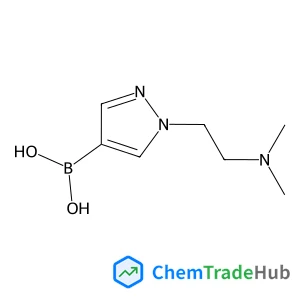
(1-(2-(Dimethylamino)ethyl)-1H-pyrazol-4-yl)boronic acid
CAS Number:
1086063-73-1
Molecular Formula:
C7H14BN3O2
![19-[Chloro(dideuterio)methyl]-19-deuterio-20,20-dideuteriooxyoctatriacontane-18,21-dione structure](https://static.chemtradehub.com/structs/124/1246818-85-8-6244.webp "19-[Chloro(dideuterio)methyl]-19-deuterio-20,20-dideuteriooxyoctatriacontane-18,21-dione structure")
19-[Chloro(dideuterio)methyl]-19-deuterio-20,20-dideuteriooxyoctatriacontane-18,21-dione
CAS Number:
1246818-85-8
Molecular Formula:
C39H75ClO4


(S)-(1,4-Dioxan-2-yl)methyl 4-methylbenzenesulfonate
CAS Number:
917882-64-5
Molecular Formula:
C12H16O5S
Recommended Suppliers





Disclaimer
This page provides academic journal information for reference and research purposes only. We are not affiliated with any journal publishers and do not handle publication submissions. For publication-related inquiries, please contact the respective journal publishers directly.
If you notice any inaccuracies in the information displayed, please contact us at support@chemtradehub.com. We will promptly review and address your concerns.