













New approaches for the calibration of exchange-energy densities in local hybrid functionals
Literature Information
Publication Date
2016-04-05
DOI
10.1039/C6CP00990E
Impact Factor
3.676
Authors
Toni M. Maier, Matthias Haasler, Alexei V. Arbuznikov, Martin Kaupp
View Original
Abstract
The ambiguity of exchange-energy densities is a fundamental challenge for the development of local hybrid functionals, or of other functionals based on a local mixing of exchange-energy densities. In this work, a systematic construction of semi-local calibration functions (CFs) for adjusting the exchange-energy densities in local hybrid functionals is provided, which directly links a given CF to an underlying semi-local exchange functional, as well as to the second-order gradient expansion of the exchange hole. Using successive steps of integration by parts allows the derivation of correction terms of increasing order, resulting in more and more complicated but also more flexible CFs. We derive explicit first- and second-order CFs (pig1 and pig2) based on B88 generalized-gradient approximation (GGA) exchange, and a first-order CF (tpig1) based on τ-dependent B98 meta-GGA exchange. We combine these CFs with different long-range damping functions and evaluate them for calibration of LDA, B88 GGA, and TPSS meta-GGA exchange-energy densities. Based on a minimization of unphysical nondynamical correlation contributions in three noble-gas dimer potential-energy curves, free parameters in the CFs are optimized, and performance of various approaches in the calibration of different exchange-energy densities is compared. Most notably, the second-order pig2 CF provides the largest flexibility with respect to the diffuseness of the damping function. This suggests that higher-order CFs based on the present integration-by-parts scheme may be particularly suitable for the flexible construction of local hybrid functionals.
Related Literature
Localised and delocalised excitons in star-like squaraine homo- and heterotrimers
Harald Ceymann, Moritz Balkenhohl, Alexander Schmiedel, Marco Holzapfel, Christoph Lambert
2015-12-18
Paper
DOI: 10.1039/C5CP06917C
The fabrication of In2O3/In2S3/Ag nanocubes for efficient photoelectrochemical water splitting
Rui Xu, Haohua Li, Wenwen Zhang, Zepeng Yang, Guiwu Liu, Ziwei Xu, Haicheng Shao
2015-12-17
Paper
DOI: 10.1039/C5CP05833C
ZnO modified ZSM-5 and Y zeolites fabricated by atomic layer deposition for propane conversion
Ting Gong, Lijun Qin, Jian Lu, Hao Feng
2015-11-20
Paper
DOI: 10.1039/C5CP05043J
How can carbon favor planar multi-coordination in boron-based clusters? Global structures of CBxEy2− (E = Al, Ga, x + y = 4)
Zhong-hua Cui, Jing-jing Sui, Yi-hong Ding
2015-10-30
Paper
DOI: 10.1039/C5CP04776E
Synthesis of branched Pd nanocrystals with tunable structures, their growth mechanism, and enhanced electrocatalytic properties
Xueli Guo, Yiwei Tan
2015-10-26
Paper
DOI: 10.1039/C5CP05531H
A real-space stochastic density matrix approach for density functional electronic structure
2015-05-08
Paper
DOI: 10.1039/C5CP01222H
Theoretical study of the coordination behavior of formate and formamidoximate with dioxovanadium(v) cation: implications for selectivity towards uranyl
Nada Mehio, J. Casey Johnson, Vyacheslav S. Bryantsev
2015-10-28
Paper
DOI: 10.1039/C5CP06165B
Ullmann coupling mediated assembly of an electrically driven altitudinal molecular rotor
Colin J. Murphy, Zachary C. Smith, Alex Pronschinski, Emily A. Lewis, Melissa L. Liriano, Chloe Wong, Christopher J. Ivimey, Mitchell Duffy, Wojciech Musial, Andrew J. Therrien, Samuel W. Thomas III, E. Charles H. Sykes
2015-11-03
Paper
DOI: 10.1039/C5CP05294G
You might also like
Compound Q&A
How should waste containing (6-Bromo-2-naphthyl)oxy](dimethyl)(2-methyl-2-propanyl)silane be handled?
Waste containing (6-Bromo-2-naphthyl)oxy](dimethyl)(2-methyl-2-propanyl)silane (...
100751-65-3[(6-Bromo-2-naphthyl...
Compound Q&A
How is 7-Fluoro-4-isoquinolinecarboxylic acid (CAS: 1841081-40-0) typically synthesized?
7-Fluoro-4-isoquinolinecarboxylic acid can be synthesized via a multi-step proce...
1841081-40-07-Fluoro-4-isoquinol...
Compound Q&A
What are the physical and chemical properties of 2,3,5,6-Tetrabromothieno[3,2-b]thiophene (CAS: 124638-53-5)?
2,3,5,6-Tetrabromothieno[3,2-b]thiophene is a crystalline compound with a high m...
124638-53-52,3,5,6-Tetrabromoth...
Compound Q&A
Is 1-[4-(Benzylamino)-7,8-dihydro-5H-pyrano[4,3-d]pyrimidin-2-yl]-2-methyl-1H-indole-4-carboxamide (CAS: 1542705-92-9) safe?
1-[4-(Benzylamino)-7,8-dihydro-5H-pyrano[4,3-d]pyrimidin-2-yl]-2-methyl-1H-indol...
1542705-92-91-[4-(Benzylamino)-7...
Compound Q&A
What is the market or research trend for imidazo[5,1-d]-1,2,3,5-tetrazine-8-carboxylic acid, 3,4-dihydro-3-methyl-4-oxo- (CAS: 113942-30-6)?
The market for imidazo[5,1-d]-1,2,3,5-tetrazine-8-carboxylic acid, 3,4-dihydro-3...
113942-30-6Imidazo[5,1-d]-1,2,3...
Compound Q&A
What is 3-(Triisopropylsilyl)propiolaldehyde (CAS: 163271-80-5)?
3-(Triisopropylsilyl)propiolaldehyde is a synthetic organic compound with the CA...
163271-80-53-(Triisopropylsilyl...
Compound Q&A
What regulatory guidelines apply to 6-Nitro-2H-1,4-benzoxazin-3(4H)-one (CAS: 81721-87-1)?
6-Nitro-2H-1,4-benzoxazin-3(4H)-one (CAS: 81721-87-1) is subject to various regu...
81721-87-16-Nitro-2H-1,4-benzo...
Compound Q&A
How should waste containing (3-Fluorophenyl)(4-{[(2-methyl-2-propanyl)oxy]carbonyl}-1-piperazinyl)acetic acid (CAS: 885272-91-3) be handled?
Waste containing (3-Fluorophenyl)(4-{[(2-methyl-2-propanyl)oxy]carbonyl}-1-piper...
885272-91-3(3-Fluorophenyl)(4-{...
Compound Q&A
What are the physical and chemical properties of N,N'-4,4'-Biphenyldiyldiisonicotinamide (CAS: 55119-40-9)?
N,N'-4,4'-Biphenyldiyldiisonicotinamide is a white crystalline solid with a mole...
55119-40-9N,N'-4,4'-Biphenyldi...
Compound Q&A
What industries use 6-Bromo-8-fluoro-2-quinazolinol (CAS: 1036756-15-6)?
6-Bromo-8-fluoro-2-quinazolinol is primarily used in the pharmaceutical industry...
1036756-15-66-Bromo-8-fluoro-2-q...
Source Journal
Physical Chemistry Chemical Physics

CiteScore:
5.5
Self-citation Rate:
10.3%
Articles per Year:
3036
Physical Chemistry Chemical Physics (PCCP) is an international journal co-owned by 19 physical chemistry and physics societies from around the world. This journal publishes original, cutting-edge research in physical chemistry, chemical physics and biophysical chemistry. To be suitable for publication in PCCP, articles must include significant innovation and/or insight into physical chemistry; this is the most important criterion that reviewers and Editors will judge against when evaluating submissions. The journal has a broad scope and welcomes contributions spanning experiment, theory, computation and data science. Topical coverage includes spectroscopy, dynamics, kinetics, statistical mechanics, thermodynamics, electrochemistry, catalysis, surface science, quantum mechanics, quantum computing and machine learning. Interdisciplinary research areas such as polymers and soft matter, materials, nanoscience, energy, surfaces/interfaces, and biophysical chemistry are welcomed if they demonstrate significant innovation and/or insight into physical chemistry. Joined experimental/theoretical studies are particularly appreciated when complementary and based on up-to-date approaches.
Recommended Compounds

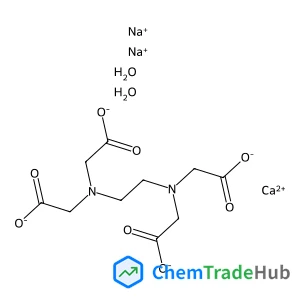
EthylenediaminetetraaceticacidcalciumDisodiumsalthydrate
CAS Number:
23411-34-9
Molecular Formula:
C10H16CaN2Na2O10


Recommended Suppliers





Disclaimer
This page provides academic journal information for reference and research purposes only. We are not affiliated with any journal publishers and do not handle publication submissions. For publication-related inquiries, please contact the respective journal publishers directly.
If you notice any inaccuracies in the information displayed, please contact us at support@chemtradehub.com. We will promptly review and address your concerns.