












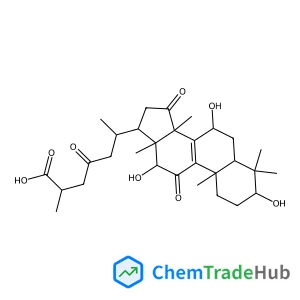
(3beta,7beta,12beta)-3,7,12-Trihydroxy-11,15,23-trioxolanost-8-en-26-oic acid
CAS Number:
98665-22-6
Molecular Formula:
C30H44O8
Birte Jache, Jan Oliver Binder, Takeshi Abe, Philipp Adelhelm
The abundance of sodium has recently sparked considerable interest in sodium-ion batteries (NIBs). Their similarity to conventional lithium-ion technology is obvious; however, the cell chemistry often significantly deviates. Graphite, although being the standard negative electrode in Li-ion batteries, is largely inactive for Na-ion storage in conventional non-aqueous carbonate-based electrolytes, for example. Very recently, it has been demonstrated that graphite can be activated for Na-ion storage in cells with ether-based electrolytes. The storage mechanism is based on co-intercalation of solvent molecules along with the Na-ions, forming ternary graphite intercalation compounds (t-GICs). This process is highly reversible but yet poorly understood. Here, we provide a comprehensive study on the formation and the stability of t-GICs. A series of ether solvents are being discussed: linear glymes with different chain lengths (mono-, di-, tri-, and tetraglyme), several derivatives with side groups as well as tetrahydrofuran (THF) as a cyclic ether and one crown ether. We show that the redox potentials shift depending on the ether chain length and mixing of ethers might enable tailoring of the redox behaviour. The inferior behaviour of triglyme is likely due to the less ideal ion coordination. Complementary experiments with lithium are made and demonstrate the superior behaviour of sodium. We find that the increase in graphene layer spacing during intercalation only slightly depends on the chain length and is in the range of 250%, and still mechanical stability is preserved. We further show the t-GICs possess chemical stability and demonstrate that the kinetically favoured charge transfer is probably due to the absence of a solid electrolyte interphase.
Kaiqi Wu, Wenfei Li, Lu Yu, Wei Tong, Yue Feng, Shenglong Ling, Longhua Zhang, Xiao Zheng, Maojun Yang
DOI: 10.1039/C6CP08107J
Paulo R. Bueno, David A. Miranda
DOI: 10.1039/C6CP02504H
Chaozheng Li, Yonggang Yang, Donglin Li, Yufang Liu
DOI: 10.1039/C6CP07716A
Katharine Moore Tibbetts, Xiao-Jiang Feng, Herschel Rabitz
DOI: 10.1039/C6CP06187G
Xiaoli Sun
DOI: 10.1039/C6CP07690D
Lianjie Xue, Fehmi Bardak, George Tamas, Edward L. Quitevis
DOI: 10.1039/C6CP08263G
Penghui Li, Fang Wang, Shiqian Wei, Xinyu Li
DOI: 10.1039/C6CP08409E
Stanley Udochukwu Ofoegbu, Tiago L. P. Galvão, José R. B. Gomes, João Tedim, Helena I. S. Nogueira, M. G. S. Ferreira
DOI: 10.1039/C7CP00241F
When handling 4-(2-Furylmethyl)thiomorpholine 1,1-dioxide (CAS: 79206-94-3), it ...
When handling 4-Chloro-N-[2-(4-morpholinyl)ethyl]benzamide (CAS: 71320-77-9), it...
Waste containing this compound (CAS: 62921-74-8) should be handled according to ...
Waste containing (S)-Methyl 2-amino-3-cyclohexylpropanoate should be collected i...
This compound can be synthesized using a multi-step process involving the conjug...
There are several alternatives to (2E)-3-(3,4-Dichlorophenyl)acrylic acid in syn...
Ethyl 6-(2-nitrophenyl)imidazo[2,1-b][1,3]thiazole-3-carboxylate (CAS: 925437-84...
Waste containing 2-(1,3-Thiazol-2-yl)ethanamine (CAS: 18453-07-1) should be coll...
Methyl 5-iodo-2-methylbenzoate can be synthesized through the iodination of meth...
5-Chloro[1,2,4]triazolo[1,5-a]pyridine is commonly synthesized via the condensat...

Physical Chemistry Chemical Physics (PCCP) is an international journal co-owned by 19 physical chemistry and physics societies from around the world. This journal publishes original, cutting-edge research in physical chemistry, chemical physics and biophysical chemistry. To be suitable for publication in PCCP, articles must include significant innovation and/or insight into physical chemistry; this is the most important criterion that reviewers and Editors will judge against when evaluating submissions. The journal has a broad scope and welcomes contributions spanning experiment, theory, computation and data science. Topical coverage includes spectroscopy, dynamics, kinetics, statistical mechanics, thermodynamics, electrochemistry, catalysis, surface science, quantum mechanics, quantum computing and machine learning. Interdisciplinary research areas such as polymers and soft matter, materials, nanoscience, energy, surfaces/interfaces, and biophysical chemistry are welcomed if they demonstrate significant innovation and/or insight into physical chemistry. Joined experimental/theoretical studies are particularly appreciated when complementary and based on up-to-date approaches.
![[4-Amino-2-(methylsulfanyl)-5-pyrimidinyl]methanol structure](https://static.chemtradehub.com/structs/588/588-36-3-fc73.webp "[4-Amino-2-(methylsulfanyl)-5-pyrimidinyl]methanol structure")
![5-Acetyl-2,3-dihydrobenzo[b]furan structure](https://static.chemtradehub.com/structs/908/90843-31-5-eea4.webp "5-Acetyl-2,3-dihydrobenzo[b]furan structure")





