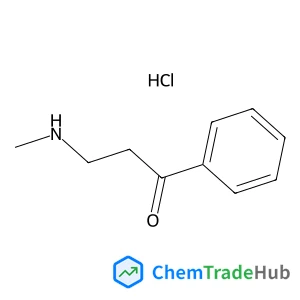
3-(Methylamino)-1-phenyl-1-propanone hydrochloride (1:1)
CAS Number:
2538-50-3
Molecular Formula:
C10H14ClNO
The ability of a selected nanoparticle to form stable systems with superhalogens (i.e. AlF4, AlCl4, MgF3, MgCl3, LiF2, LiCl2, and LiI2) is examined on the basis of theoretical considerations supported by ab initio calculations. It is demonstrated that the C60 fullerene molecule should form stable and strongly bound (C60)˙+(superhalogen)− radical cation salts when combined with an appropriately chosen superhalogen radical (acting as an oxidizing agent). The conclusion is supported by providing: (i) the structural deformation of superhalogens and C60 nanoparticles upon ionization, (ii) predicted charge flow between the fullerene and each superhalogen (which allows estimating the amount of electron density withdrawn from the C60 molecule during the ionization process), (iii) the localization of the spin density distribution, and (iv) the interaction energies for the compounds obtained both at the B3LYP/6-31+G(d) level and at the B3LYP-D3/6-31+G(d) level. Solvent effects have been considered in the present study by means of the polarizable continuum model. It is found that the stability of C60/superhalogen species can be improved in solvents. We believe that the results provided in this contribution may likely be of prospective relevance in the future studies on the issue of binding and removal of this potentially risky nanoparticle.

Chinese Journal of Chemistry

Journal of the Indian Institute of Science

Critical Reviews in Solid State and Materials Sciences

Colloid Journal

NDT & E International

Herald of the Russian Academy of Sciences

Topics in Catalysis

Main Group Chemistry

Journal of Chemical Sciences

Bioorganic & Medicinal Chemistry Letters
Kai Welke, Hiroshi C. Watanabe, Tino Wolter, Marcus Elstner
DOI: 10.1039/C3CP44181D
Jie Jiang, Xinghui Wang, Qing Zhang, Jingqi Li, X. X. Zhang
DOI: 10.1039/C3CP50197C
Sharon Ruthstein
DOI: 10.1039/C3CP50533B
M. Sadeghi
DOI: 10.1039/C3CP44563A
Idan Hod, Zion Tachan, Menny Shalom, Arie Zaban
DOI: 10.1039/C3CP50242B
Marco Micciarelli, Carlo Altucci, Bartolomeo Della Ventura, Raffaele Velotta, Valer Toşa, Adán B. Gónzalez Pérez, Martin Pérez Rodríguez, Ángel R. de Lera, Attila Bende
DOI: 10.1039/C3CP50343G
Ivan A. Popov, Yafei Li, Zhongfang Chen, Alexander I. Boldyrev
DOI: 10.1039/C3CP43921F
Kirsten Harth, Ralf Stannarius
DOI: 10.1039/C3CP44055A
Jamie D. Young, Dave Townsend, Justyna M. Żurek, Martin J. Paterson, Gareth M. Roberts, Vasilios G. Stavros
DOI: 10.1039/C3CP51108A
When handling 4-(2-Furylmethyl)thiomorpholine 1,1-dioxide (CAS: 79206-94-3), it ...
When handling 4-Chloro-N-[2-(4-morpholinyl)ethyl]benzamide (CAS: 71320-77-9), it...
Waste containing this compound (CAS: 62921-74-8) should be handled according to ...
Waste containing (S)-Methyl 2-amino-3-cyclohexylpropanoate should be collected i...
This compound can be synthesized using a multi-step process involving the conjug...
There are several alternatives to (2E)-3-(3,4-Dichlorophenyl)acrylic acid in syn...
Ethyl 6-(2-nitrophenyl)imidazo[2,1-b][1,3]thiazole-3-carboxylate (CAS: 925437-84...
Waste containing 2-(1,3-Thiazol-2-yl)ethanamine (CAS: 18453-07-1) should be coll...
Methyl 5-iodo-2-methylbenzoate can be synthesized through the iodination of meth...
5-Chloro[1,2,4]triazolo[1,5-a]pyridine is commonly synthesized via the condensat...

Physical Chemistry Chemical Physics (PCCP) is an international journal co-owned by 19 physical chemistry and physics societies from around the world. This journal publishes original, cutting-edge research in physical chemistry, chemical physics and biophysical chemistry. To be suitable for publication in PCCP, articles must include significant innovation and/or insight into physical chemistry; this is the most important criterion that reviewers and Editors will judge against when evaluating submissions. The journal has a broad scope and welcomes contributions spanning experiment, theory, computation and data science. Topical coverage includes spectroscopy, dynamics, kinetics, statistical mechanics, thermodynamics, electrochemistry, catalysis, surface science, quantum mechanics, quantum computing and machine learning. Interdisciplinary research areas such as polymers and soft matter, materials, nanoscience, energy, surfaces/interfaces, and biophysical chemistry are welcomed if they demonstrate significant innovation and/or insight into physical chemistry. Joined experimental/theoretical studies are particularly appreciated when complementary and based on up-to-date approaches.
![5-Acetyl-2,3-dihydrobenzo[b]furan structure](https://static.chemtradehub.com/structs/908/90843-31-5-eea4.webp "5-Acetyl-2,3-dihydrobenzo[b]furan structure")