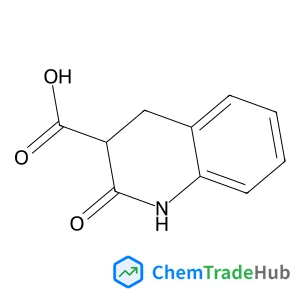
2-Oxo-1,2,3,4-tetrahydro-3-quinolinecarboxylic acid
CAS Number:
246867-17-4
Molecular Formula:
C10H9NO3
Xintian Feng, Anna I. Krylov
Electronic factors controlling singlet fission (SF) rates are investigated in covalently linked dimers of tetracene. Using covalent linkers, relative orientation of the individual chromophores can be controlled, maximizing the rates of SF. Structures with coplanar and staggered arrangements of tetracene moieties are considered. The electronic structure calculations and three-state kinetic model for SF rates provide explanations for experimentally observed low SF yields in coplanar dimers and efficient SF in staggered dimers. The calculations illuminate the role of the excimer formation in SF process. The structural relaxation in the S1 state leads to the increased rate of the multi-exciton (ME) state formation, but impedes the second step, separation of the ME state into independent triplets. The slower second step reduces SF yield by allowing other processes, such as radiationless relaxation, to compete with triplet generation. The calculations of electronic couplings also suggest an increased rate of radiationless relaxation at the excimer geometries. Thus, the excimer serves as a trap of the ME state. The effect of covalent linkers on the electronic factors and SF rates is investigated. In all considered structures, the presence of the linker leads to larger couplings, however, the effect on the overall rate is less straightforward, since the linkers generally result in less favorable energetics. This complex behavior once again illustrates the importance of integrative approaches that evaluate the overall rate, rather than focusing on specific electronic factors such as energies or couplings.
Jing-Fang Huang
DOI: 10.1039/B819658C
Simona Chessa, Nigel J. Clayden, Manfred Bochmann, Joseph A. Wright
DOI: 10.1039/B821301A
A. Prasanna de Silva, Catherine M. Dobbin, Thomas P. Vance
DOI: 10.1039/B822181B
Mark Bartholomä, John Valliant, Kevin P. Maresca, John Babich, Jon Zubieta
DOI: 10.1039/B814903H
Enbo Wang
DOI: 10.1039/B812573B
Dragoslav Vidovic, Glesni A. Pierce, Simon Aldridge
DOI: 10.1039/B816042B
Benjamin Thierry, Jane Ng, Tina Krieg, Hans J. Griesser
DOI: 10.1039/B820137D
Yan-Song Zheng, Shu-Yun Ran, Yu-Jian Hu, Xian-Xian Liu
DOI: 10.1039/B817974C
KaKing Yan, Andrew V. Pawlikowski, Chris Ebert, Aaron D. Sadow
DOI: 10.1039/B818630H
When handling 2-Methyl-2-propanyl 5-amino-2-thiophenecarboxylate (CAS: 1498311-5...
5-Bromo-1,2-dichloro-3-fluorobenzene (CAS: 1000572-93-9) is a crystalline solid ...
(2R)-2-Amino-2-(4-bromophenyl)ethanol (CAS: 354153-64-3) should be stored in a c...
Methyl 4-(aminomethyl)tetrahydro-2H-pyran-4-carboxylate hydrochloride (CAS: 3627...
1,4-Dimethyl-1H-pyrazole-5-sulfonyl chloride is primarily used as an intermediat...
Dinaphtho[1,2-b:2',1'-d]furan is generally safe when handled with appropriate pe...
The market for 7-Methyl-7,9-dihydro-1H-purine-2,6,8(3H)-trione (CAS: 612-37-3) i...
2-(4-Chlorophenyl)malonaldehyde (CAS: 205676-17-1) is a colorless or light yello...
2-Methylchrysene (CAS: 3351-32-4) is typically synthesized via the reaction of c...
N-(6-aminopyrimidin-4-yl)acetamide (CAS: 89533-23-3) is generally considered saf...

Physical Chemistry Chemical Physics (PCCP) is an international journal co-owned by 19 physical chemistry and physics societies from around the world. This journal publishes original, cutting-edge research in physical chemistry, chemical physics and biophysical chemistry. To be suitable for publication in PCCP, articles must include significant innovation and/or insight into physical chemistry; this is the most important criterion that reviewers and Editors will judge against when evaluating submissions. The journal has a broad scope and welcomes contributions spanning experiment, theory, computation and data science. Topical coverage includes spectroscopy, dynamics, kinetics, statistical mechanics, thermodynamics, electrochemistry, catalysis, surface science, quantum mechanics, quantum computing and machine learning. Interdisciplinary research areas such as polymers and soft matter, materials, nanoscience, energy, surfaces/interfaces, and biophysical chemistry are welcomed if they demonstrate significant innovation and/or insight into physical chemistry. Joined experimental/theoretical studies are particularly appreciated when complementary and based on up-to-date approaches.