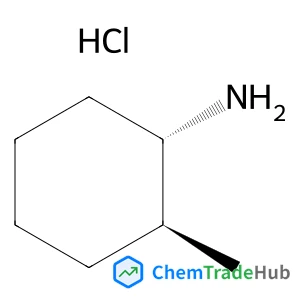
(1R,2R)-2-Methylcyclohexanamine hydrochloride (1:1)
CAS Number:
39558-31-1
Molecular Formula:
C7H16ClN
Bin Liu
The employment of a reduced Schiff-base ligand, 1,3-bis(3-methoxy-salicylamino)-2-propanol (H3L), with the assistance of acetate anions led to the isolation of eight heptanuclear heterometallic complexes containing [Cu5Ln2] cores. Single-crystal X-ray diffraction analyses have been performed for all the complexes and show that they all have dicationic [Cu5Ln2] cores with two nitrate or hexafluorophosphate anions to compensate the charge. The dicationic parts in 1–8 display centrosymmetric hexagonal-like arrangements in which one CuII ion sits on the inversion centre with six peripheral metal ions (two LnIII and four CuII) around it. The magnetic susceptibilities of all the complexes have been studied by dc magnetic measurements. The temperature dependent magnetic susceptibility data for the CuII–GdIII complex have been processed using PHI software. The results reveal that the magnetic exchange interactions between CuII and CuII ions are antiferromagnetic while those between CuII and GdIII ions are ferromagnetic. The magnetostructural correlations reveal that the bridging angles of Cu–O–Cu and Cu–O–Gd greatly influence the magnetic coupling of CuII–CuII and CuII–GdIII, respectively. Further, ac susceptibility studies have been carried out for DyIII and TbIII complexes and HoIII derivatives. The complexes CuII–HoIII and CuII–TbIII show slow magnetization relaxation behaviour of an SMM.
Ralph Koitz
DOI: 10.1039/C5CP01384D
Changzeng Fan, Jian Li
DOI: 10.1039/C5CP00001G
Eslam M. Moustafa, Ida Ritacco, Emilia Sicilia
DOI: 10.1039/C5CP00958H
Carlos Moya, María del Puerto Morales, Xavier Batlle, Amílcar Labarta
DOI: 10.1039/C5CP01052G
Diego Cortés-Arriagada, Alejandro Toro-Labbé
DOI: 10.1039/C5CP01313E
Hamed Akbarzadeh, Mohsen Abbaspour, Sirous Salemi, Mousareza Abroodi
DOI: 10.1039/C5CP01294E
S. D. Ramarao, V. R. K. Murthy
DOI: 10.1039/C5CP00569H
Michio Ikezawa, Xiuying Wang, Pengtao Jing, Haibo Li, Yasuaki Masumoto
DOI: 10.1039/C5CP00034C
(5-Sulfamoyl-3-pyridinyl)boronic acid is primarily used in chemical synthesis, p...
Benzyl 2-methyl-2-(methylsulfonyl)-4-pentenoate is typically synthesized via est...
When handling 8-Fluoroquinolin-6-ol (CAS: 209353-22-0), it is important to use p...
1,3-Dibromo-5-(2-methyl-2-propanyl)benzene (CAS: 129316-09-2) is a crystalline c...
Ethyl 7-chloro-4-oxo-1-(1,3-thiazol-2-yl)-1,4-dihydro-1,8-naphthyridine-3-carbox...
When handling Delta-7-Avenasterol (CAS: 23290-26-8), it is important to wear app...
Proper handling involves the use of personal protective equipment such as gloves...
When handling 2-Methyl-2-proanyl 4-[(2-aminophenyl)amino]-1-piperidinecarboxylat...
N-Methyl-4-chlorobenzylamine hydrochloride (CAS: 65542-24-7) is a organic compou...
[2-(Dodecyloxy)ethoxy]acetic acid (CAS: 27306-90-7) is generally considered safe...

CrystEngComm is the forum for the design and understanding of crystalline materials. We welcome studies on the investigation of molecular behaviour within crystals, control of nucleation and crystal growth, engineering of crystal structures, and construction of crystalline materials with tuneable properties and functions. We publish hypothesis-driven research into… how crystal design affects thermodynamics, phase transitional behaviours, polymorphism, morphology control, solid state reactivity (crystal-crystal solution-crystal, and gas-crystal reactions), optoelectronics, ferroelectric materials, non-linear optics, molecular and bulk magnetism, conductivity and quantum computing, catalysis, absorption and desorption, and mechanical properties. Using Techniques and methods including… Single crystal and powder X-ray, electron, and neutron diffraction, solid-state spectroscopy, spectrometry, and microscopy, modelling and data mining, and empirical, semi-empirical and ab-initio theoretical evaluations. On crystalline and solid-state materials. We particularly welcome work on MOFs, coordination polymers, nanocrystals, host-guest and multi-component molecular materials. We also accept work on peptides and liquid crystals. All papers should involve the use or development of a design or optimisation strategy. Routine structural reports or crystal morphology descriptions, even when combined with an analysis of properties or potential applications, are generally considered to be outside the scope of the journal and are unlikely to be accepted.
![2-(5-Bromo-1H-pyrrolo[2,3-B]pyridin-3-YL)acetic acid structure](https://static.chemtradehub.com/structs/106/1060795-03-0-0589.webp "2-(5-Bromo-1H-pyrrolo[2,3-B]pyridin-3-YL)acetic acid structure")