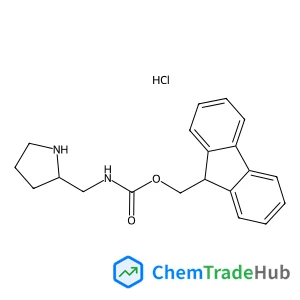
(S)-(9H-Fluoren-9-yl)methyl (pyrrolidin-2-ylmethyl)carbamate hydrochloride
CAS Number:
1217813-15-4
Molecular Formula:
C20H23ClN2O2
Eslam M. Moustafa, Ida Ritacco, Emilia Sicilia
Collision-induced dissociation (CID) experiments on protonated carnosine, [carnosine + H]+, with several collision energies were shown to yield eleven different fragment ions with the generation of product ions [carnosine–H2O + H]+ and [carnosine–NH3 + H]+ being the lowest energy processes. Energy-resolved CID showed that at slightly higher collision energies the ions [histidine + H]+ and [histidine–H2O–CO + H]+ are formed. At even higher energies four other product ions were observed, however, attained relatively lower abundances. Quantum chemistry calculations, carried out at different levels of theory, were employed to probe fragmentation mechanisms that account for all the experimental data. All the adopted computational protocols give similar energetic trends, and the range of the calculated free energy barrier values for the generation of all the observed product ions is in agreement with the fragmentation mechanisms offered here.
Peter B. Hitchcock, Gareth J. Rowlands, Rakesh Parmar
DOI: 10.1039/B507394D
Frank Hauke, Andrew J. Myles, Julius Rebek Jr.
DOI: 10.1039/B506048F
Ramsey Ida, Gang Wu
DOI: 10.1039/B505674H
Seigo Ito, Paul Liska, Pascal Comte, Raphaël Charvet, Peter Péchy, Udo Bach, Lukas Schmidt-Mende, Shaik Mohammed Zakeeruddin, Andreas Kay, Mohammad K. Nazeeruddin, Michael Grätzel
DOI: 10.1039/B505718C
Sibylle Müller, Klaus Müllen
DOI: 10.1039/B509220E
Chantal Gondran, Olivier Renaudet, Pascal Dumy, Hugues Driguez, Sébastien Fort, Serge Cosnier
DOI: 10.1039/B506699A
Nicholas S. P. Watney, Zoltán A. Gál, Matthew D. S. Webster, Simon J. Clarke
DOI: 10.1039/B505208D
Raja Kaliappan, Lakshmi S. Kaanumalle, V. Ramamurthy
DOI: 10.1039/B507517C
Patrik Västilä, Jenny Wettergren, Hans Adolfsson
DOI: 10.1039/B505516D
Waste containing N-Methoxy-N-methyl-1,3-thiazole-5-carboxamide (CAS: 898825-89-3...
N-(4-Biphenylyl)dibenzo[b,d]furan-4-amine should be stored in a tightly sealed c...
The market for 3-Acetamido-5-amino-2,4,6-triiodobenzoic acid (CAS: 1713-07-1) is...
Benzyl 2-O-acetyl-3,4,6-tri-O-benzyl-beta-D-galactopyranoside (CAS: 61820-03-9) ...
2-Ethylpiperazine dihydrochloride (CAS: 438050-52-3) is regulated under the Glob...
1,1'-[1,3-Phenylenebis(methylene)]bis(3-methyl-1H-pyrrole-2,5-dione) (CAS: 11946...
Several alternatives can be used in the synthesis of 5-Fluoro-2-(1-pyrrolidinyl)...
Proper personal protective equipment (PPE) must be worn when handling this compo...
When handling 6-Bromoimidazo[1,2-a]pyridin-8-amine, it is important to wear appr...
Alternatives to (2S,4R)-4-(4-Nitrobenzyl)pyrrolidine-2-carboxylic acid hydrochlo...

Physical Chemistry Chemical Physics (PCCP) is an international journal co-owned by 19 physical chemistry and physics societies from around the world. This journal publishes original, cutting-edge research in physical chemistry, chemical physics and biophysical chemistry. To be suitable for publication in PCCP, articles must include significant innovation and/or insight into physical chemistry; this is the most important criterion that reviewers and Editors will judge against when evaluating submissions. The journal has a broad scope and welcomes contributions spanning experiment, theory, computation and data science. Topical coverage includes spectroscopy, dynamics, kinetics, statistical mechanics, thermodynamics, electrochemistry, catalysis, surface science, quantum mechanics, quantum computing and machine learning. Interdisciplinary research areas such as polymers and soft matter, materials, nanoscience, energy, surfaces/interfaces, and biophysical chemistry are welcomed if they demonstrate significant innovation and/or insight into physical chemistry. Joined experimental/theoretical studies are particularly appreciated when complementary and based on up-to-date approaches.