












![5-Chloropyrrolo[2,1-f][1,2,4]triazin-4(3H)-one structure](https://static.chemtradehub.com/structs/888/888720-60-3-4f7c.webp "5-Chloropyrrolo[2,1-f][1,2,4]triazin-4(3H)-one structure")
Oxidation and temperature dual responsive polymers based on phenylboronic acid and N-isopropylacrylamide motifs
Literature Information
Publication Date
2016-01-14
DOI
10.1039/C5PY01999K
Impact Factor
5.582
Authors
Mei Zhang, Cheng-Cheng Song, Ran Ji, Zeng-Ying Qiao, Chao Yang, Fang-Yi Qiu, De-Hai Liang, Fu-Sheng Du, Zi-Chen Li
View Original
Abstract
Oxidation stress has been becoming an important target for the development of smart nanomedicines, triggering research interest in oxidation responsive polymers. Herein, we report a new type of temperature/oxidation dual responsive copolymer. They were synthesized by the sequential atom transfer radical copolymerization (ATRP) of N-isopropylacrylamide (NIPAM, M1) and a phenylboronic pinacol ester-containing acrylate (M2) and dialysis against water to remove the pinacol protecting groups. The copolymers with a small amount of phenylboronic acid units (<7%) were soluble in cold neutral phosphate buffer but showed lower critical solution temperatures in the range of 12–31 °C. The thermally induced phase transition profiles depended on both the composition and concentration of the polymers. The cloud points of the copolymers were shifted to higher temperatures upon H2O2 induced oxidation of the phenylboronic acid and the subsequent 1,6-elimination. Using PEG-Cl as the macroinitiator to initiate ATRP of M1 and M2, three block copolymers composed of a PEG block and a temperature/oxidation dual responsive segment were prepared after dialysis in water. These block copolymers had a similar ratio of NIPAM to phenylboronic acid units but different molecular weights. We have studied their thermal self-assembly and H2O2 triggered decomposition by laser light scattering, 1H NMR, and transmission electron microscopy. Upon a fast heating protocol, these block copolymers formed stable micelle-like nanoparticles (at 37 °C) that were capable of encapsulating doxorubicin (DOX) and showed H2O2 triggered release. The naked nanoparticles were cytocompatible, however the DOX-loaded ones exhibited concentration dependent cytotoxicity, in particular to cancer cells.
Related Literature
Subsystem-DFT potential-energy curves for weakly interacting systems
Danny Schlüns, Kevin Klahr, Christian Mück-Lichtenfeld, Lucas Visscher, Johannes Neugebauer
2014-12-23
Paper
DOI: 10.1039/C4CP04936E
Pit assisted oxygen chemisorption on GaN surfaces
Mandeep Kaur, Sandeep Singh
2015-05-06
Paper
DOI: 10.1039/C5CP00540J
The solid state conversion reaction of epitaxial FeF2(110) thin films with lithium studied by angle-resolved X-ray photoelectron spectroscopy
Ryan Thorpe, Sylvie Rangan, Ryan Whitcomb, Ali C. Basaran, Thomas Saerbeck, Ivan K. Schuller, Robert A. Bartynski
2015-05-11
Paper
DOI: 10.1039/C5CP01150G
Molecular diffusion and dc conductivity perfectly correlated with molecular rotational dynamics in a plastic crystalline electrolyte
M. Zachariah, M. Romanini, P. Tripathi, J. Ll. Tamarit, R. Macovez
2015-05-20
Paper
DOI: 10.1039/C5CP02345A
Controlling the thermoelectric properties of polymers: application to PEDOT and polypyrrole
Mario Culebras, Belén Uriol, Clara M. Gómez, Andrés Cantarero
2015-04-28
Paper
DOI: 10.1039/C5CP01940K
Molecular and ionic diffusion in aqueous – deep eutectic solvent mixtures: probing inter-molecular interactions using PFG NMR
Carmine D’Agostino, Lynn F. Gladden, Mick D. Mantle, Andrew P. Abbott, Essa, I. Ahmed, Azhar Y. M. Al-Murshedi, Robert C. Harris
2015-05-15
Paper
DOI: 10.1039/C5CP01493J
Structural effects on the photophysical properties of mono-β-diketonate and bis-β-diketonate EuIII complexes
Tianyu Zhu, Peng Chen, Hongfeng Li, Wenbin Sun, Ting Gao, Pengfei Yan
2015-05-18
Paper
DOI: 10.1039/C5CP01392E
Tuning of electron transfer reactions in pluronic–surfactant supramolecular assemblies
Poonam Verma, Haridas Pal
2015-05-18
Paper
DOI: 10.1039/C5CP01480H
Tuning the crystalline and mesophase structure of olefin block copolymer through self-nucleation and annealing treatments
Jiashu Fan, Qinglong Zhang, Jiachun Feng
2015-05-19
Paper
DOI: 10.1039/C5CP00548E
Carrier concentration dependent optical and electrical properties of Ga doped ZnO hexagonal nanocrystals
Manas Saha, Sirshendu Ghosh, Vishal Dev Ashok, S. K. De
2015-05-22
Paper
DOI: 10.1039/C4CP05480F
You might also like
Compound Q&A
What are the main uses of (5-Sulfamoyl-3-pyridinyl)boronic acid (CAS: 951233-61-7)?
(5-Sulfamoyl-3-pyridinyl)boronic acid is primarily used in chemical synthesis, p...
951233-61-7(5-Sulfamoyl-3-pyrid...
Compound Q&A
How is Benzyl 2-methyl-2-(methylsulfonyl)-4-pentenoate (CAS: 1942858-50-5) typically synthesized?
Benzyl 2-methyl-2-(methylsulfonyl)-4-pentenoate is typically synthesized via est...
1942858-50-5Benzyl 2-methyl-2-(m...
Compound Q&A
What precautions should be taken when handling 8-Fluoroquinolin-6-ol (CAS: 209353-22-0)?
When handling 8-Fluoroquinolin-6-ol (CAS: 209353-22-0), it is important to use p...
209353-22-08-Fluoroquinolin-6-o...
Compound Q&A
What are the physical and chemical properties of 1,3-Dibromo-5-(2-methyl-2-propanyl)benzene (CAS: 129316-09-2)?
1,3-Dibromo-5-(2-methyl-2-propanyl)benzene (CAS: 129316-09-2) is a crystalline c...
129316-09-21,3-Dibromo-5-(2-met...
Compound Q&A
What industries use Ethyl 7-chloro-4-oxo-1-(1,3-thiazol-2-yl)-1,4-dihydro-1,8-naphthyridine-3-carboxylate (CAS: 174726-87-5)?
Ethyl 7-chloro-4-oxo-1-(1,3-thiazol-2-yl)-1,4-dihydro-1,8-naphthyridine-3-carbox...
174726-87-5Ethyl 7-chloro-4-oxo...
Compound Q&A
What precautions should be taken when handling Delta-7-Avenasterol (CAS: 23290-26-8)?
When handling Delta-7-Avenasterol (CAS: 23290-26-8), it is important to wear app...
23290-26-8Delta-7-Avenasterol
Compound Q&A
What precautions should be taken when handling N-({(5R)-3-[3-Fluoro-4-(4-morpholinyl)phenyl]-2-oxo-1,3-oxazolidin-5-yl}methyl)acetamide (CAS: 872992-20-6)?
Proper handling involves the use of personal protective equipment such as gloves...
872992-20-6N-({(5R)-3-[3-Fluoro...
Compound Q&A
What precautions should be taken when handling 2-Methyl-2-proanyl 4-[(2-aminophenyl)amino]-1-piperidinecarboxylate (CAS: 79099-00-6)?
When handling 2-Methyl-2-proanyl 4-[(2-aminophenyl)amino]-1-piperidinecarboxylat...
79099-00-62-Methyl-2-propanyl ...
Compound Q&A
What is N-Methyl-4-chlorobenzylamine hydrochloride (CAS: 65542-24-7)?
N-Methyl-4-chlorobenzylamine hydrochloride (CAS: 65542-24-7) is a organic compou...
65542-24-7N-Methyl-4-chloroben...
Compound Q&A
Is [2-(Dodecyloxy)ethoxy]acetic acid (CAS: 27306-90-7) safe?
[2-(Dodecyloxy)ethoxy]acetic acid (CAS: 27306-90-7) is generally considered safe...
27306-90-7[2-(Dodecyloxy)ethox...
Source Journal
Polymer Chemistry

CiteScore:
8.6
Self-citation Rate:
7.3%
Articles per Year:
457
Polymer Chemistry welcomes submissions in all areas of polymer science that have a strong focus on macromolecular chemistry. Manuscripts may cover a broad range of fields, yet no direct application focus is required.
Recommended Compounds
![(4-Methyl-1H-benzo[d]imidazol-2-yl)methanamine structure](https://static.chemtradehub.com/structs/933/933756-31-1-7b0b.webp "(4-Methyl-1H-benzo[d]imidazol-2-yl)methanamine structure")
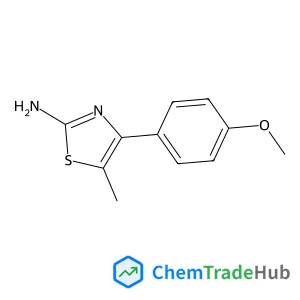
4-(4-Methoxyphenyl)-5-methyl-1,3-thiazol-2-amine
CAS Number:
105512-88-7
Molecular Formula:
C11H12N2OS
Recommended Suppliers





Disclaimer
This page provides academic journal information for reference and research purposes only. We are not affiliated with any journal publishers and do not handle publication submissions. For publication-related inquiries, please contact the respective journal publishers directly.
If you notice any inaccuracies in the information displayed, please contact us at support@chemtradehub.com. We will promptly review and address your concerns.