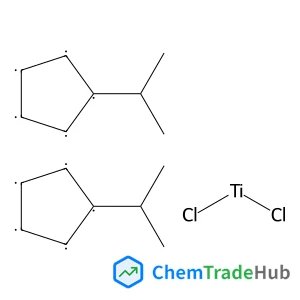
BIS(I-PROPYLCYCLOPENTADIENYL)TITANIUM DICHLORIDE
CAS Number:
12130-65-3
Molecular Formula:
C16H22Cl2Ti
Mario Culebras, Belén Uriol, Clara M. Gómez, Andrés Cantarero
Poly(3,4-ethylenedioxythiophene) (PEDOT) and polypyrrole (PPy) films have been prepared by an electrochemical method in a three electrode cell. The films have been obtained at different oxidation levels regarded as bipolaron, polaron and neutral states by varying the voltage, as is usually done in conjugated heterocyclic polymers. The voltage (−0.2 < V < 1.0 V) has been applied versus a Ag/AgCl reference electrode, producing a variation of one order of magnitude in the electrical conductivity and the Seebeck coefficient of the films. In the voltage range explored, the electrical conductivity increases from 80 to 766 S cm−1 in PEDOT and from 15 to 160 S cm−1 in PPy, while the Seebeck coefficient decreases from 37.0 to 9.6 μV K−1 for PEDOT and from 51.0 to 6.7 μV K−1 for PPy. The thermal conductivity remains unchanged with the oxidation state of the film, κ ≈ 0.35 ± 0.02 W m−1 K−1 for PEDOT and 0.17 ± 0.02 W m−1 K−1 for PPy. A maximum thermoelectric efficiency of 1.4 × 10⁻² for PEDOT and 6.8 × 10⁻³ for PPy has been achieved. These changes are related to the doping level of the polymer films and they can be accurately controlled by the applied voltage. In this work, we provide a very simple method to control and optimize the power factor or the figure of merit of conducting polymers.
Pengxiang Xu, Jiaping Lin, Liangshun Zhang
DOI: 10.1039/C8CP02062K
Long Van Duong, Miquel Solà, Hadi Behzadi, Mohammad Jafar Momeni
DOI: 10.1039/C8CP03737J
Ho-Il Ji, Hyoungchul Kim, Hae-Weon Lee, Byung-Kook Kim, Kyung Joong Yoon
DOI: 10.1039/C8CP01880D
Alexander P. Nemudry
DOI: 10.1039/C8CP02924E
Thana Maihom, Michael Probst, Jumras Limtrakul
DOI: 10.1039/C8CP06841K
Ying-Tao Liu, Xue Yin, Xiao-Yong Lai, Xin Wang
DOI: 10.1039/C8CP01069B
Manish Kumar Dixit, Mrigendra Dubey
DOI: 10.1039/C8CP04579H
José Carlos Germino, Jônatas Faleiro Berbigier, Cristina Aparecida Barboza, Marcelo Meira Faleiros, Deborah de Alencar Simoni, Miguel Tayar Galante, Matheus Serra de Holanda, Fabiano Severo Rodembusch, Teresa Dib Zambon Atvars
DOI: 10.1039/C8CP06485G
Maria Eugenia Fortes Brollo, Patricia Hernández Flores, Lucía Gutiérrez, Christer Johansson, Domingo Francisco Barber, María del Puerto Morales
DOI: 10.1039/C8CP03016B
E. L. Gromnitskaya, V. V. Brazhkin
DOI: 10.1039/C8CP07588C
2-Methylbenzene-1,4-diamine dihydrochloride (CAS: 615-45-2) should be stored in ...
(1S,4S)-2,5-Diazabicyclo[2.2.1]heptane dihydrobromide is generally considered sa...
(6-Chloropyridazin-3-YL)methanamine finds applications in the pharmaceutical ind...
2-Fluoro-3-methylphenol is primarily used in the synthesis of pharmaceuticals, p...
When handling 3-Methoxy-4-nitrobenzonitrile, it is important to wear appropriate...
When handling 1,3-Oxazolo[4,5-b]pyridine-2(3H)-thione (CAS: 211949-57-4), it is ...
4-Ethynylbenzamide (CAS: 90347-86-7) falls under various regulatory guidelines i...
3-(2-Ethylphenyl)-2-thioxo-4-imidazolidinone is primarily used as an intermediat...
(2-Fluoro-6-methoxyphenyl)acetic acid, also known as 4-fluoro-3-methoxybenzoic a...
Market trends for 2-[4-(Hydroxymethyl)phenoxy]ethanol (CAS: 102196-18-9) indicat...

Physical Chemistry Chemical Physics (PCCP) is an international journal co-owned by 19 physical chemistry and physics societies from around the world. This journal publishes original, cutting-edge research in physical chemistry, chemical physics and biophysical chemistry. To be suitable for publication in PCCP, articles must include significant innovation and/or insight into physical chemistry; this is the most important criterion that reviewers and Editors will judge against when evaluating submissions. The journal has a broad scope and welcomes contributions spanning experiment, theory, computation and data science. Topical coverage includes spectroscopy, dynamics, kinetics, statistical mechanics, thermodynamics, electrochemistry, catalysis, surface science, quantum mechanics, quantum computing and machine learning. Interdisciplinary research areas such as polymers and soft matter, materials, nanoscience, energy, surfaces/interfaces, and biophysical chemistry are welcomed if they demonstrate significant innovation and/or insight into physical chemistry. Joined experimental/theoretical studies are particularly appreciated when complementary and based on up-to-date approaches.