


Activation of ice recrystallization inhibition activity of poly(vinyl alcohol) using a supramolecular trigger
Literature Information
Publication Date
2016-01-29
DOI
10.1039/C5PY01948F
Impact Factor
5.582
Authors
Daniel J. Phillips, Thomas R. Congdon, Matthew I. Gibson
View Original
Abstract
Antifreeze (glyco)proteins (AF(G)Ps) have potent ice recrystallisation inhibition (IRI) activity – a desirable phenomenon in applications such as cryopreservation, frozen food and more. In Nature AF(G)P activity is regulated by protein expression levels in response to an environmental stimulus; temperature. However, this level of regulation is not possible in synthetic systems. Here, a synthetic macromolecular mimic is introduced, using supramolecular assembly to regulate activity. Catechol-terminated poly(vinyl alcohol) was synthesised by RAFT polymerization. Upon addition of Fe3+, larger supramolecular star polymers form by assembly with two or three catechols. This increase in molecular weight effectively ‘switches on’ the IRI activity and is the first example of external control over the function of AFP mimetics. This provides a simple but elegant solution to the challenge of external control of AFP-mimetic function.
Recommended Journals

Current Pharmaceutical Biotechnology

Nature Reviews Drug Discovery

Foundations of Chemistry

Photochemical & Photobiological Sciences

Coloration Technology

Mini-Reviews in Medicinal Chemistry

Physical Chemistry Chemical Physics

Molecular Diversity

Journal of Medical Biochemistry

Environmental Toxicology and Pharmacology
Related Literature
Volatile metabolites differentiate air–liquid interface cultures after infection with Staphylococcus aureus
Waqar Ahmed, Michael D. Davis
2023-01-04
Paper
DOI: 10.1039/D2AN01205G
A critical evaluation of compressed line-scan Raman imaging
Yajun Yu, Yichuan Dai, Xianli Wang, Kaiqin Chu, Zachary J. Smith
2023-05-08
Paper
DOI: 10.1039/D3AN00228D
Differential response for multiple ions: a smart probe to construct optically tunable molecular logic systems
Monaj Karar, Rikitha S. Fernandes, Nilanjan Dey
2023-02-04
Paper
DOI: 10.1039/D2AN01945K
Controllable synthesis of MoS2@TiO2 nanocomposites for visual detection of dopamine secretion with highly-efficient enzymatic activity
Chonghui Wei, Xuan Xie, Yue Mou, Shiqi Cheng, Jin Yang, Kaixin Xue, Kewei Yu, Xinru Lin, Chunfen Zhang, Yujie Zhao, Xingyu Luo, Yilin Wang
2023-03-10
Paper
DOI: 10.1039/D3AN00089C
Rapid determination of serum amyloid A using an upconversion luminescent lateral flow immunochromatographic strip
Xinwen Sun, Xiaoru Dai, Shisheng Ling, Wenkun Dong, Dong Chen, Mengting Li, Xvsheng Qiao, Zhiyu Wang, Xianping Fan, Guodong Qian
2023-05-13
Paper
DOI: 10.1039/D3AN00482A
Sensitive colorimetric assay of T4 DNA ligase by the oxidase nanozyme of LaMnO3.26 coupled with a hyperbranched amplification reaction
Aohuan Guo, Jie Sun, Menghua Yan, Guang-Li Wang
2023-04-03
Paper
DOI: 10.1039/D3AN00195D
A dichromatic plasmonic ELISA CD81 protein sensor for ultrasensitive detection of preeclampsia
Kexuan Chen, Nan Ma, Haobo Sun, Xueji Zhang, Jinming Kong
2023-02-21
Paper
DOI: 10.1039/D3AN00213F
You might also like
Compound Q&A
What are the main uses of 4-Nitrophenyl phosphate disodium salt hexahydrate (CAS: 333338-18-4)?
4-Nitrophenyl phosphate disodium salt hexahydrate is primarily used as a substra...
333338-18-44-Nitrophenyl phosph...
Compound Q&A
What are the main uses of 2-(Trifluoromethyl)-1,3-oxazole-4-carboxylic Acid (CAS: 1060816-01-4)?
2-(Trifluoromethyl)-1,3-oxazole-4-carboxylic Acid (CAS: 1060816-01-4) is widely ...
1060816-01-42-(Trifluoromethyl)-...
Compound Q&A
How should 2-Fluoro-4-biphenylcarboxylic acid (CAS: 137045-30-8) be stored?
2-Fluoro-4-biphenylcarboxylic acid should be stored in a cool, dry place at room...
137045-30-82-Fluoro-4-biphenylc...
Compound Q&A
What industries use Prednisolone-21-Carboxylic Acid (CAS: 61549-70-0)?
Prednisolone-21-Carboxylic Acid is primarily used in the pharmaceutical industry...
61549-70-0Prednisolone-21-Carb...
Compound Q&A
How should 4-(Hydrazinomethyl)-1,2,3-benzenetriol (CAS: 3614-72-0) be stored?
4-(Hydrazinomethyl)-1,2,3-benzenetriol (CAS: 3614-72-0) should be stored in a co...
3614-72-04-(Hydrazinomethyl)-...
Compound Q&A
What industries use 4-Amino-1-methyl-1H-pyrazole-5-carboxylic acid hydrochloride (CAS: 92534-70-8)?
4-Amino-1-methyl-1H-pyrazole-5-carboxylic acid hydrochloride (CAS: 92534-70-8) i...
92534-70-84-Amino-1-methyl-1H-...
Compound Q&A
What regulatory guidelines apply to dehydropachymic acid (CAS: 77012-31-8)?
Dehydropachymic acid (CAS: 77012-31-8) is regulated by various agencies. It fall...
77012-31-8Dehydropachymic acid
Compound Q&A
What is the market or research trend for 6-[(2,2-Dimethylpropanoyl)amino]nicotinic acid (CAS: 898561-66-5)?
The market and research trends for 6-[(2,2-Dimethylpropanoyl)amino]nicotinic aci...
898561-66-56-[(2,2-Dimethylprop...
Compound Q&A
How should 1,10-Phenanthroline-2,9-dicarbaldehyde (CAS: 57709-62-3) be stored?
1,10-Phenanthroline-2,9-dicarbaldehyde should be stored in a cool, dry place awa...
57709-62-31,10-Phenanthroline-...
Compound Q&A
How is 5-Carbamoyl-11-oxo-10,11-dihydro-5H-dibenzo[b,f]azepin-10-yl acetate (CAS: 113952-21-9) typically synthesized?
5-Carbamoyl-11-oxo-10,11-dihydro-5H-dibenzo[b,f]azepin-10-yl acetate can be synt...
113952-21-95-Carbamoyl-11-oxo-1...
Source Journal
Polymer Chemistry

CiteScore:
8.6
Self-citation Rate:
7.3%
Articles per Year:
457
Polymer Chemistry welcomes submissions in all areas of polymer science that have a strong focus on macromolecular chemistry. Manuscripts may cover a broad range of fields, yet no direct application focus is required.
Recommended Compounds
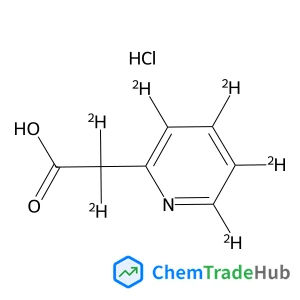
2,2-dideuterio-2-(3,4,5,6-tetradeuterio-2-pyridyl)acetic acid;hydrochloride
CAS Number:
1329799-67-8
Molecular Formula:
C7H2ClD6NO2
Recommended Suppliers






Disclaimer
This page provides academic journal information for reference and research purposes only. We are not affiliated with any journal publishers and do not handle publication submissions. For publication-related inquiries, please contact the respective journal publishers directly.
If you notice any inaccuracies in the information displayed, please contact us at support@chemtradehub.com. We will promptly review and address your concerns.